THE HAPPINESS PROJECT - EPISODE 3: HEARTH AND HOME at ZERO...

Curated by José Freire.
––
“Remember that in our day every cultured man, even the most healthy, is most irritable in his own home and among his own family, because the discord between the present and the past is first of all apparent in the family.”
- Anton Chekhov
When viewed from the outside, the home appears to be a fortress of stability, where values are passed from one generation to another. Oftentimes, however, the home is a site of nascent resistance, a breeding ground for opposition. But that utility can only be seen when one is on its inside, hidden away from the hegemonic forces that suffuse the outside air. Language, government, the fifth estate, the arts are all sites where our norms are negotiated and perpetuated, but the home is by far the most potent.
The physical structure “house” serves as the locus for family, writ large. And the family is more than a social construct. It is also a psychical institution, bringing along with it powerful, dangerous and destabilizing forces: emotions, aspirations, the erotic, the private, the individual. The family’s protection, its envelope, where it remains both outside community and a part thereof, is the house, with its cache of objects that signify status, store memory, and help form that great ineffable: taste.
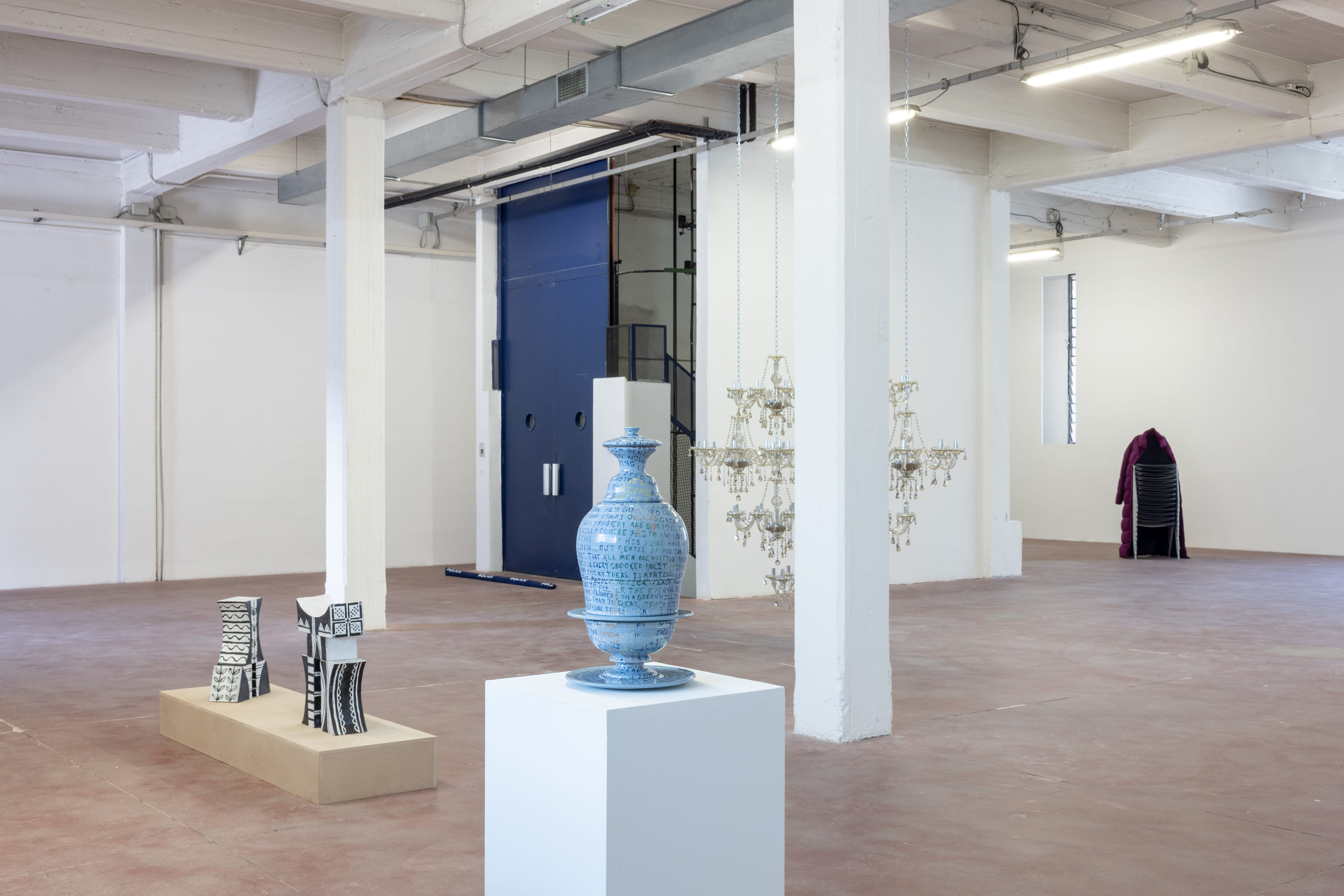
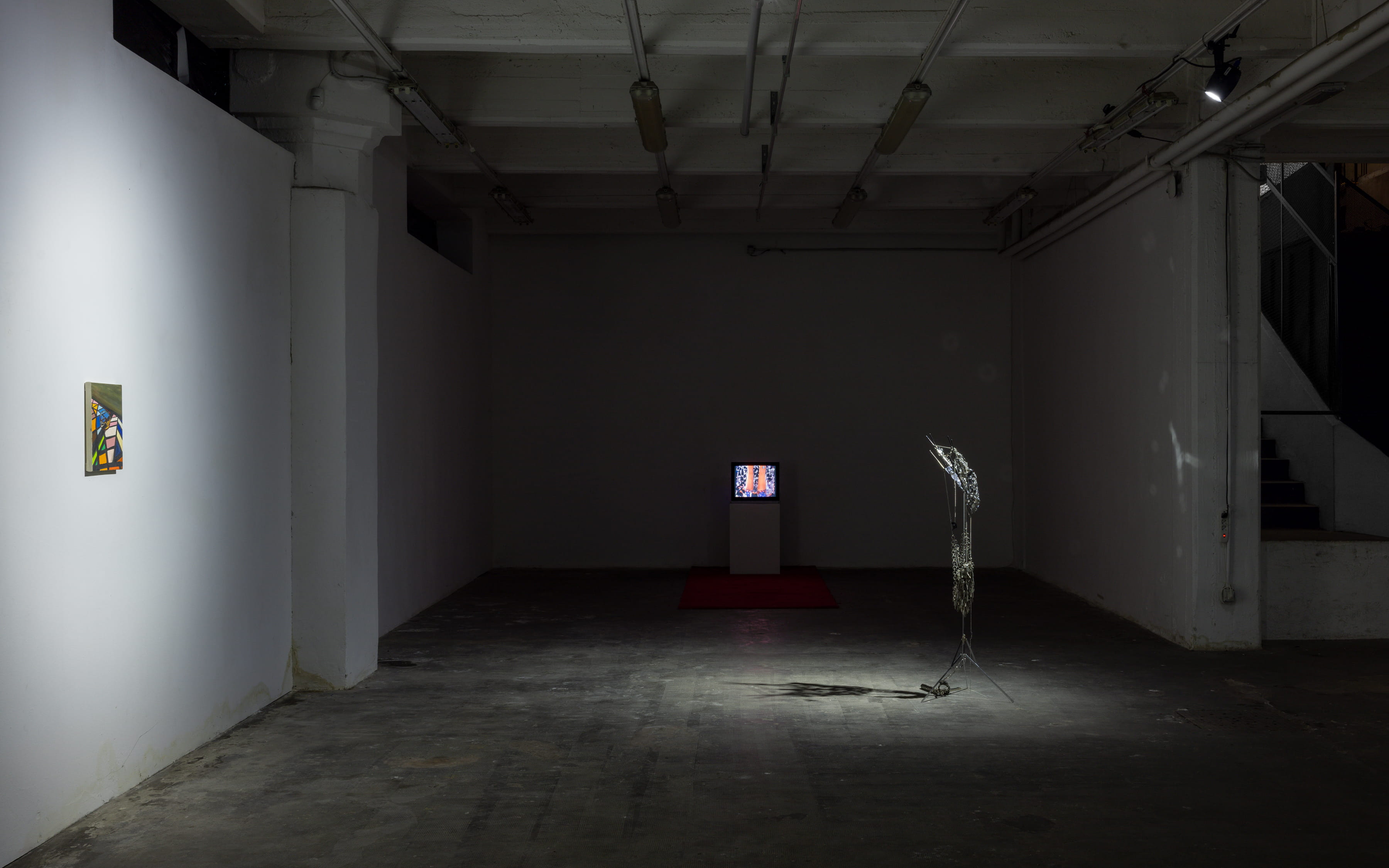
HEARTH & HOME is an installation that attempts to replicate, in skeletal form, a domestic setting — the gallery acting as a minimalist stage set for a piece of Brechtian theater. There are chairs, lighting fixtures, vases, vanity mirrors, and other objects of interior design. The works on view, however, are hardly props. Although they sometimes echo the real in their form, or physically incorporate functional items, they remain fictive. The placement of the works — which include sculpture, painting, photography, and video — across the two floors of Zero... generates a jagged, paratactic meaning, leaving viewers to connect these points of signification to each other and to the exhibition’s motif: to follow its hermeneutic line. An unimpeded passage through the space, permitting us to read its works in whatever order suits, allows for the unraveling of its weave of concerns.
The austerity and frigidity of most of the pieces selected for inclusion, coupled with the rough, industrial nature of the gallery’s rooms, conflict with the exhibition’s title, which calls to mind the warmth of domestic comforts. By choosing a theme that lends itself to love and anger, to passion and fury, yet to populate the venue with cool, neutral works creates a gap between the audience’s expectations and the pieces on view. One’s assumptions, which rightfully arise from the exhibition’s subtitle, produce a tension with the artworks, creating expanded interpretive possibilities.
In the arts, domestic life is rarely represented as ordinary, if it’s represented at all. Fictions about family life are prone to doses of hysteria, heightened registers are deemed necessary to hold an audience’s attention. Understood most simply as a language of “excessive” expression, the melodramatic is present in this exhibition predominantly in its title, the somewhat antiquated term “hearth” an obvious clue. But this emotional valence does not reside in any of the specific works, which remain stabilized by their rather clinical exteriors.
The domestic appears here in many guises: in the references to the functional of Ojo, Sarmiento and Wermers; in the crafts of painting and ceramics, as practiced by Kley, Holstad and Neff; in the nods to self-presentation in Fleury and Hoeck/Miller; in the emanations of the underground central to the practices of Bougatsos and Snow. But these categorizations are merely short-cuts to an understanding, as these artists can all be cast as workers in more than one of these arbitrary subsets. Fleury, for example, has consistently tempered her quotations from minimalist masters with subcultural voices and, as such, she is both a bellwether of the domesticated and the combative, able to both storm the palace and gild its gates.
“Tell me what you own, and I will tell you what you think.”
- Honoré de Balzac
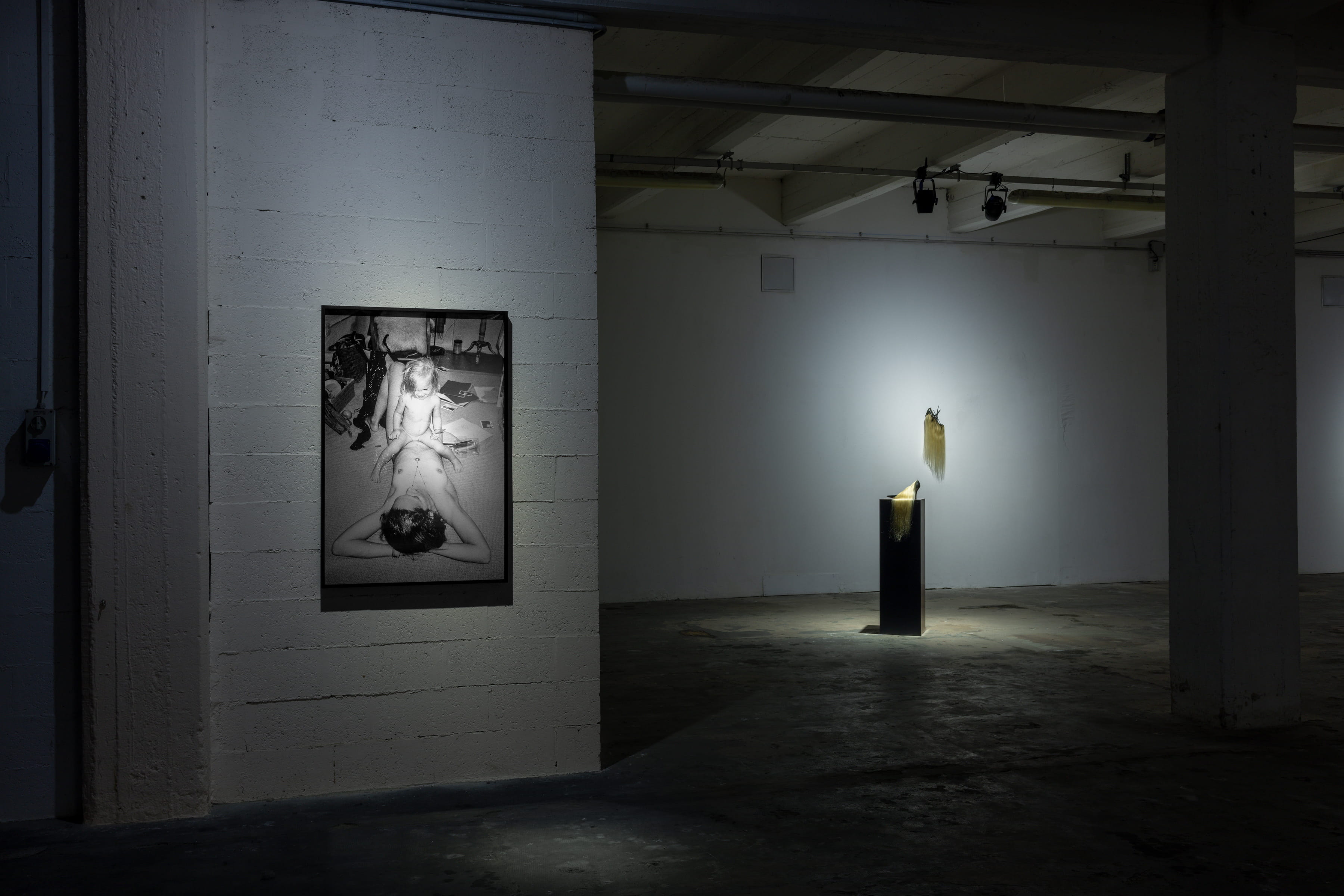
The readymade finds itself incorporated into most of the art included in HEARTH & HOME. (The two exemptions — Neff and Snow — provide paintings and photographs that depict home life directly, with objects often central.) Whether aggressively bricolaged, merely re-contextualized, or slavishly mimicked, recognizable items have been stripped of their function, transformed into material devices to frame meaning. Sometimes the found object is entirely subordinated to the artwork, its initial purpose as well as its cultural value permanently altered. By and large, the objects here carry with them an aspirational nature, neither coded as entirely luxurious nor as purely proletarian but as something in between. It’s difficult to picture Lizzi Bougatsos’ artwork apart from its genesis in New York City, that place where resilience, born of contingency, demands that one be able to fix just about anything with a piece of gaffer’s tape. Across numerous media, she seems, more than most, a quintessential creative laborer whose production is most fruitfully read against the background of that city’s life. Blessed with a surrealist’s eye, Bougatsos rescues, recasts and reinvigorates the found object, poeticizing the whole, injecting her artworks with autobiography, movement, wry wit, and a keen sense of cultural historiography.
Positioned as both a harsh feminist critic of late capitalism, and as a conveyor and celebrant of its corrupt values, it appears that Sylvie Fleury has been tasked with covering conflicting territories. Regardless, her Trojan horses sit in places of power, waiting to explode. One can only imagine, with joy in one’s heart, that someday her subversive sculptures — in living rooms and gardens, in museums and in corporate lobbies — will come to life and tear their masters limb from limb. The artist is here represented by two works, both of which focus on the way that gender takes root as a ritualized performance learned in the home. In the first, a vanity mirror sits above a small glass shelf on which have been positioned an assortment of beauty products. In the second, a pair of stilettoed shoes stomp Christmas ornaments in a dance of destruction.
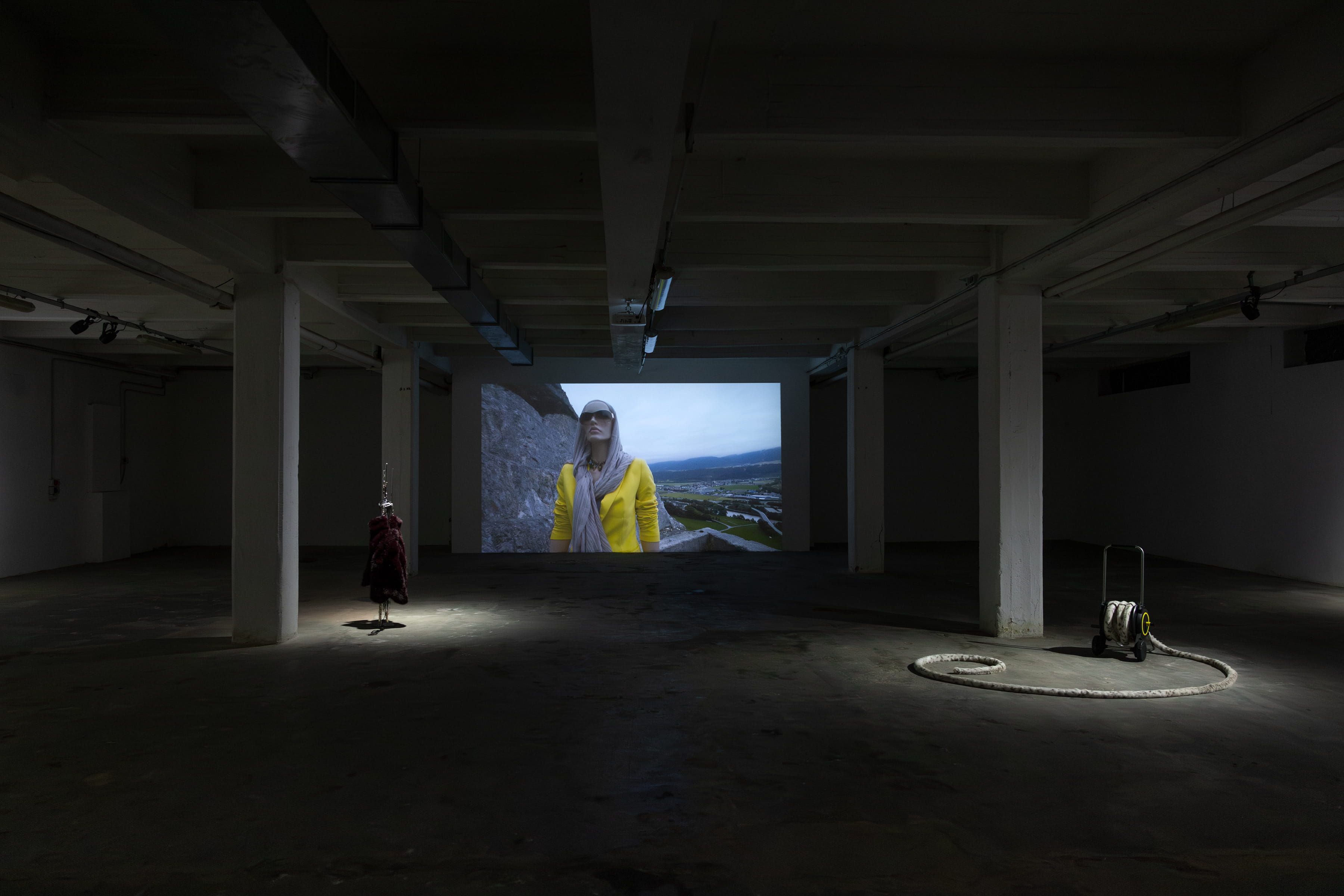
Although both known for their individuated practices, Richard Hoeck and John Miller began to also work collaboratively in the late 1990s and, since then, the mannequins who populate their installations have led fruitful lives in the eyes of the art public. These plaster people seemed a perfect conduit for cataloguing the way that identities are made manifest through the construction of a look, and the way that the look selected reveals assimilated goals and desires. As a surrogate for both the artists and their audience, these near- humans function as blanks on whom personhood can be projected, with more than a few helpful hints embedded in their accoutrements. The figures who plunge to their deaths in the pair’s Mannequin Death video could be read as members of the family that is absent from HEARTH & HOME yet inscribed throughout it: each of them trying to play a part in their self-determination or die trying.
Over the years, Christian Holstad has knit together an intensely multi- disciplinary practice that exhibits a commitment to storytelling. Concerned with the way alternative histories are recorded, his collages and works on paper have provided his broad practice with a consistency: signposts to his views on sexuality and the negotiation of personal and public power. Working with materials as diverse as textiles, mosaics, papier-mâché, even pasta, Holstad has repeatedly enlisted traditional techniques to eccentric ends, never more so than with his ceramics. He is here represented by a totem that uses the Renaissance impagliata as its model. In its historical form, stackable elements intended to hold various foodstuffs — among them broth, an egg, salt and pepper — were given to a new mother to help nurture her through post-natal confinement. Holstad has expanded upon tradition by including a plate for cookies and a small “cavity” to hold flowers. Its eight separable elements are colorfully adorned with a heart-rending text written by his grandfather when he had sent Christian off to school and, hence, to the great big world. This decorative gesture returns Holstad’s contemporary impagliata to something that rhymes with its original purpose.
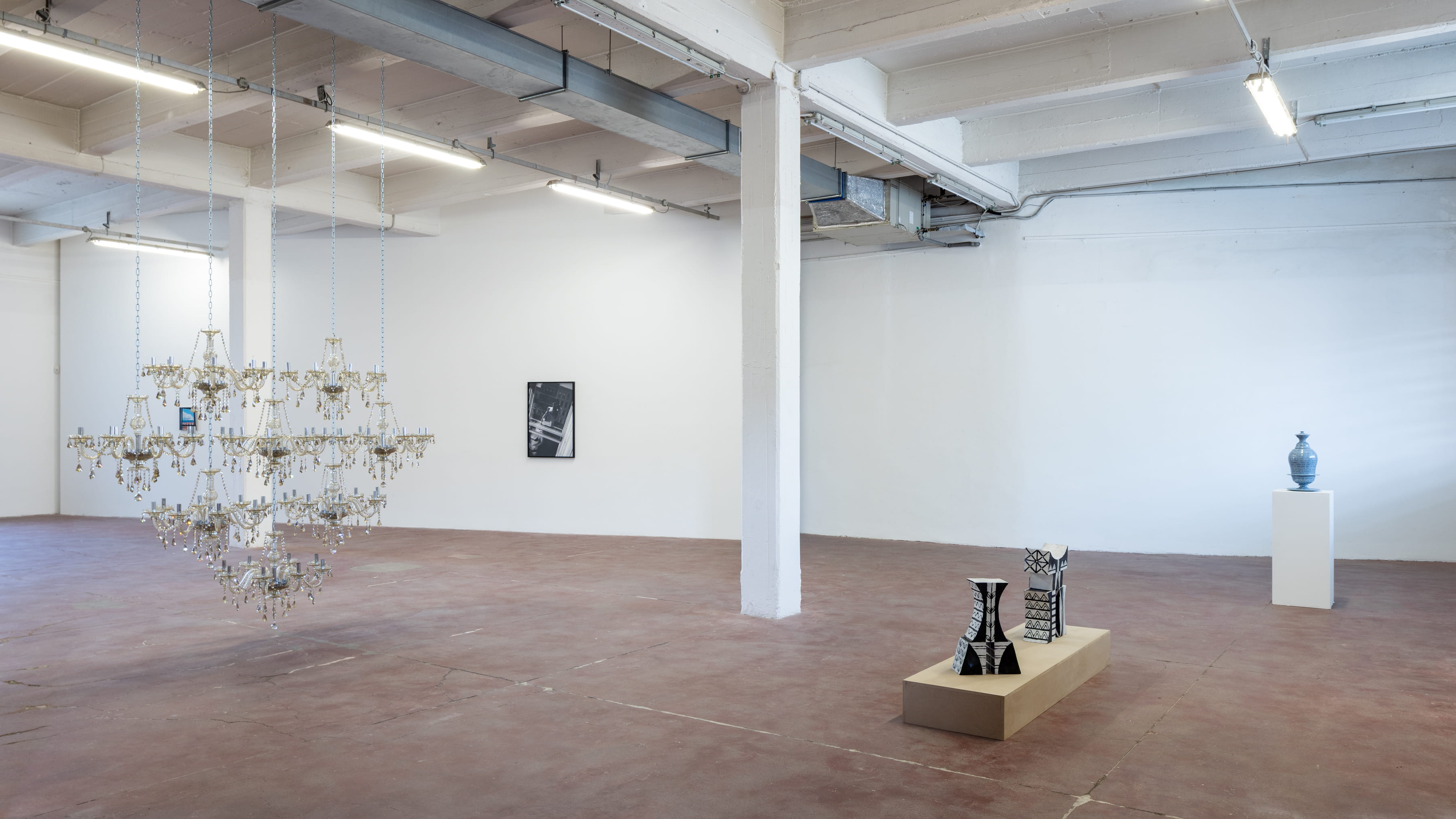
Elisabeth Kley, like Holstad, enlists long-established methodologies to gently kick at the gatekeepers of culture. Her work, however, is not reportage, it is requiem; her vessels reliquaries for the dearly departed, both craftspersons and the styles they’ve left behind. Inspired as much by art history as by the voices of avant-garde communities, Kley’s works marry the quotidian with the ceremonial. She is represented here by two sculptures, each decorated with the black and white geometric patterning with which she’s most associated. Although her practice is not limited to pottery (or to black and white, for that matter) — the artist also creates watercolors, paintings, prints, and tapestries — this exhibition’s conceptualization begged for her to pose as a kind of purveyor of housewares, albeit of the most erudite variety. For decades, aided by her lost mentors, Kley has raised a choral voice of optimism. Although folkloric in inspiration, her work is marked by a rejection of nostalgia, its wit and precision forever keeping it engaged in a vibrant reanimation.
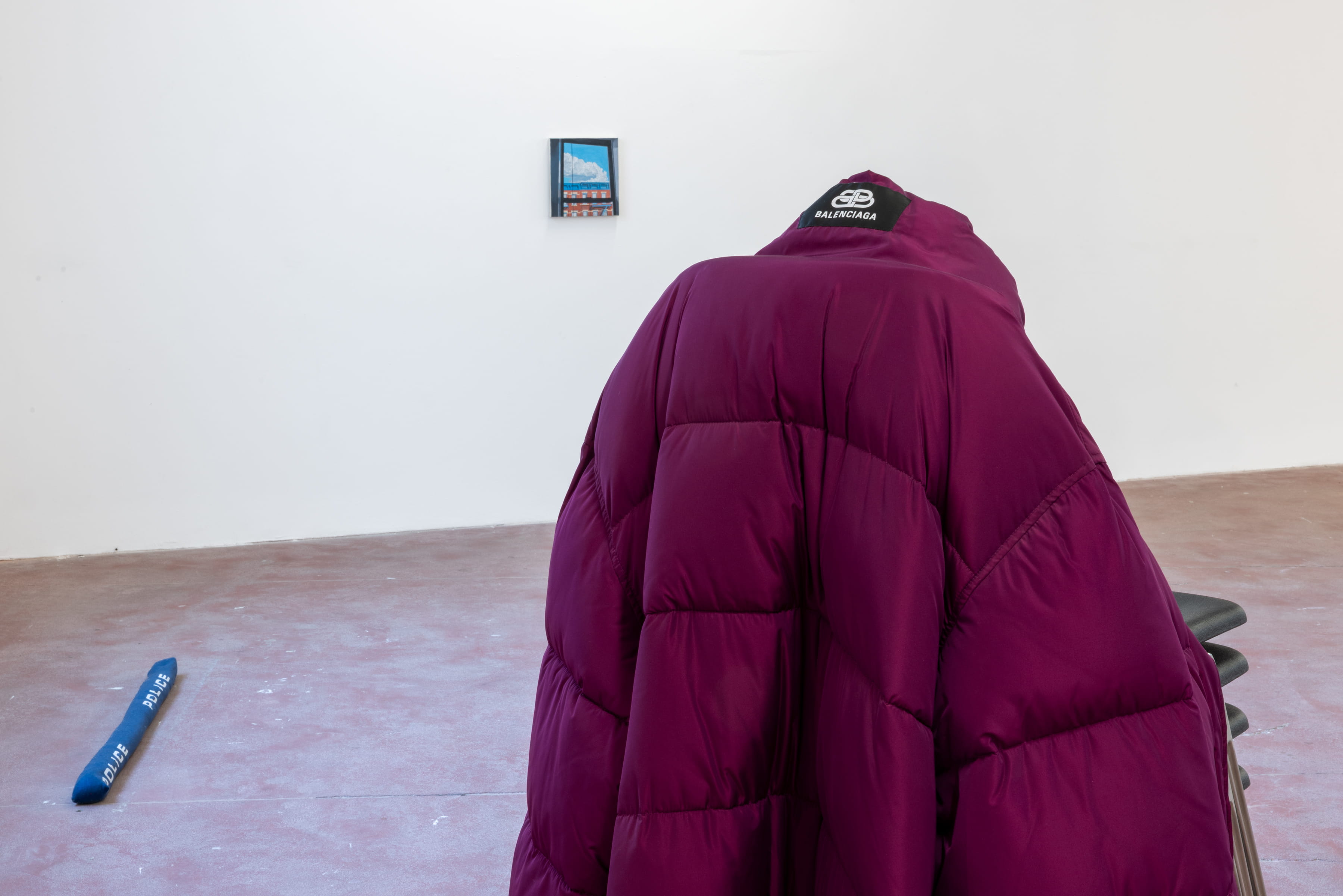
Rejecting momentous shared moments in favor of small private ones, Liam Neff’s paintings are fragments of quotidian existence that glisten like mosaics. There’s enough there — in the color and the structure — to pull us in, but these pictures remain enigmatic, details of a world that is onlynow, through the artist’s intercession, being brought to our attention. The casual nature of his chosen images is belied by the tender and diligent manner in which they’ve been rendered. Neff’s daytime window views, all urban in the extreme, are odes to potentiality, taking place on the one day in a hundred where the New York City sky is a triumph of pure blue. On the other hand, his paintings of objects lit by artificial means always have a slight edge to them, like items from 90’s neo-noirs, sometimes calling to mind the chintzy allure of stained glass.
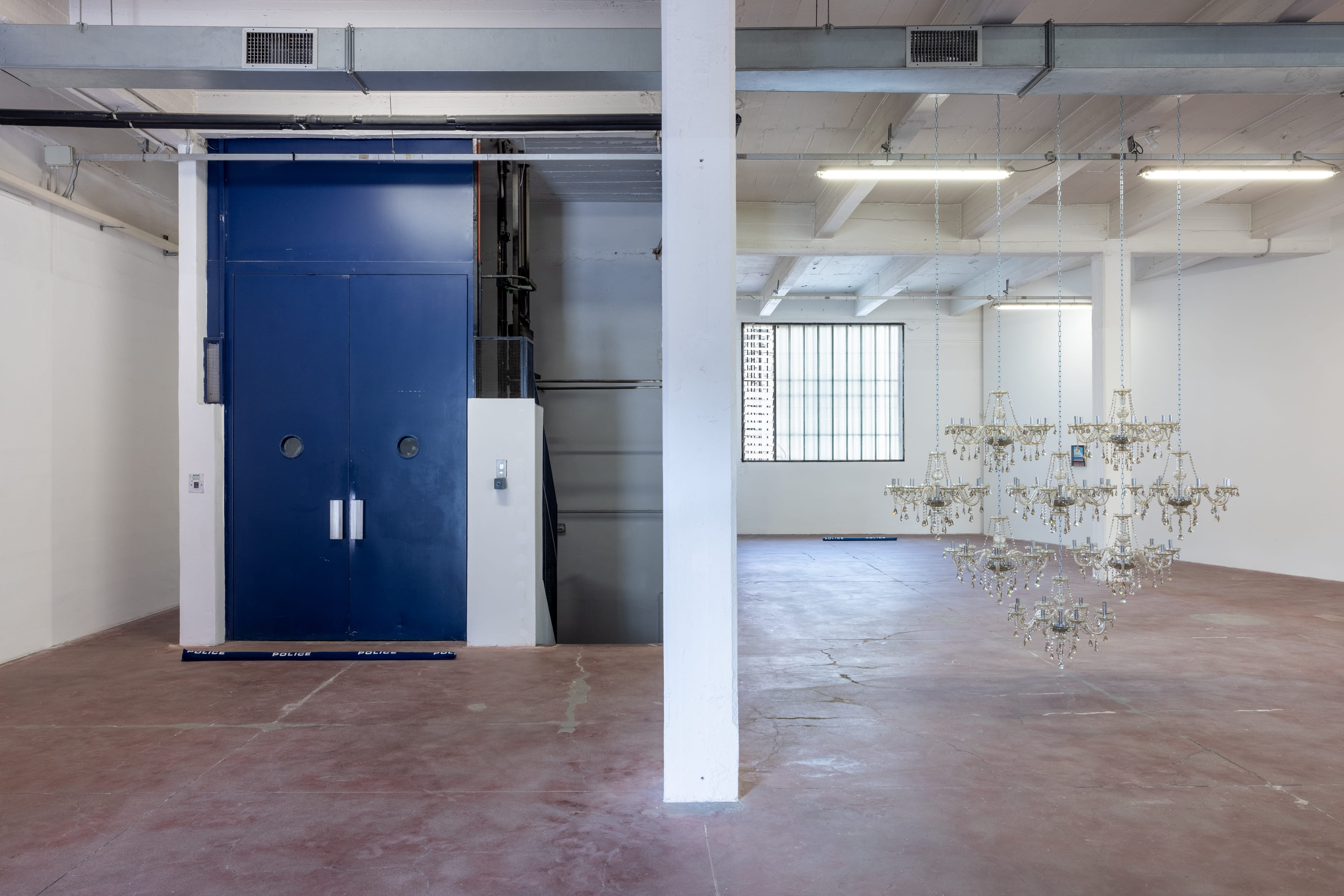
Weaned on institutional critique and relational aesthetics, Kayode Ojo makes sculptures, each one a tiny subversion, that playact as Marx’s dancing tables. His assemblages are made by repurposing internet-available, luxe-presenting items in the construction of a new something that borders on the too-much. There’s a beauty there — a lump-in-one’s-throat, a kitschy romanticism — that acts as a foil to their aridity, but their feigned opulence masks that savage moment where a digital image of an object, and its subsequent possession, feeds the illusion of ascendance central to consumerism. Filling his basket with furniture, clothing and glittering accessories, his sculptures perform the tragedy of buyer’s remorse. Ojo’s chosen readymades may fulfill a function, but with their pretensions to glamour they are hardly necessities. In HEARTH & HOME, one of his decadent chandelier agglomerations adorns the main space of the gallery: eight “cognac” colored lighting fixtures chained to the ceiling. But their very proliferation also speaks of a kind of impoverishment, courting pathos as it fails to pass as “the genuine article”.
Patrick Sarmiento is something of a glitch poet: he conjures an admixture of often shattered, yet always seductive, references using modest means at a modest scale. Imagistic, but contra-painting, his attitudes are perfectly encapsulated in objects that ghost every call to function. Garbage cans, mirrors, and flypaper are among the many items he’s thwarted. He’s here represented by three works from his “Draftstopper” series, hand-made plays on those uber-crafty, snake-like objects placed in front of doors and windows to keep out the cold. Each of these has been emblazoned with the text “POLICE” in the typeface and color scheme associated with those Americans intended to function as keepers of the peace. In these works, there is a semantic play that links soft sculpture to the truncheon, the artist showing how even an element of design can become associated with violence and power.
Dash Snow’s photography, like his sculptural and 2-D assemblages, manifests a very strong sense of style, in the postmodern sense. When one reflects on his choices — the saturated, often lurid color typical of the Polaroid, the softly expressive possibilities of black and white 35mm film — one sees an artist skilled at masterfully manufacturing a vision that is deliberately transhistorical. His work persistently slips free of an association with a particular period. Dressed in the visual tropes of bygone eras — his collages can call to mind both Weimar Republic high art and the cut- and-paste style of the subcultural leaflet — Snow has always engaged with an aesthetics of authenticity and resistance. Few artists of his generation have made work as stridently incendiary, however, amidst the chaos, the sex, drugs, race baiting and Sadam Hussein, there is a diaristic thread that documents a complex individual who was, among other things, a loving father. The photographs that form the core of his practice serve not only as a chronicle of a community, they trace the life of a family man.
Nicole Wermers’ sculptures appear as still lives of objects arranged and/or altered to form perfect aesthetic bundles, frequently hiding the artist’s own labor within a fiction of completeness. They present themselves as seemingly inevitable conflations and, no matter how surrealist some of her juxtapositions, it is their very unity that defines them. That the work is often witty and playful is merely a surface ruse that disguises an aching view of the isolation written into contemporary social spaces: the kitchen can be as lonely as the community center or the local café, each of them merely a location for the selling of products. Her sculptures are generally produced in series and two of those are represented here: the “Domestic Tails” and her untitled chairs. In the former she has fashioned a hybrid of tail and hose from various materials including faux fur, in the latter coats have been draped over smart, modernist furniture, creating a figural presence.
Like Fleury and Ojo, Wermers evades easy political categorization as her works constantly fluctuate between critique and celebration. This continuum is just one of many ribboned throughout this exhibition — from the abstract to the concrete, the folk to the industrial, the high end to the crude, the store- bought to the cunningly crafted, from commitment to detachment, sincerity to irony, acquiescence to contention.
“Home is where the heart is/Home is so remote/Home is just emotion/Sticking in my throat/
Home is hard to swallow/Home is like a rock/Home is good clean living/Home is ... I forgot/
Let’s go to your place.”
- Lene Lovich & Les Chappell
Curatorial choice does imply, at a certain level, that the pieces of art selected are, in fact, interacting versions of the same work. So, it would seem at first that curation is a reduction of sorts. However, it’s a reduction that is reversed by a viewer interested in, and capable of, unpacking the individuality of an exhibition’s disparate elements.
This, then, is a home, deconstructed, and we ask that you play whichever role you’re most comfortable with: mother, daughter, sister, brother, son, father.
- Josè Freire