Martin Kippenberger at Galerie Gisela Capitain

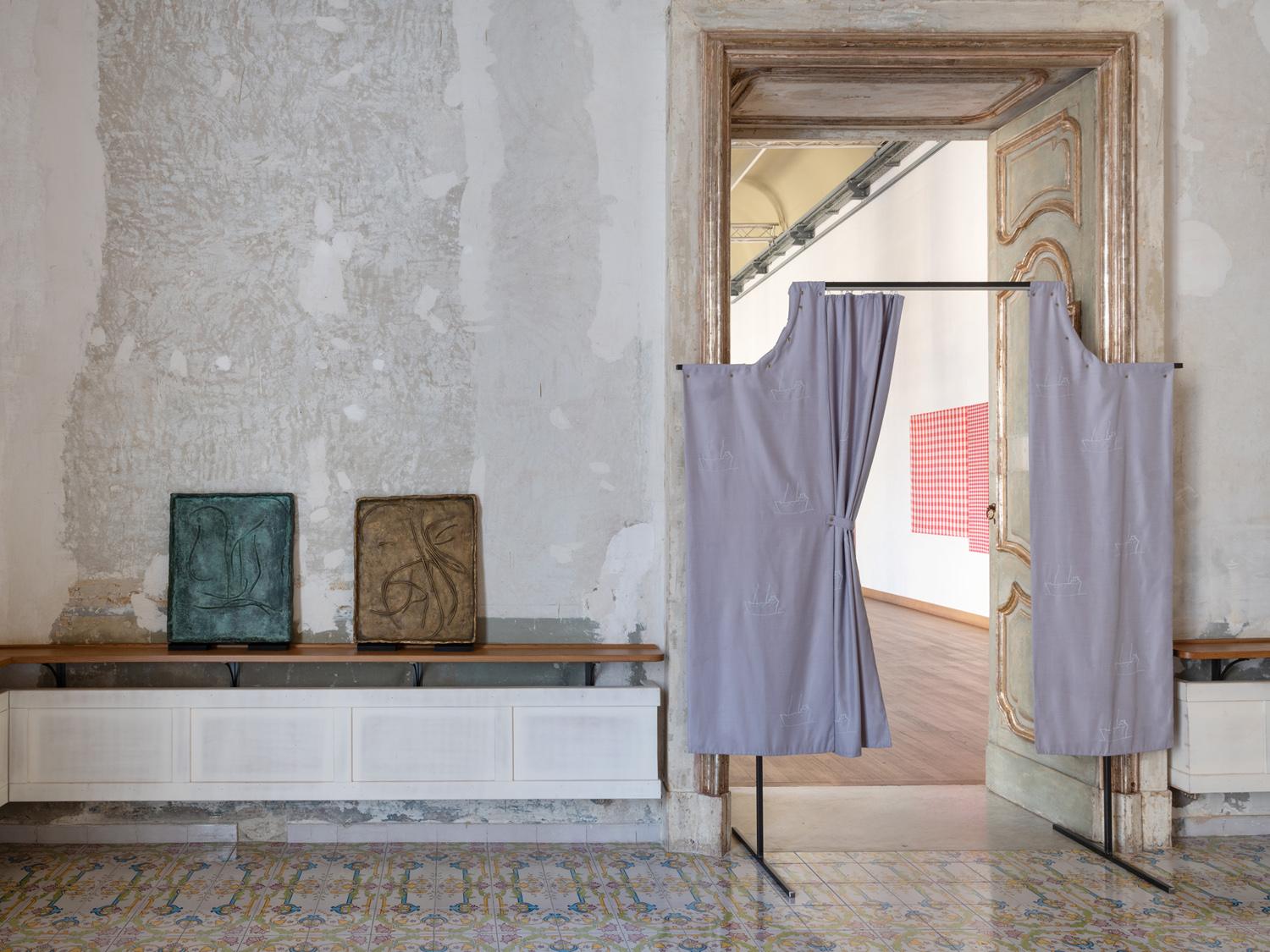
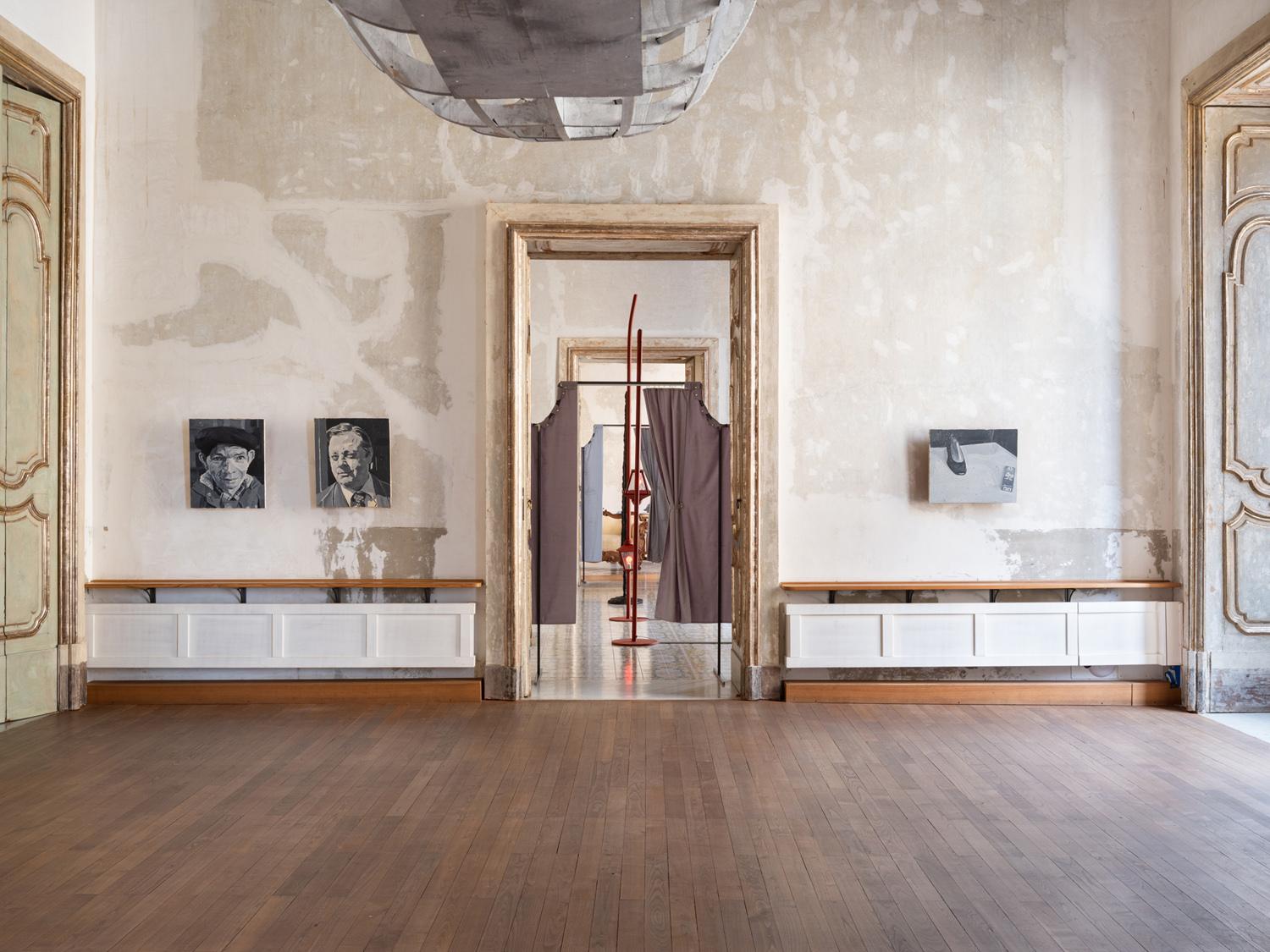
Galerie Gisela Capitain is pleased to announce Zweigstelle Capitain IX, the ninth edition of its temporary exhibition project, taking place once again at the prestigious Palazzo Degas in Naples. Within the spaces of C.A.S.A. (Centro delle Arti della Scena e dell’Audiovisivo), Zweigstelle Capitain IX will present two special exhibitions: Martin Kippenberger. Per Pasta ad Astra and 40 Years Galerie Gisela Capitain.
It all began in Florence. In 1976, Martin Kippenberger moved to Italy to pursue an acting career. When success eluded him, he turned to painting instead. His very first body of work was titled Uno di voi, un Tedesco in Firenze (1976/77). This initial series comprises 83 paintings featuring a diverse mix of portraits, interiors and cityscapes, alongside details from advertising brochures, shop windows and sculptures that he encountered while walking through Florence. The paintings were originally intended to be stacked to the same height as Kippenberger
himself. This black-and-white tower of images depicts everyday life more than classical motifs, portraying people, shop displays, and, above all, lanterns, a recurring motif in Kippenberger’s work. Lanterns instead of Leonardo: a very different Italiensehnsucht.
The longing for Italy, this deeply felt German obsession with la dolce vita, the sun, art, and gelato-lined piazzas, has stirred German hearts and stamped their passports since the 19th century. With Uno di voi, un Tedesco in Firenze, Kippenberger sought to inscribe himself directly into the Italian artistipantheon that he discovered in Florence: Donatello, Leonardo, Michelangelo, and Raphael, all the great names that give the city its mythical radiance. 'I am one of you,' he declares, and here, his body, his very self, becomes an integral part of the work.
This concept recurs throughout Kippenberger’s oeuvre: the artist who sacrifices himself to express a form of truth; the artist who nails himself to the cross through his art. Through these shifts in context, Kippenberger articulates an early critical stance, one that resonates throughout his entire body of work.
This is evident in Sozialkistentransporter/Transporter for Social Boxes (1989). This sculpture is a reproduction of a Venetian gondola carrying a fictional cargo of "social pasta." Pasta per tutti! Pasta is, of course, a general term in Italian cuisine referring to products of different sizes, types, and shapes. However, pasta also appears as a recurring motif in numerous works by Kippenberger, across all of his media. He loved pasta as a daily pleasure, a warm culinary constant amid the instability of his work and personality. Yet, from an artistic and conceptual perspective, pasta was much more than that.
The Italian checkered tablecloth, typically red and white, is often associated with the cosy, rustic atmosphere of Italian restaurants, osterias, small pizzerias, or corner taverns. In his tablecloth paintings, Kippenberger appropriates these everyday patterned fabrics, combining humour, domesticity, and critique to transcend the boundaries between art and social spaces. He even moves beyond red and white; the series includes works featuring green and white as well as pastel blue and white checks. For anyone who didn’t know, plastic tablecloths say nothing about the quality of the food. From the late 1970s in Florence to 2026 in Naples, Per Pasta ad Astra – because it all began in Italy.
The exhibition is accompanied by a publication.
–
Martin Kippenberger’s work, shown as part of the gallery’s anniversary, is a reminder of the pivotal role he played in shaping Galerie Gisela Capitain during its formative years and he continues to resonate throughout the gallery’s history. Celebrating its 40th anniversary, the gallery reflects on this legacy and traces four decades of artistic engagement through the exhibition. 40 Years Galerie Gisela Capitain presents artists’ relationships, formative moments, exhibitions, and projects through a rich selection of publications, catalogues, LPs, and other ephemera produced over the course of the gallery’s history.
Martin Kippenberger was born on February 25, 1953, in Dortmund, and he grew up in Essen. He spent several months in Florence in 1976 and moved to Berlin the following year, where he and Gisela Capitain founded Kippenbergers Büro in 1978. He spent the last two years of his life in Vienna and Burgenland, Austria. He died on March 7, 1997, in Vienna. In recent years, Kippenberger's work has been featured in several major retrospectives, including exhibitions at the Van Abbemuseum in Eindhoven and the Museum Moderner Kunst Stiftung Ludwig Wien in 2003/04, the Tate Modern in London and the Kunstsammlung Nordrhein-Westfalen in Düsseldorf in 2006, the Museum of Contemporary Art in Los Angeles in 2008, and the Museum of Modern Art in New York in 2009. In 2011, an exhibition at the Picasso Museum in Málaga highlighted Kippenberger's interest in Pablo Picasso's work. In 2013, the Hamburger Bahnhof, Nationalgalerie der Gegenwart in Berlin presented a retrospective entitled Sehr Gut/Very Good. In 2016, the Kunstforum in Vienna devoted a special focus to language in Kippenberger's work. In 2019, the next major retrospective, Bitteschön Dankeschön, was presented at the Bundeskunsthalle in Bonn. Kippenberger's large-scale installation, The Happy End of Franz Kafka's 'Amerika,' was presented at the Fondazione Prada in Milan in 2020 and at the Museum Folkwang in Essen in 2021. Preparations are currently underway for a major solo exhibition at the Louisiana Museum of Modern Art in Humblebaek, Denmark, which will open in early 2027.