Larry Johnson at Galerie Buchholz

Everything You Always Wanted to Know About Hollywood But Were Afraid To Ask Larry Johnson
1. Anecdotes, biographemes, captions, quips, Hollywood legends, unsolved mysteries, cold cases. And smash cuts: It was a night like any other, just another day at the beach, a joyride, a pleasure cruise, and then…
2. The proverbial other shoe dropping. The knock on the door.
3. For their contributor’s note in the second issue of Wedge (Fall 1982), A PICTURE IS NO SUBSTITUTE FOR ANYTHING employed an uncredited maxim from The Society of the Spectacle : “Only the real negation of culture can preserve its meaning. It can no longer be cultural . Thus it is what in some way remains at the level of culture, but with a completely different meaning.”
4. You might be wondering why anyone would glance backward to A PICTURE IS NO SUBSTITUTE FOR ANYTHING, or 1982. I wish I had time to get into all the reasons, but I’ll leave you with two: this is a show made up of text and pictures, or as the parlance then had it, text and image, and with the snippets of gay information Larry deploys pasteup as collage (collage as pasteup?) in a way as refined and minimal as Sherrie Levine in her early, pre-Edward Weston collages, and he redeploys pictures of work by another artist, in a way that pays femmage to Louise Lawler. May 1982 saw the New York Times ’s first mention of the dismal acronym GRID (Gay-Related Immune Deficiency), in an article whose title, “New Homosexual Disorder Worries Health Officials”, seems more troubled by an abandonment of (a stereotype of) finicky homosexual neatness and/or a potential disorderly conduct hearkening back to Stonewall than with any cause for actual concern. (It had been almost a year since the Gray Lady reported on “a rare cancer observed in 41 homosexuals.” She was called “gray” because the paper supposedly didn’t traffic in yellow journalism.)
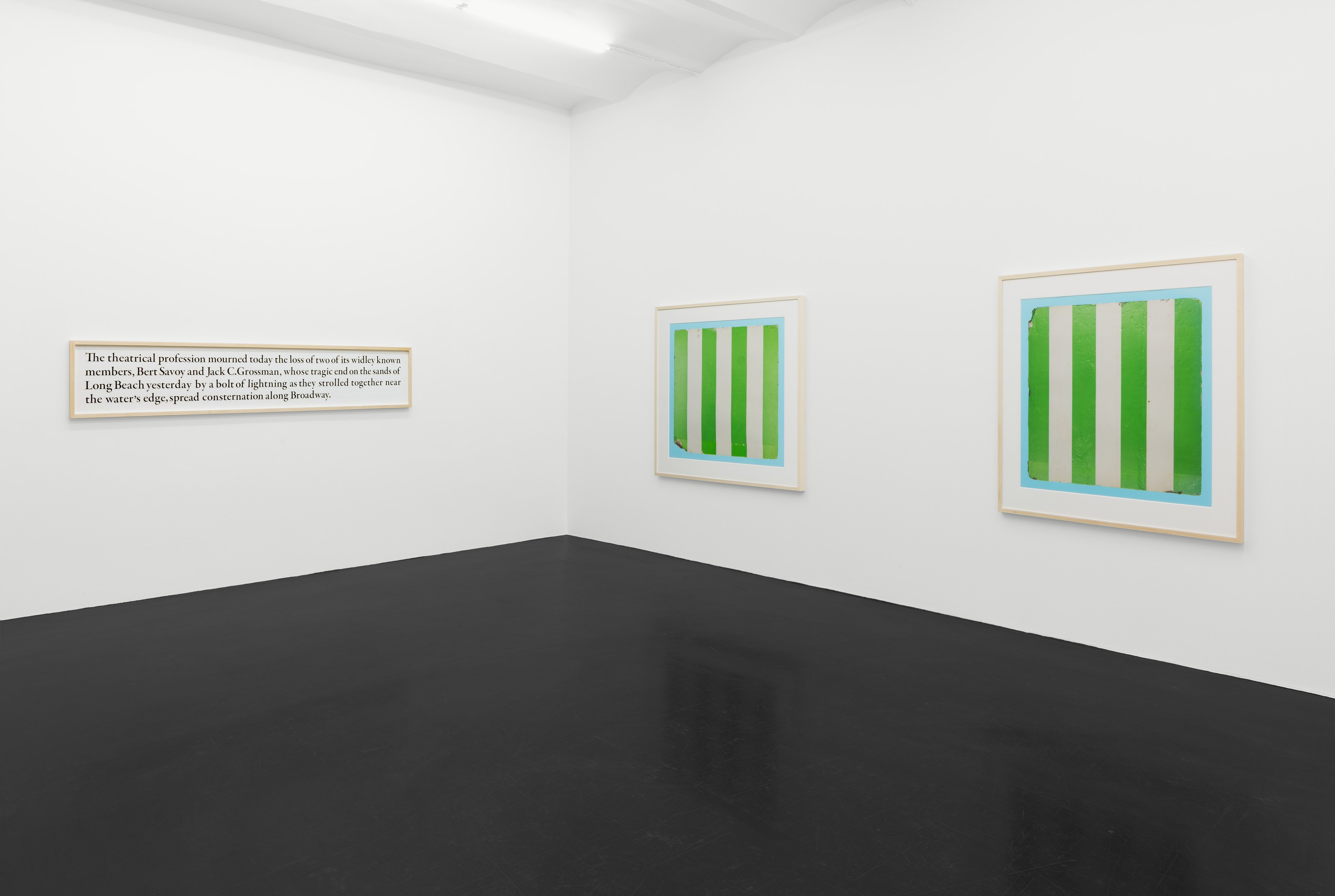
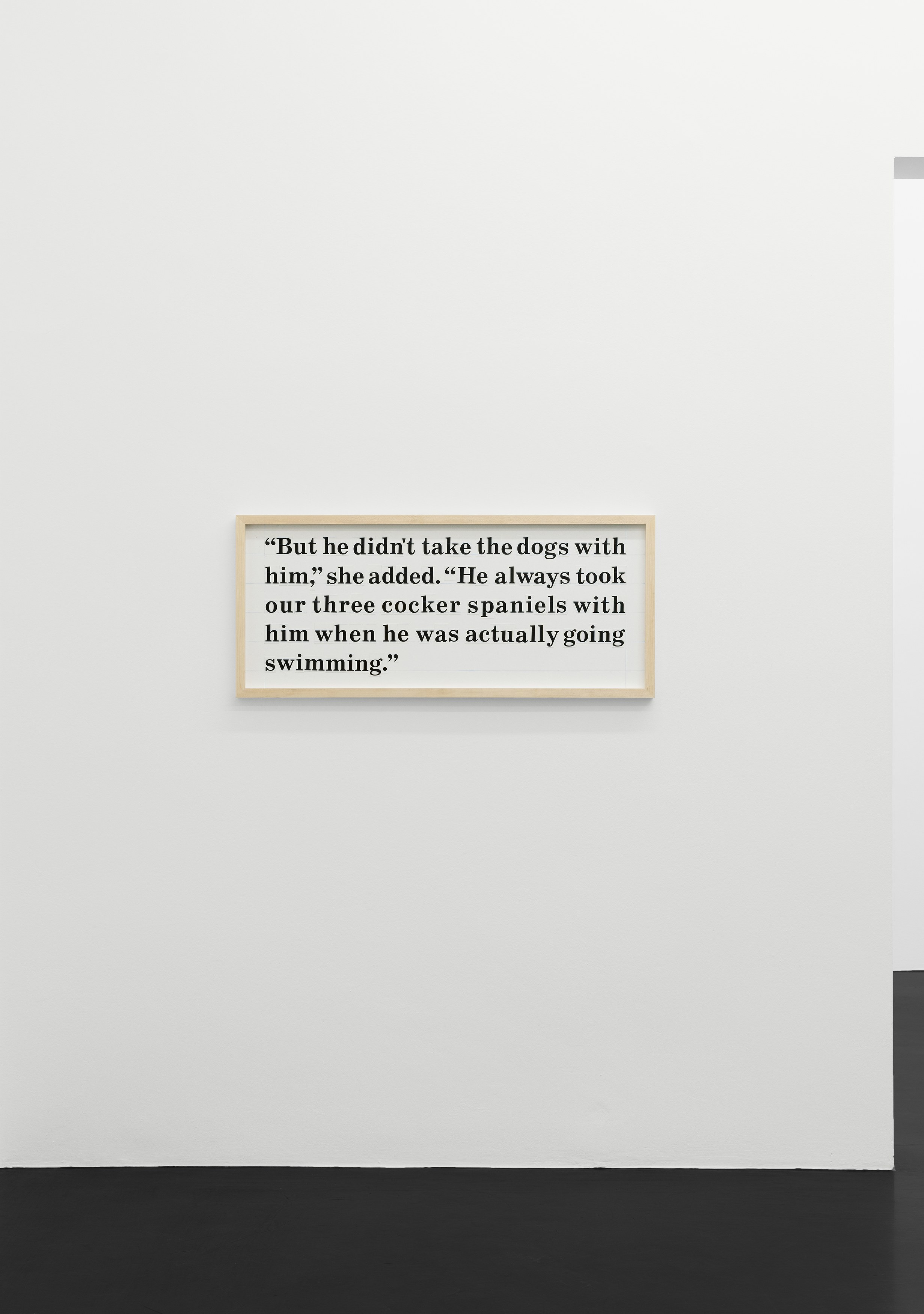
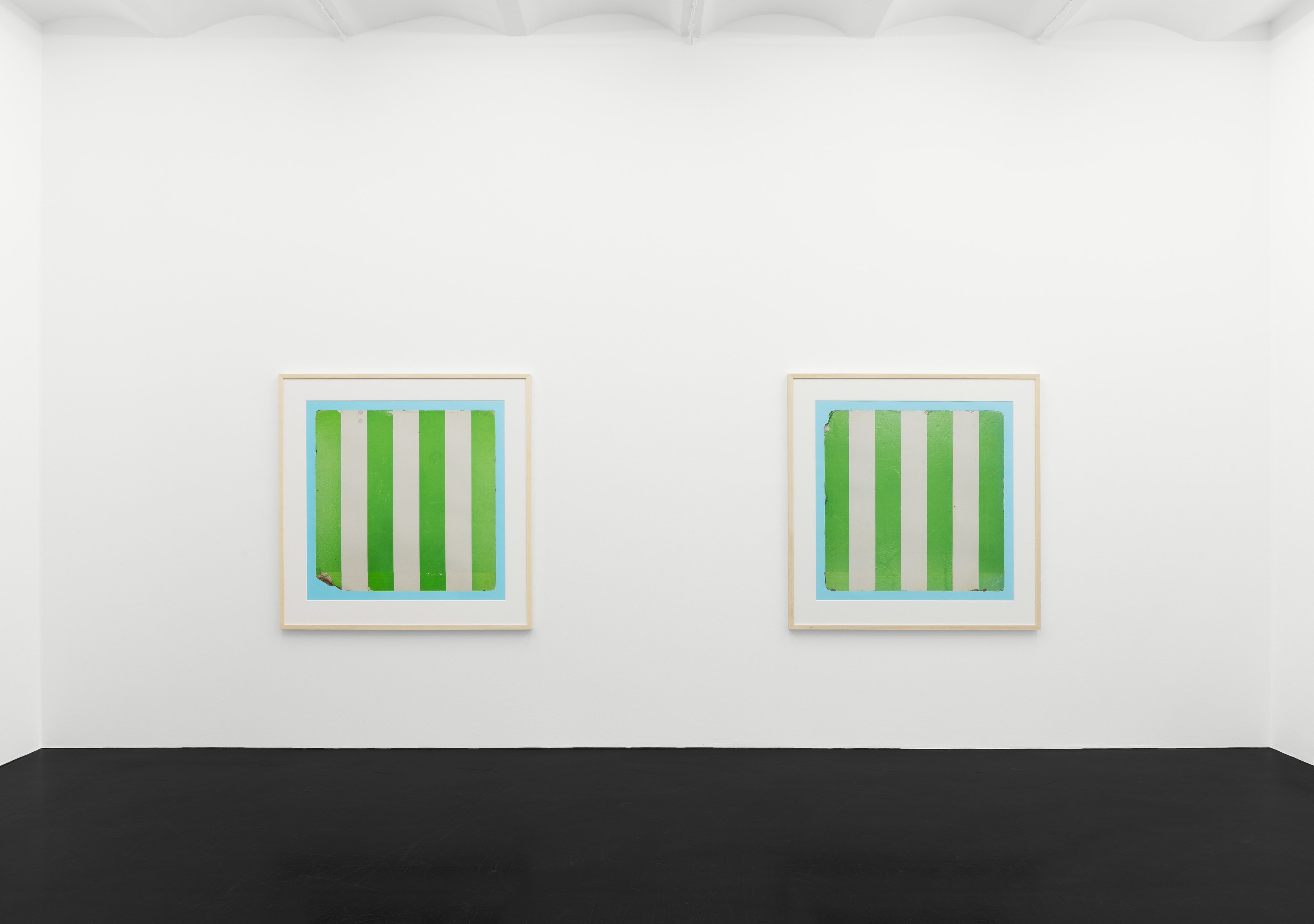
5. Add to the list: items, headlines, exposés - and backstories. Untitled (Moved to Tears) , 2010, can operate as the ur-picture for so much of this, especially the tension between text and picture, since Moved to Tears is both text as well as a picture of its process (pasteup) and priority (pasteup is what would arrive prior to the announcement card it helps to produce).
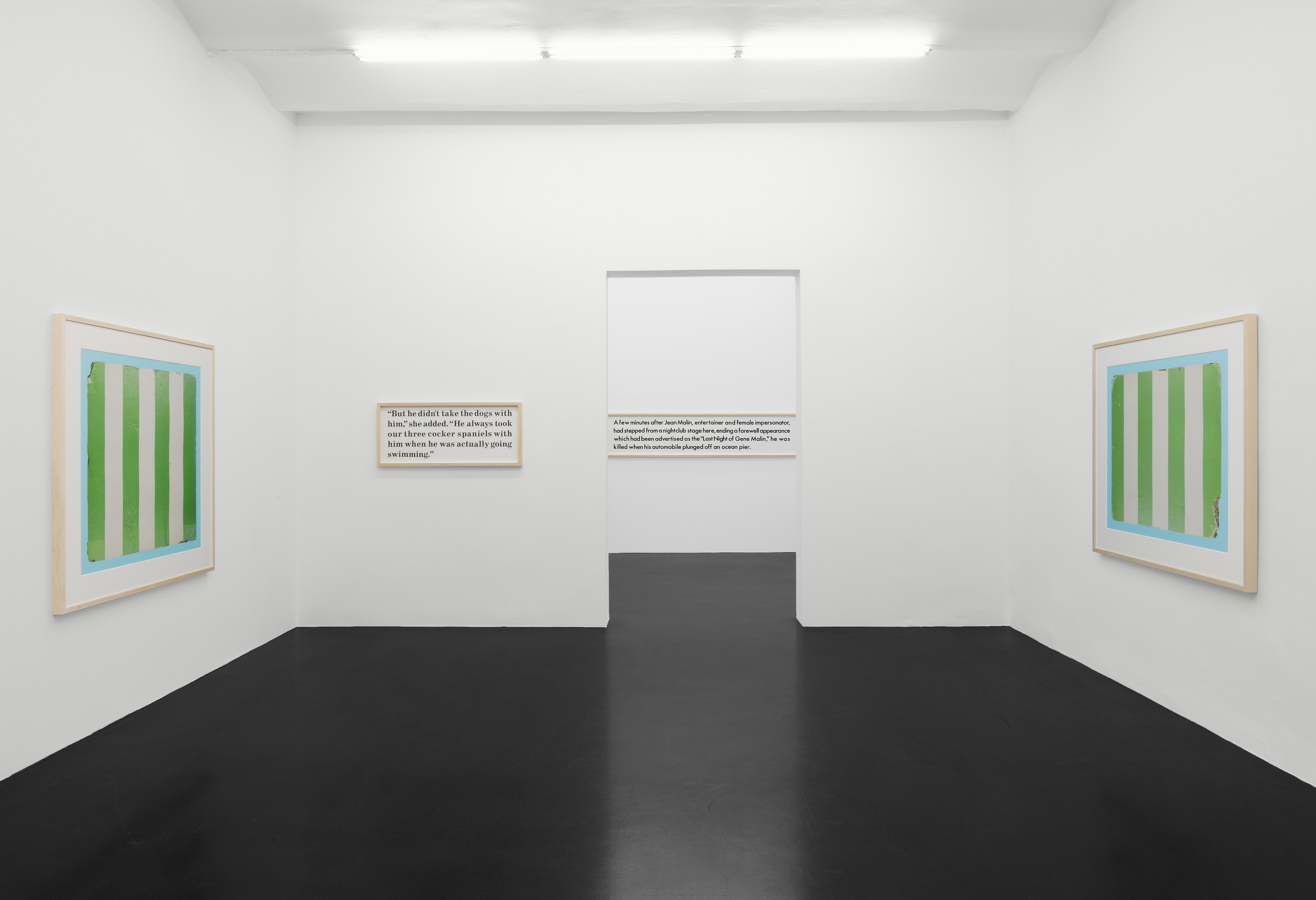
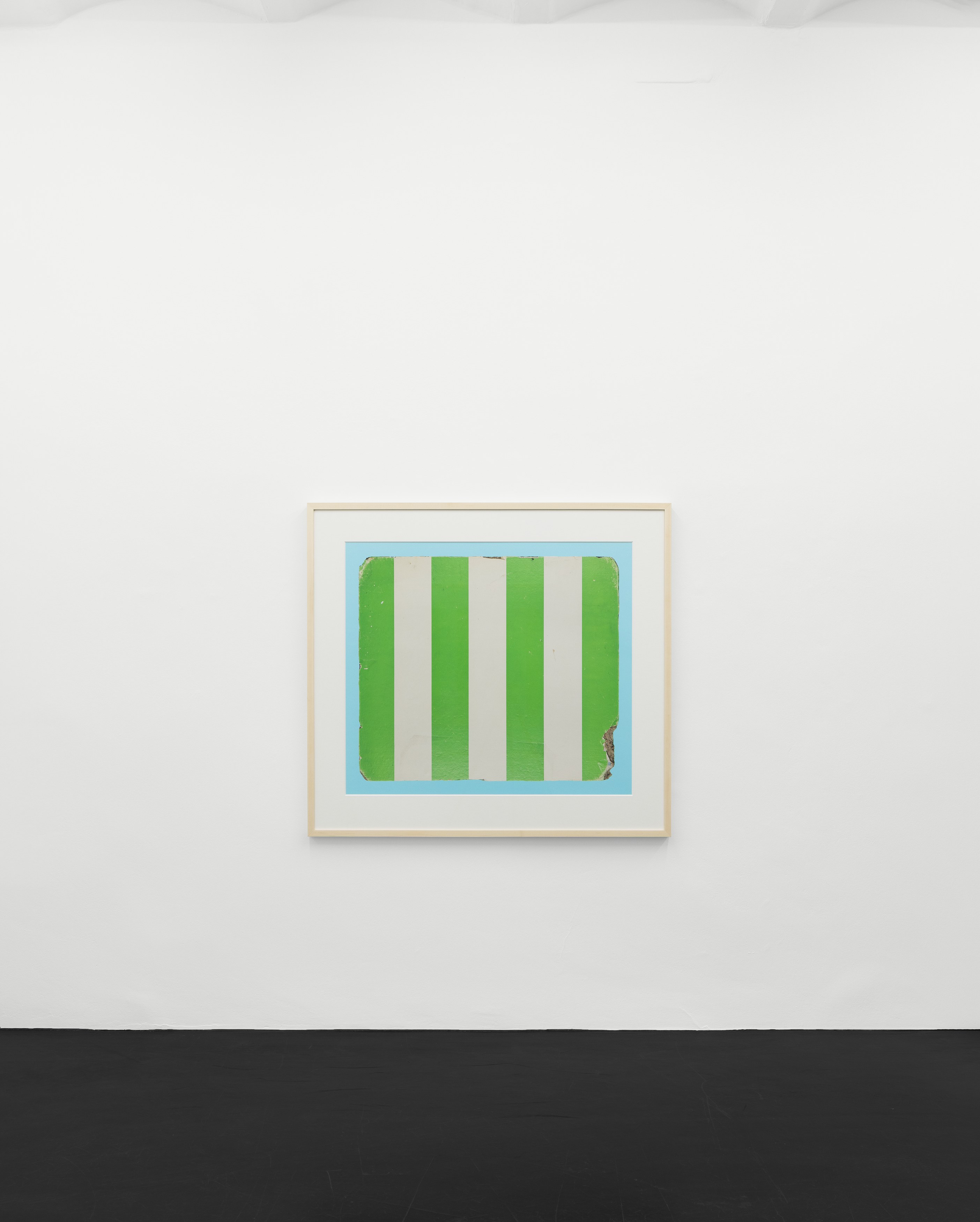
6. The stripes of the four photographic works - not the green and white stripes in the design scheme of the Beverly Hills Hotel; not the yellow and white stripes of the somehow never quite not gauche Giorgio Beverly Hills (would its last heyday have been the 1980s? Its scent, Giorgio, created by the celebrated Francis Camail [the nose behind Revlon’s Charlie, Annick Goutal’s Eau d’Hadrien, among others], launched in 1981); not the variegated stripes that Paul Rand designed for IBM - were described by Daniel Buren as “[s]triped paper (green and white) each strip 8.7 cm” and used in Frost and Defrost , a work in situ Buren made for the Otis Art Institute Gallery when it was still located at 2401 Wilshire Boulevard, Los Angeles, CA, and Hal Glicksman its director. The gallery’s ceiling panels were “covered on their backs systematically” with the striped paper. The “ceiling” panels were then installed on the walls of the two rooms of the gallery in a grid “in direct connection with the grid on the ceiling.” The work functioned from January 28 to March 4, 1979.
7. As Buren wrote:
From the second day of the exhibition in both rooms the [ceiling] panels will be reinstalled (by the unit of 7 per day per room) to the original place on the ceiling. The original surface of the ceiling (their fronts) being exposed, the striped paper (their backs) not being visible At the same time the objects left in room B [ladders, industrial push carts, “objects…used for any new installation”] are reinstalled, day by day in the storage room, work room, etc.
8. Re: “functioned”: see the first five (of twelve) “remarks” by Buren for the slim publication that accompanied the work:
The rooms A & B before being touched for this exhibition are frosted (white cubes).
The radio, when on, in room B gives the only relationship of inside to outside in this cubic freezer
in which no light is let in from the outside.
The work installed as it is (as described before) on the first day defrosted the white cubes.
Then the work installed in rooms A & B as well as the objects in B are frosted for one day in their
situation.
Then defrosted, then frosted, then defrosted, etc….
9. Larry’s striped panels from Frost and Defrost are dinged, fly-specked, stained, damaged. Ruins. Yet they still convey a cabana quality, beach awnings, bathing trunks, by-the-sea-ness - or, if not quite by the sea (however not faraway the Pacific is), the lake, whether MacArthur Park Lake or Loon Lake.
10. From Buren stripes via a track from Blondie’s Parallel Lines playing on the radio or on a jukebox at a bar to Lacan’s barred signifier, barred subject. “The signifier and the signified are separated by a bar… There is never an easy correlation between signifier and signified; meaning arises only from the failure of language to coincide with itself,” Uncle Jacques wrote in his Écrits (trans. by B. Fink).
11. “One Way or Another” and “Picture This”: barred subjects.
12. I.e., “I Know But I Don’t Know.”
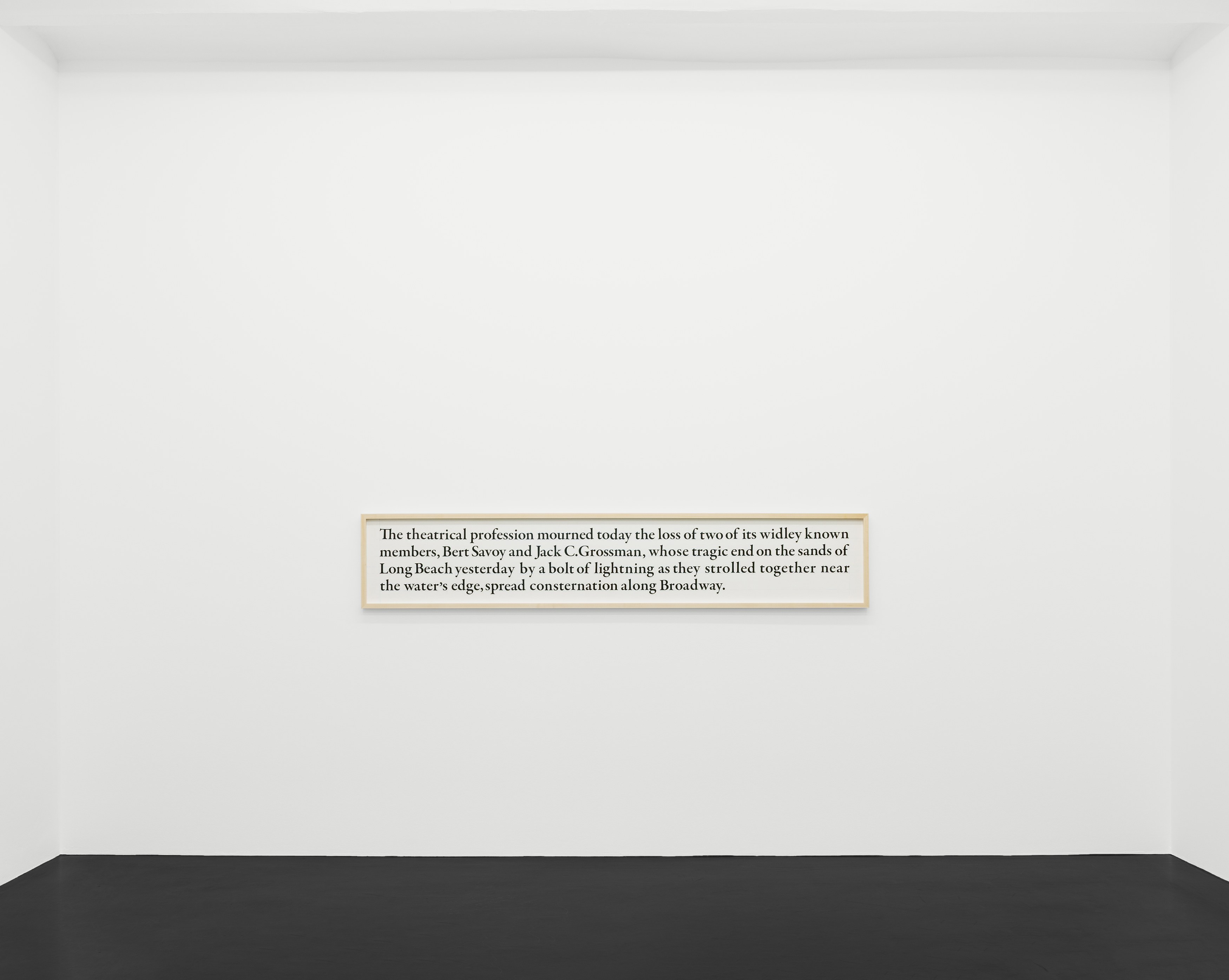
13. The pasteup works recount tales of things suddenly going wrong, lightning striking from out of an almost clear blue sky. A joyride’s crash and burn or sinking. A lucky streak’s ending. Unlike the burning circus tents and elephants balancing on balls of Larry’s wallpaper, Flaming Big Top (For Charles Nelson Reilly) , 2015, one has to imagine rather than seeing depictions of their sudden ends:
of Jean Malin, Jazz Age darling, bright blossom of the “Pansy Craze,” whom one journalist described as a “baby-faced lad who lisped and pressed his fingers into his thighs,” age 25, whose car careened off a pier, killing him, injuring his companions, one of whom was the irrepressible Patsy Kelly, Hollywood actress and dyke;
of Bert Savoy, performer, flaming queen, Mae West-adjacent, and of Jack C. Grossman, friend, walking on the beach when lightning struck the locker key Savoy had hanging around his neck, killing both him, age 35, and Grossman, whose hand, in some accounts, rested on Savoy’s shoulder at the time of the bolt - the strike synchronized to Savoy’s (apocryphal?) last words, according to Zagria: “Mercy, ain’t Miss God cutting up something awful?”;
of David Bacon, star of The Masked Marvel serial, films he considered a low point but for which he is best remembered, age 29 (married, but lover, at the time of his death, of Laird Cregar, hulking, brutish character actor whose sexuality was often called “complicated” but who flourished in homosexual milieux), who, having left his house without his three cocker spaniels, was discovered dead, “wearing only a swimsuit.” A wallet and camera were also found in his car. “Allegedly,” as Wiki records it, “the film from the camera was developed and found to contain only one image, that of Bacon, nude and smiling on a beach.”
14. These seaside demises of gay performers teach something about the flash event no camera captured and yet, not photographs, nevertheless now function in relation to the photographic .
15. See above, Sherrie Levine, but also clock one of her earliest published statements (1980):
Certainly the best thing in life is ordinary sexual love. But we find unsanctioned violence, frightening as well as exhilarating, because without manners or form, it yields no meaning or hope. It has no stake in the future.
Reluctant moralists, we make art that suggests our simultaneous longing for anarchy and order— to have nothing and everything. An uneasy peace is made between the reassuring mythologies society and culture provide and our wish to see ourselves as free agents. The very best in art makes public our private anguish in the face of this ineluctable conflict.
We want images and stories which present us with ideals but at the same time are not innocent of the other side of the coin - our desire to have no ideals, no fetters whatsoever. We aspire to the best of both worlds.
16. The deaths intersect in their fairy facticity with Benjamin’s Aktualität , which, Esther Leslie points out (in a heavily highlighted passage Larry texted to me), “is the obverse of the eternal in history, and is endlessly more significant for historical, political and cultural research. […] An attitude informed by Aktualität grabs quotidian objects whose very insignificance and ‘unconscious nature’ warrant their indexical relationship to social truth and social lies.” Here, instead of objects, it is news items of sudden calamity involving staunch homosexuals that negate, even in death, so many ridiculous social lies of the (current) moment - that there are only two sexes would be one; that vibrant gay culture is a recent phenomenon would be another.
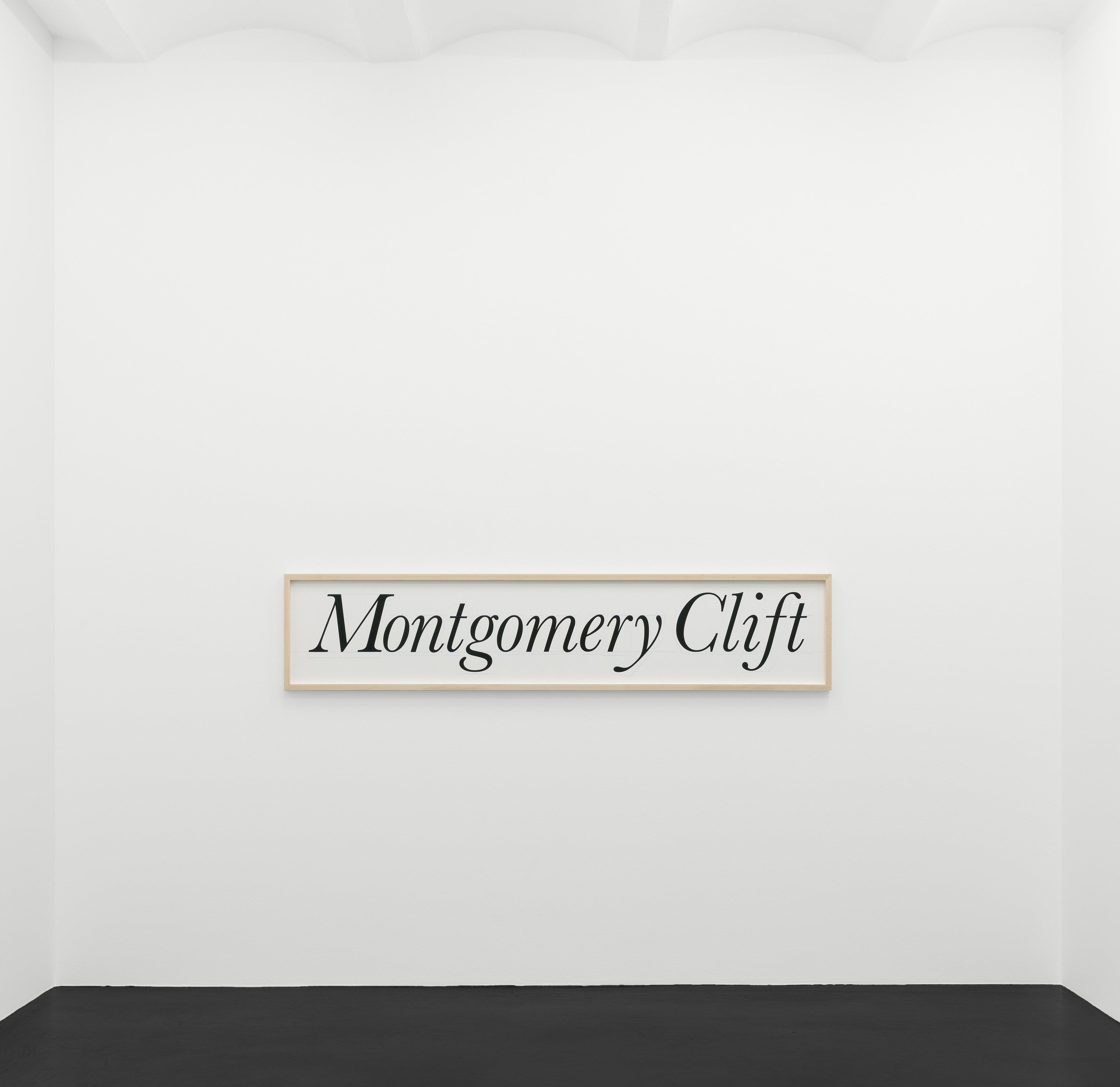
17. Montgomery Clift dazed, moaning, crashing his car immediately after leaving the dinner party at Elizabeth Taylor’s “crow’s nest” near the top of Benedict Canyon (he’d given his chauffeur the night off; the road up to the house Liz described as “murderous…a real cork-twister”), Liz screaming “oh, God, oh, God, oh, God!” and running to the wreck - motor still running, gas leaking, windshield shattered, dashboard smashed in, pinning her dear friend under the steering wheel - climbing through the car’s back door, over the seat to get to him, cradling his head in her lap, pietà. Monty “bleeding from the head so much that it looked like his face had been halved,” Elizabeth said, Kitty Kelly reported. Monty’s teeth knocked out, lodged in his throat, “causing him to choke,” and Elizabeth ramming her hand into his mouth and pulling them out so he could breathe (Monty giving them to her later, macabre memento of the evening). She rode with him in the ambulance to the hospital, “trying not to vomit from the smell of his blood all over her silk dress.”
18. Isn’t that actual event basically the plot of the movie version of Suddenly, Last Summer - screenplay by Tennessee Williams and Gore Vidal? Everyone trying to reach into someone’s head or pockets or closet to extract something. Who’s to say that after the trauma of the psychoanalytic session the film unreels (lobotomy averted) Monty and Liz or Catherine Holly and Dr. Sugar don’t go back to Cabeza de Lobo and then onward and have more festive times? Maybe, like Sebastian, Dr. Sugar - whom, at the movie’s end, Katherine Hepburn as Mrs. Violence, I mean, Violet Venable conflates with her dead fag poet son - still pays for sexual playmates or doesn’t and either way it isn’t thwarted or abject, and Catherine/Liz is there enjoying her place in the fun.
19. Montgomery’s clit. The full Monty.
20. He was, as Bruce LaBruce put it, “largely gay” - largely instead of mostly . LaBruce palpates the adverb in a parenthetical corrective: “(Or maybe not largely - according to Kenneth Anger, [Clift’s] nickname was “Princess Tinymeat,” although this might be due to the fact that he was a messy bottom often on speed and therefore probably couldn’t get properly hard, that’s my theory!)”
21. About many gay men there is little to no information about how many or with exactly whom they fucked or got handsy or had a BJ from or just exchanged really intense looks, cruising interrupted before anything more could happen. Certain exchanges, transactions, anonymous quickies, resist historicization, which doesn’t in anyway diminish their importance, their Aktualität . There is so much thinking-through yet to be done on relationality tout court , but especially when the objective of the relations isn’t coupledom or even what traffics under the name of intimacy , but, instead, thrust , pleasure , and/or involvement , however fleeting.
22. Clift, as LaBruce notes, “was deeply and intensely involved with Broadway choreographer Jerome Robbins and apparently gave him the idea for West Side Story . He also had flings with a number of celebrities, including actor Farley Granger and author Truman Capote.” In an essay on Bill Gunn, Hilton Als mentions Clift’s “close relationship to two men of color - his companion, Lorenzo James, and Bill [Gunn], who was a young actor working in 1950s summer stock when he was taken up by the older performer. Were they lovers? I don’t know. Also: Who was this guy? A little research in our 1990, pre-Google world, revealed that, in addition to acting with James Dean and Ethel Waters, among others, Bill had, later in his career, directed masterpieces like Ganja & Hess and Personal Problems , both of which took decades to become widely available in their original forms.” Gunn perished of AIDS in 1989.
23. The invitation to the show returns Monty his place in the sun. Candid Kodacolor on Fire Island. It’s before the wreck that split his face and his career in half. “I think his looks,” wrote Liz, “are even more poignant now because they are not so perfect.”
24. A while ago, Larry texted me a picture of a page from a book which included this thinking:
Since memory is actually a very important factor in struggle (really, in fact, struggles develop in a kind of conscious moving forward of history), if one controls people’s memory, one controls their dynamism. And one also controls their experience, their knowledge of previous struggles. Just what the Resistance was, must no longer be known…
25. Historical knowledge (of the working class, of homosexuals, of working-class homosexuals), its continual shrinking: Montgomery Clift was, throughout his career, cast as a figure of that knowledge. In Red River (1948), John Wayne considers him soft. In The Misfits , struggles and last-ditch efforts ricochet off the faces of each of the stars playing figures down and out and barely surviving, but especially off and then between Clift and Marilyn Monroe, and it’s as excruciating as it is moving - what they mirror in one another, the concepts of part, persona, and person collapsing.
26. In A Place in the Sun , Clift plays the poor nephew of a bathing suit tycoon. While the specificities of class differences and striving structure almost every scene (complicated or burnished by the genetic windfall of physical beauty), in so many crucial interactions between Clift’s George Eastman and Elizabeth Taylor’s Angela Vickers, she senses something that isn’t immediately or easily tractable - despite her obvious desire for him (part of her desire for him) - that she nevertheless qualifies with a quasi-economically-inflected term: misspent . “I see you had a misspent youth,” she tells him at first glance. Then, later: “You look unusual.” “You seem so strange.” While this could be her way of negotiating the signifiers of the working class that Clift’s character is struggling to outmaneuver, it isn’t only that, which is to say that it could be her way of negotiating the signifiers of Monty’s third meaning. By the time she encourages him to “Tell mama, tell mama all,” it’s not clear what he will confess - or the confession she wants or expects to hear. He is found guilty of and executed for desiring a better life, class trespassing, shrugging off religiosity, as much as the accidental death of Alice Tripp (Shelley Winters). In response to so much of it, Clift performs a heartbreaking bewilderment rather than ressentiment. Explaining to Elizabeth/Angela’s father (Shepperd Strudwick) the predicament: “Who am I to think of marrying Angela? Angela has everything. We were very poor people.”
*
I’d wanted this to be more fun and less pedagogical (I’m not sure that’s quite the word). I’d wanted to link Frost and Defrost to The Other Side of Aspen and especially The Other Side of Aspen 2 , which gave Kurt Marshall his place in the sun - in no small part because of how Buren’s work opens a dossier on “fronts” and “backs” as well as on relations between “inside” and “outside” information. I’d wanted to say something about men so covered in cum that parts of them are frosted.
But then I had trouble remembering how I first heard about the Buren panels. I know it occurred in the 2000s, early in the years Larry and I were teaching together at Otis - classes on Elizabeth Taylor, on the Hollywood musical, on juvenile delinquents, among other matters. Somehow I had construed that a student of ours, the artist Mark Roeder, had not quite discovered them but instigated a conversation about them. To clarify some points, I wrote to Mark, and he responded:
I came across the panels because I was bored and nosey. I did a work-study job in the Otis Gallery. I only worked Saturdays. It was always empty. There was nothing to do but read. I had a photocopied version on For Publication , the second edition published by Marian Goodman. It had the Otis publication information in it too. The file cabinets were unlocked so I just went looking. I was looking for anything about the Dan Graham exhibition. I spent lots of time sifting through those files. There was so much happening there in the 1970s. Hal Glicksman was the curator then. I think he moved on to Cal State Long Beach or maybe the Long Beach Museum. I met him at a John McCracken show at PACE or ACE or maybe at LA Louvre. I think that was in 2001. He was into using computers for kids with disabilities, I think. In the gallery files, there was a lot of correspondence. Most of it was about funding. Lots of postcards from Dan. The file for Buren’s exhibition was pretty bare. I took notes about some of what was there. I’ll look for that notebook. There were two copies of the Buren catalog. […] There isn’t much to it. Description, sketch, work in progress documentation. Buren dedicates the work to Christopher D’Arcangelo, who committed suicide sometime after the exhibition.
At some point while I was snooping through all this stuff I talked to Larry about it. He told me he took a stack of the panels from the old Otis campus before the move. That place has a habit of throwing out important stuff. I know when the gallery closed in 2020, they just threw out a lot of the gallery materials.
I photographed it the same day he gave it to me. He told me he wanted to give one to me and I knew what I wanted to do with it for a few weeks before he brought it to me. It just seemed right. I also wanted the Blondie album Parallel Lines but couldn’t find a copy at the time. Ebay was brand new at this time. So I made my own. I didn’t want the photograph to seem nostalgic or illustrative of something. I was thinking about parallelism and repeating or reproducing. My thinking at the time, and often continues in this way, is something like do this, then do the same thing and see what’s better or what happens or what to stop.
Written as only an artist who had learned more than a little from Larry could.
So the Buren panels point to pedagogy, their somewhat tattered state emblematic of what’s been done to education in these barely United States - one almost wants to say to knowledge, history, and memory (as if that weren’t already constitutive of what teaching is or should be) - not to mention to so-called institutional critique. They’re not just signs of a salvage mission when institutions fail, they’re evidence of the materialist remnants of Conceptualism, objects never quite as dematerialized as anyone perhaps wishes; of the ways to reconsider the object of art and its afterlife.
An obituary for Christopher D’Arcangelo that ran in the summer 1979 LAICA Journal included the description of the “Nine days work…purchased by Louise Lawler” that Christopher D’Arcangelo and Peter Nadin completed in her loft, its “design by function.” The site for early meetings and exhibitions of A PICTURE IS NO SUBSTITUTE FOR ANYTHING. D’Arcangelo and Nadin had stated that they had “joined together to execute functional constructions and to alter or refurbish structures as a means of surviving in a capitalistic economy.” Nadin concluded the memorial notice by invoking “Robert Owen’s assertion that ‘the natural standard of value is human labor.’” He continued: “The value of the expenditure of that labor is the way in which it responds to the needs of society. By society’s term, we were good workers, in the end you either have to work or you don’t. […] There is no choice between participation or nonparticipation. You might not like what you do but you do it. You have to.”
Let Elizabeth Taylor gloss this ultimatum: “I was made so aware of the silence , this huge, loud silence , regarding AIDS. How no one wanted to talk about it. No one wanted to become involved. Certainly no one wanted to give money or support. And it so angered me, that I finally thought to myself, Bitch, do something yourself, instead of sitting there just getting angry. Do something.” The three fonts in Larry’s text pieces are Futura Medium, Garamond Premier Pro Semibold, and Baskerville Italic (regular).
Taken together these new works resist - with antipictorial désœuvrement , with negation, with Fag tualität - this moment of rapid and rabid (so-called) hyperrealism, but perhaps all you really need to begin working throughthe juxtapositions, the comings together, of Monty smiling on a Fire Island beach and seaside circumstances going and gone wrong and pictures of Frost and Defrost panels is to recall that A Place in the Sun is based on a novel by Theodore Dreiser called An American Tragedy.
Bruce Hainley, January 2026
An addendum that never should have been an addendum. Sometimes matters come to one’s attention not soon enough. One is thinking about certain itineraries at play and, for no good reason, for no reason at all, not (recalling) others - and that’s not quite the same thing as repression (memory is a funny thing), although the gap in one’s thinking certainly is to be filed into a dossier labeled chagrin. In terms of antecedents, there is another important reply within Larry’s photographs of the Frost and Defrost panels: Christopher Williams’ 2006 photograph, whose title provides a keen negotiation of artist-to-artist conversations as well as calls and responses - some arriving only now, late but never too late:
One of 406 Ceiling Panels
(23 ¾ x 23 ¾ inches each)
Covered on the back with striped paper
(green and white)
Each Stripe is 8.7 cm.
From “Frost and Defrost: A Work in Situ
By Daniel Buren”
Otis Art Institute Gallery, 2401 Wilshire
Boulevard, Los Angeles, California
January 28 - March 4, 1979
Hal Glicksman, Gallery Director;
Christopher D’Arcangelo, Assistant to
Daniel Buren
Photography by the Douglas M. Parker
Studio, Glendale, California
May 4, 2006
2006
Chromogenic print
Paper: 91.4 x 76 cm (36 x 30 in.);
framed: 107 x 105.5 cm (42 ¼ x 41 ¼ in.)