German painter David Ostrowski has made a career from doing nothing – or, in academic parlance, from a ‘desire to eliminate painterly knowledge’, from ‘satirical deconstructions of the traditions and authority of painting’, or, quite simply, self-imposed ‘artistic oblivion’. Known for his near-empty canvases that mordantly push the envelope of what JJ Charlesworth cynically refers to as ‘endgame painting’, Ostrowski has come to occupy a marked position in a generation of millennial artists that embraced not only lingering questions of painting’s ability to survive its eternal morbid return, but within a post-ironic 21st century zeitgeist that increasingly forces us to ponder if we’re in on the joke hidden behind its deadpan delivery – or if someone else is having the last laugh.
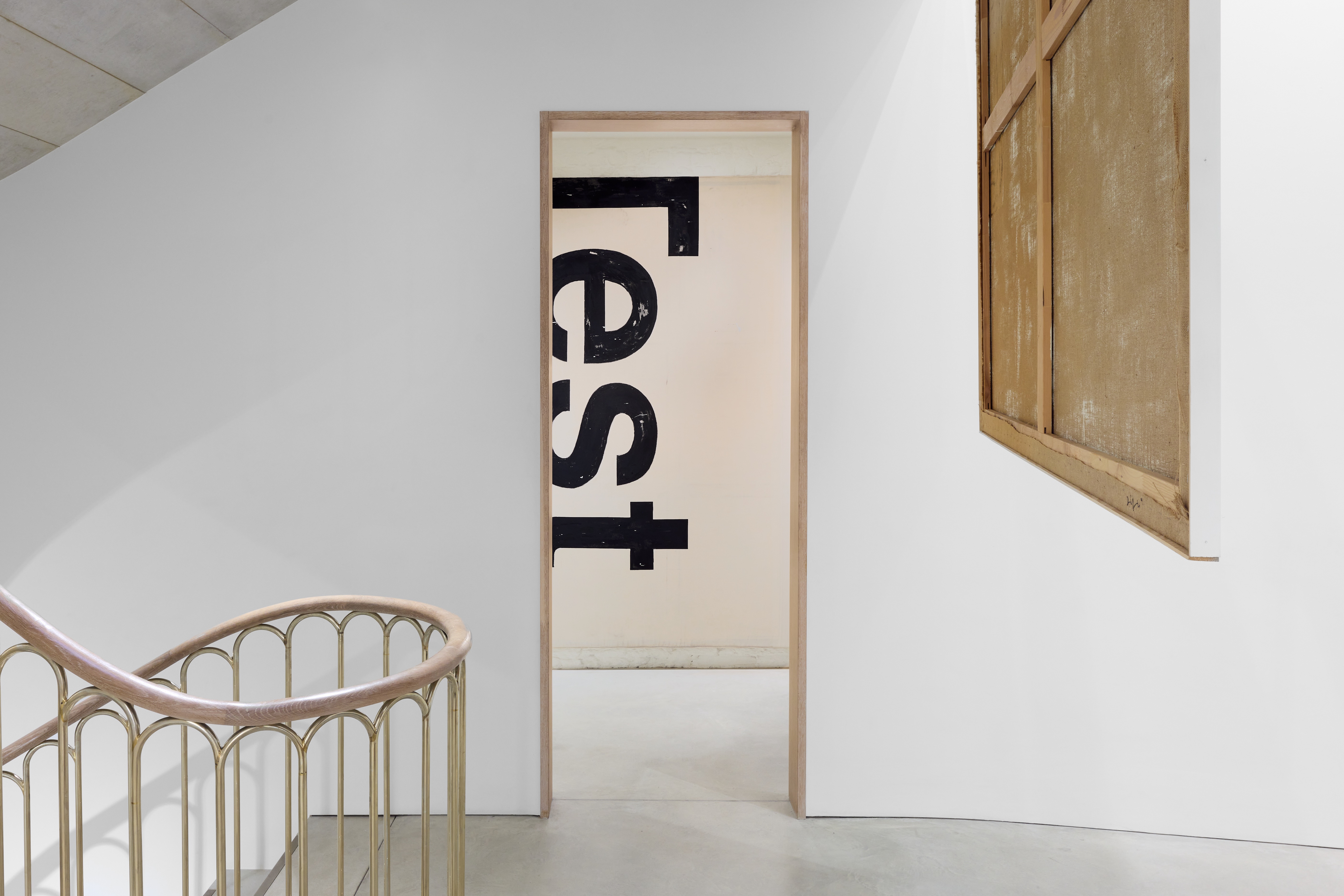
On show at The Perimeter in London, Test marks the first exhibition in which Ostrowski brings together different bodies of work and exhibits them side by side, having made many of the paintings between 2024-25 specially for the show. The exhibition includes his now-infamous F-series, commonly interpreted as standing for ‘failure’ or Fehlermalerei, meaning ‘error painting’; his Parliament Paintings, in which the leitmotif of asignifying, gormless and acerbic-looking owls undoes his broader minimalist purism; and new Letters paintings, which include elements of graphic typography. There are 18 works in total, spread across an elegant three-storey mews building in Bloomsbury. Founded in 2018 by Alex Petalas, a Swiss-Greek collector born the same year as Ostrowski (1981), The Perimeter is an expansive and marvellous exhibition space replete with nickel-silver balustrades, cast-concrete floors and spiraled cantilever stairs, albeit coddled by the need to remove your shoes on entry.
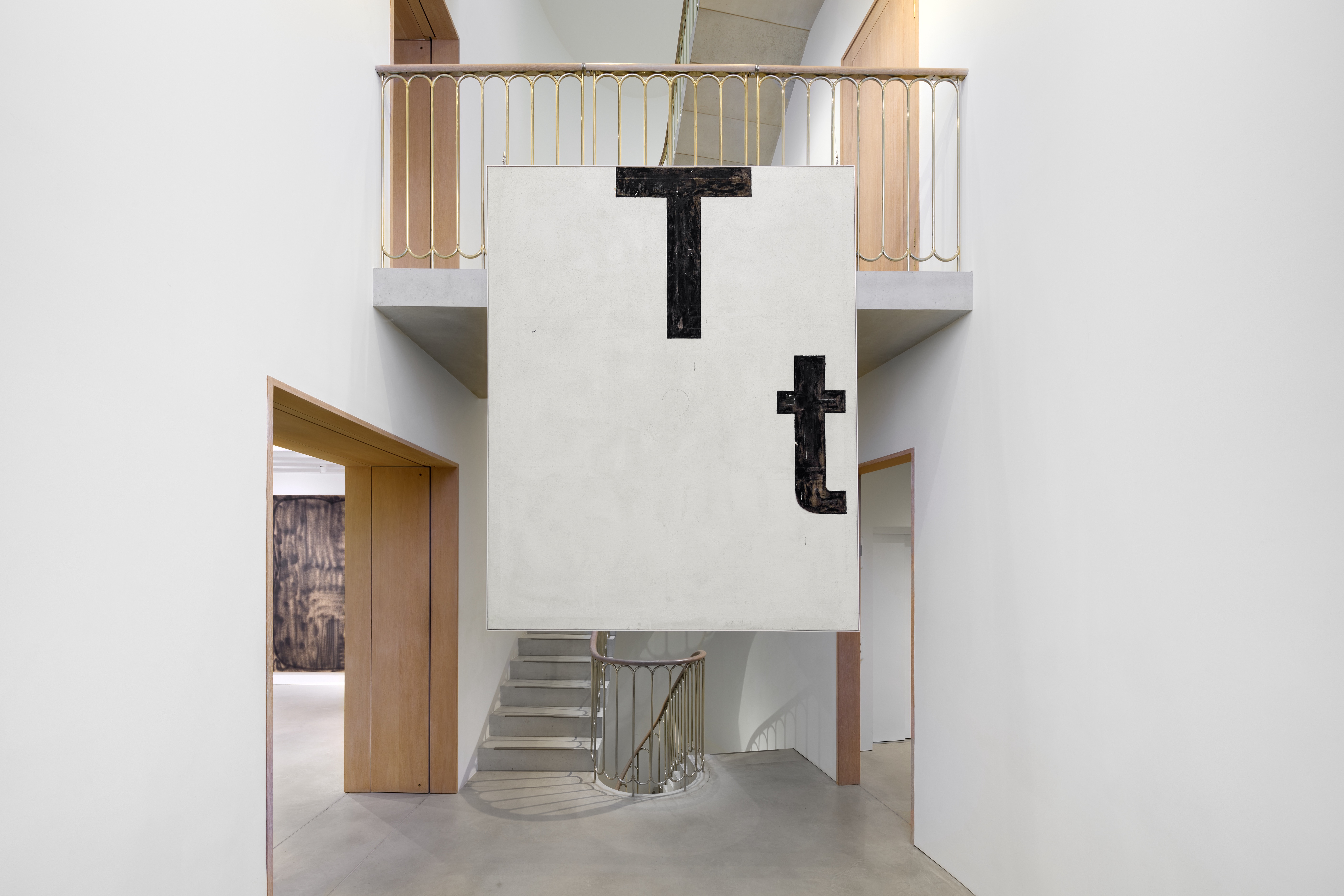
Shoes dispensed with, one is first greeted by a large portrait canvas floating effortlessly above head height, hung on wires from a two-storey entrance hall. The painting, Untitled (Letters) (2024), tells us all we need to know, and in fact already know, about Ostrowski’s practice and the show to come: a broadly vacant canvas etched by accidental gestures (a paint drop here, a ring mark there, a piece of packing tape likely somewhere) and – in this case, somewhat novel – two areas of thin black acrylic in the form of a capital and lowercase ‘t’. In its stuttered, Guyton-esque style, the painting assumes the character of a magnified print proof – a ‘test’, if you will – that becomes a welcoming hero image for the show’s unapologetically sober, minimalist and graphic sensibility – and as such, one that is tastefully urban too.
Courtesy the artist and Sprüth Magers. Photography by Stephen James
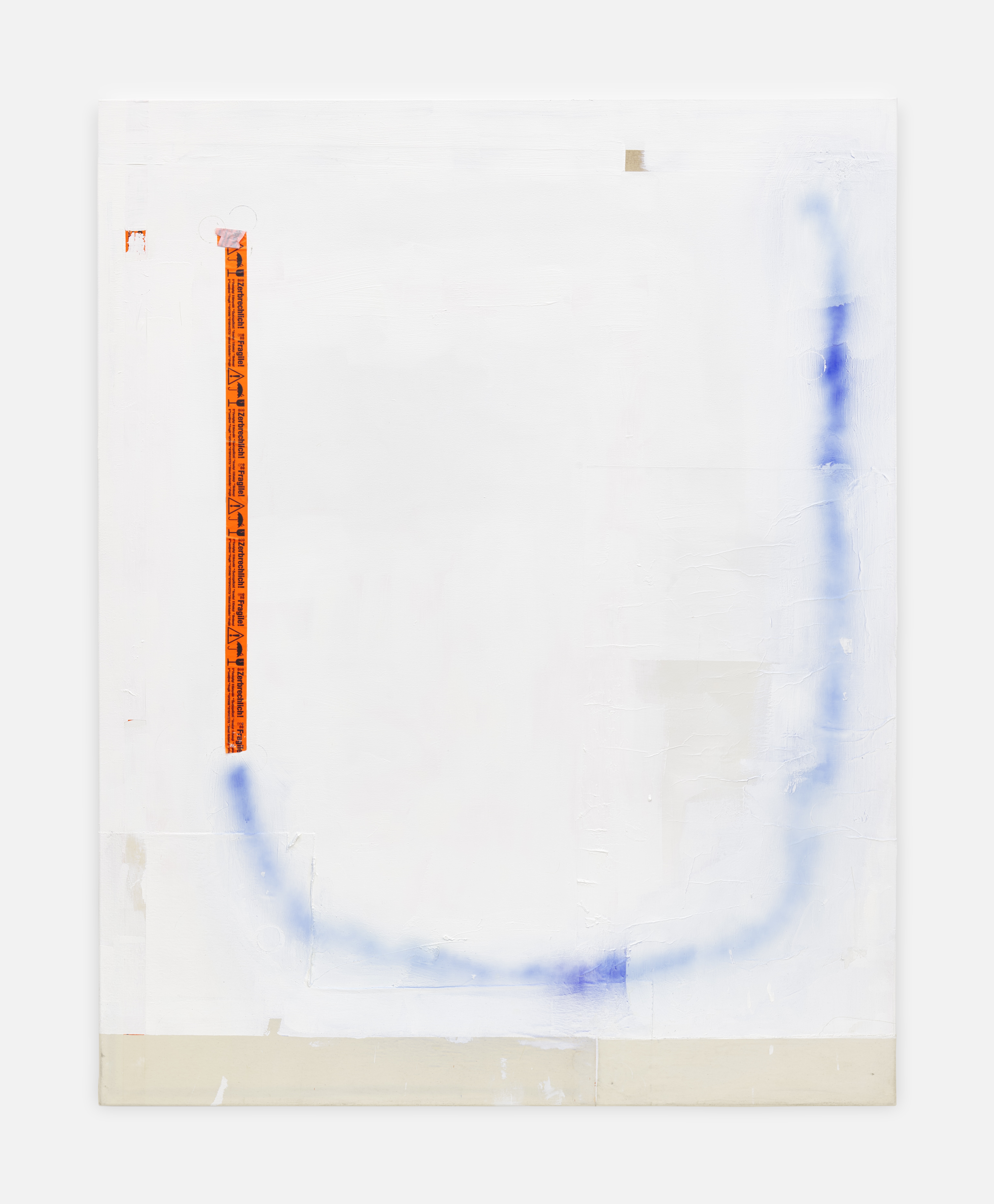
What follows is variations on theme, showcasing Ostrowski’s signature for works that delicately – if at times frustratingly – interrogate the line between visibility and erasure, rebellion and asceticism, refrained tastemaking and farcical lampoon. The largely monochrome works feature light-use of acrylic and coloured spray paint – applied in crude streaks and fuzzy passages – coupled with an assortment of applied detritus from his ex-car park studio in Cologne: scraps of canvas or neon-orange shipping tape struck roughly across the surface. At times, his work appears as nothing more than scribbles of urban graffiti (see the barren state of F (Chuzpe) (2016) or F (Windows of opportunity) (2025), for example). Whilst at others their methodical use of coincidence and error leads to tentative, sparsely constructed compositions suffused with internal tension and balance, enveloped by subtle notes of freedom, failure, melancholy and crisis (see the fleeting, ruinous assemblages of his 2025 Letters paintings).
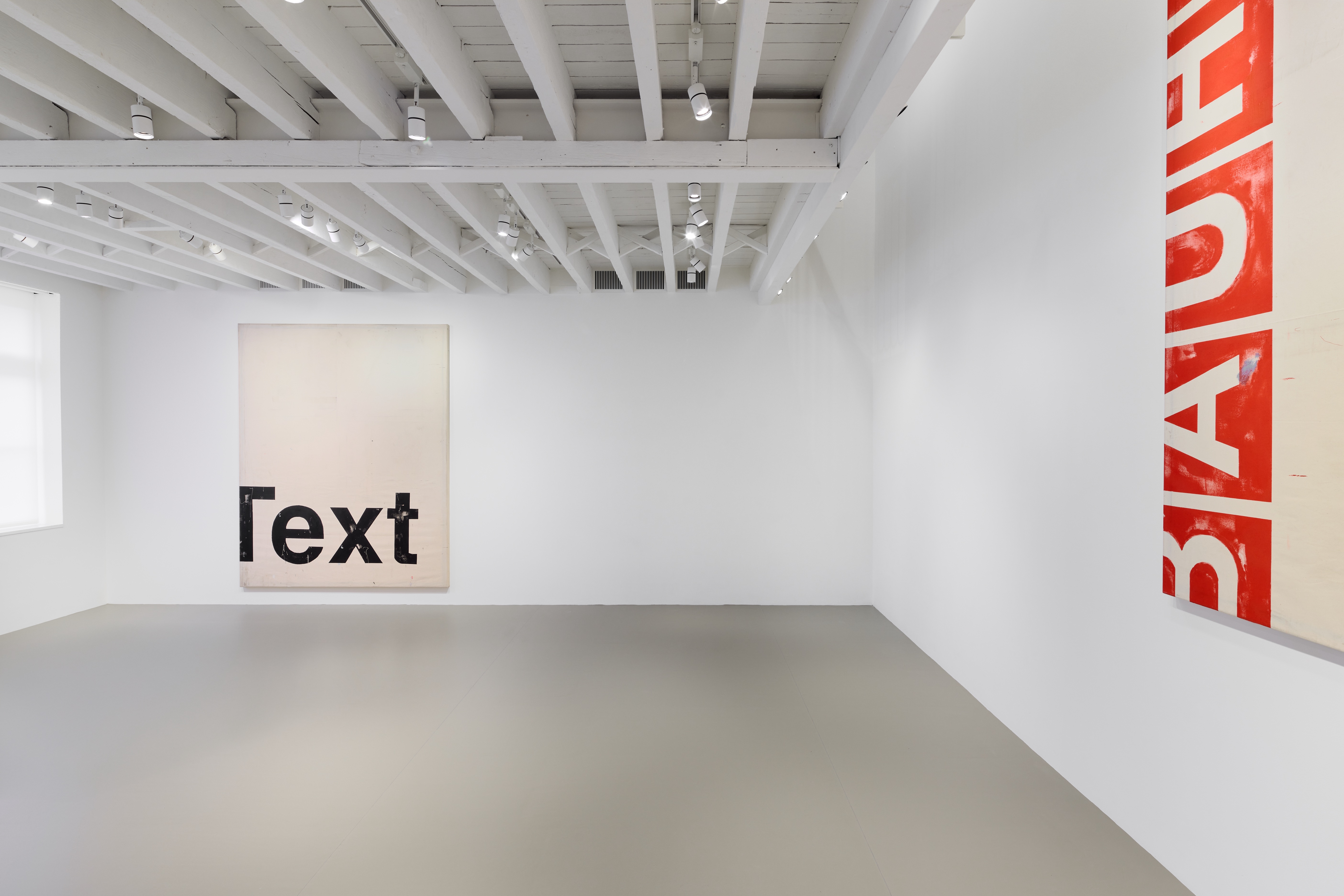
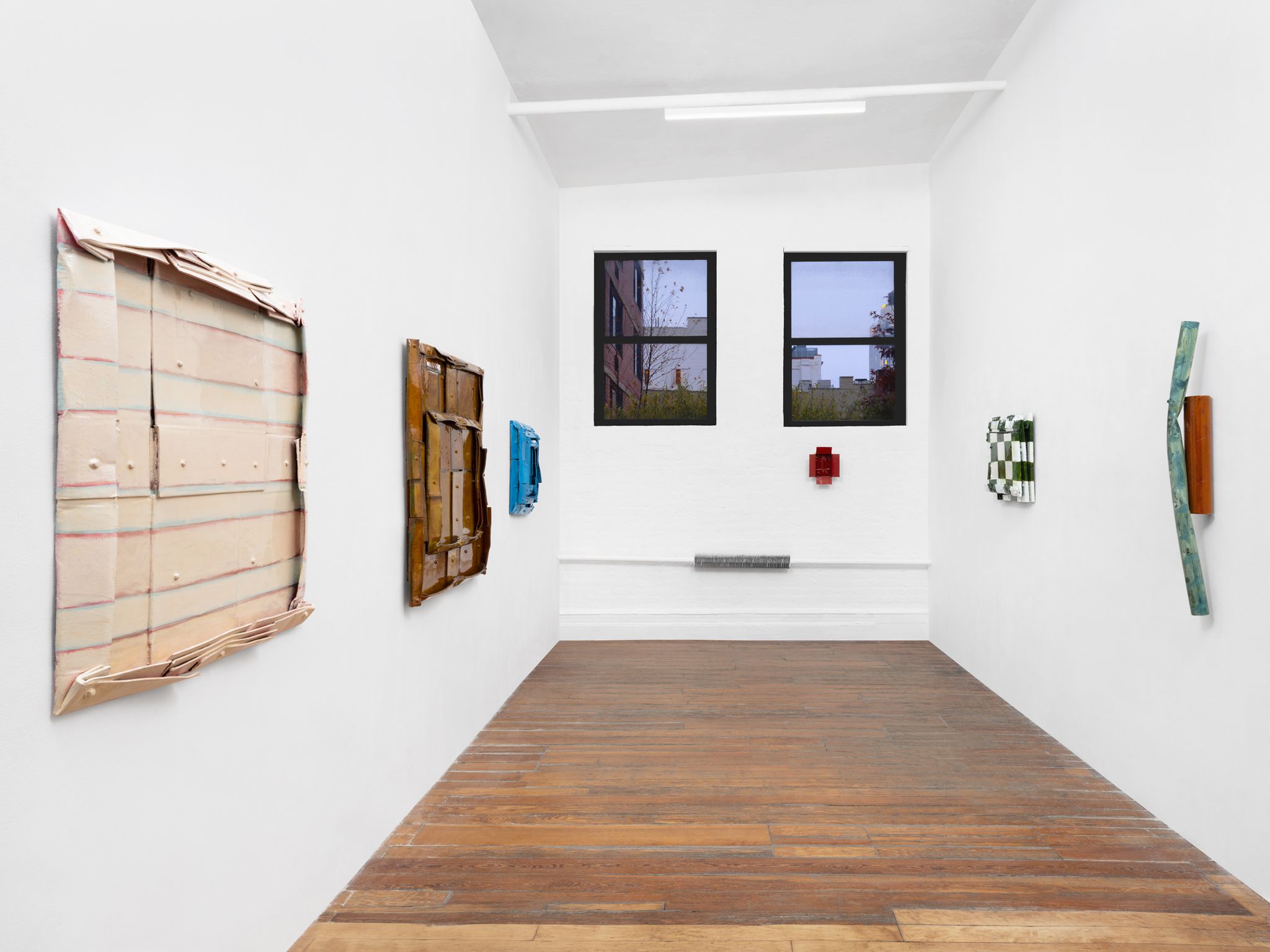
Throughout the show there are further interventions – a painting raised on the wall to be partly obscured by a girder; works hung off-set from the wall on wires; and coloured linoleum, yellow and grey, installed onto the floor of several rooms – all in the effort to expand his painterly language into the architecture of the gallery space. Ultimately these feel like safe, domesticated gestures when compared with the outright refusal and negation inherent to Ostrowski’s paintings themselves: works which run riot, in the words of Sprüth Magers, ‘against the usual criteria for creating value in contemporary art – material value, painterly bravura, conceptual references, institutional critique, ties to intellectual discourse, or forced self-referentiality’, and in which he has adroitly carved a unique space in the contemporary canon of abstraction.
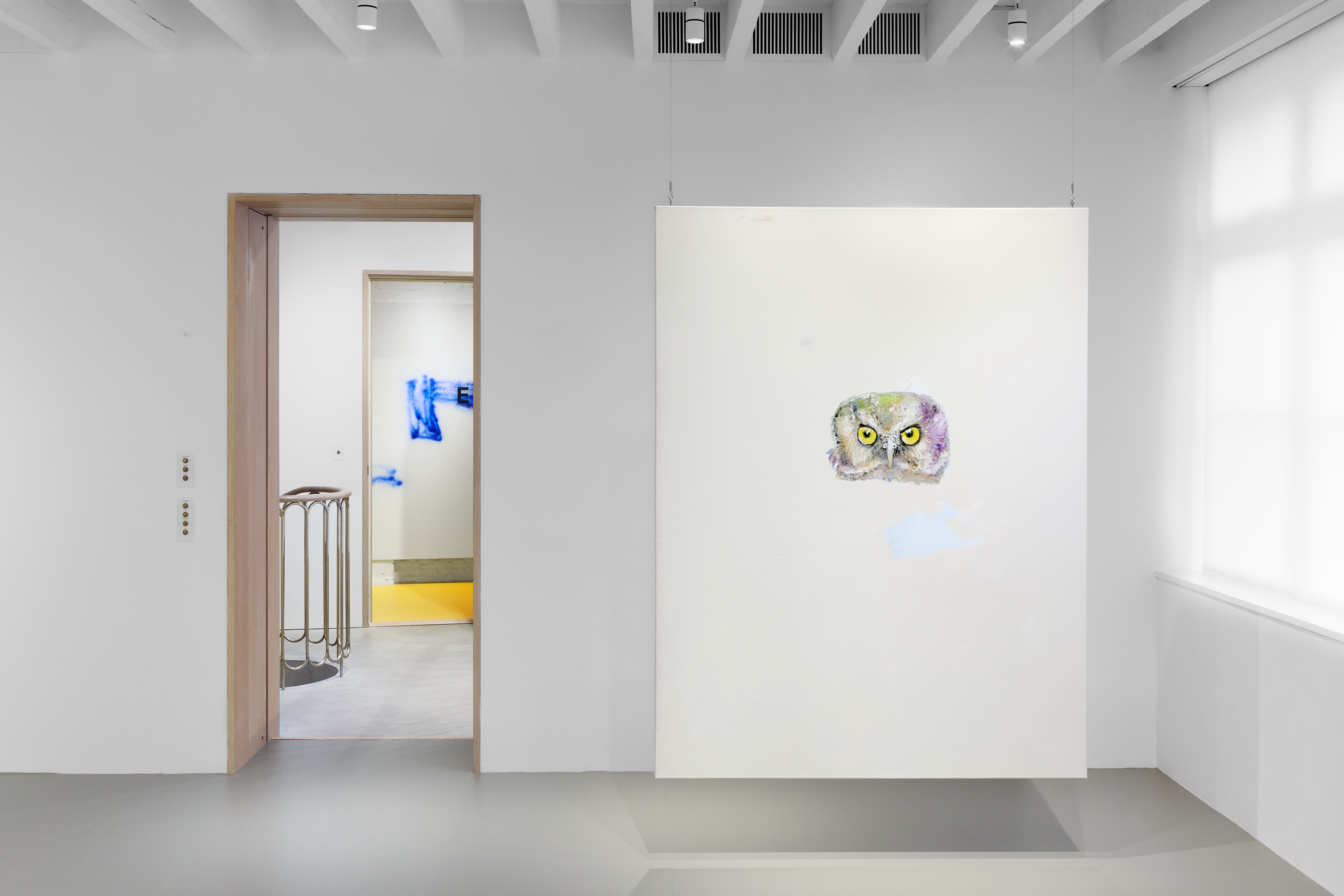
To this end, although the exhibition itself rarely felt testing, it is clear that the idea of a test-run flows consistently throughout – from Ostrowski’s fundamentally spontaneous, unthought and unmediated approach to painting, to the introduction of graphic ‘proof prints’, the combination of old and new styles, as well as the beautifully-produced accompanying catalogue, designed by the artist in collaboration with Christopher Tröster & Max Schropp of CTMS, which variously crops, remixes and repeats his paintings in a series of juxtaposed formal experiments. Taken together the exhibition moves beyond Ostrowski’s usual charges of fanatical negation and depthless nihilism – ‘these paintings are a waste of time to try to understand’ – and pokes at something new in his overarching practice. Something which combines speed, immediacy and impulse within a wider editing process, substituting zero point painting with fractional, indefinite expression.
—
David Ostrowski (*1981 in Cologne) lives and works in Cologne. From 2004–2009 he studied at the Düsseldorf Art Academy under Albert Oehlen. Ostrowski is a professor for painting at the Academy of Arts in Karlsruhe. Selected solo exhibitions include Aranya Art Center, Beidaihe (2025), Sprüth Magers, New York (2024), Fig., Tokyo and Ramiken, New York (both 2023), Sprüth Magers, Berlin (2021), Lady Helen, London (2020 with Angharad Williams) Avant-Garde Institute, Warsaw (2020 with Tobias Spichtig), Jir Sandel, Copenhagen and Leeahn Gallery, Seoul (both 2020), Sundogs, Paris and Piece Unique, Cologne (both 2019), Sprüth Magers, London and Wschód, Warsaw (both 2018); Halle 9 Kirowwerk, Leipzig and Blueproject Foundation, Barcelona (both 2017), Leopold Hoesch Museum, Düren (2016 with Michail Pirgelis), Arken Museum of Modern Art, Copenhagen and Kunstraum Innsbruck (both 2015), Rubell Family Collection, Miami andFondazione Sandretto Re Rebaudengo, Turin (both 2014). Selected group exhibitions include Standard Oslo and Weiss Falk at XYZcollective, Tokyo (both 2023), Akademie der Künste, Berlin and Fuhrwerkswaage, Cologne (both 2021), Triest, New York, Melange, Cologne and Pio Pico, Los Angeles (all 2020), Galerie Bernhard, Zurich, DuMont Kunsthalle, Cologne, and Braunsfelder, Cologne (both 2019), Aishti Foundation, Beirut (2018), Museum of Modern Art, Gunma (2017), Fondazione Carriero, Milan (2016), M Woods Museum, Beijing (2015), Halle für Kunst & Medien, Graz and Institute of Contemporary Arts, London (both 2014). His work are held in public collections internationally, including the Moderna Museet, Stockholm, Aishti Collection, Beirut; Arken Museum of Modern Art, Copenhagen; Colección Jumex, Mexico City; Fondazione Sandretto Re Rebaudengo, Torino; Los Angeles County Museum of Art, Los Angeles; Louis Vuitton Collection, Paris, among others.
Charlie Mills is a curator and writer based in London. He works as Senior Curator of Visual Arts at Bold Tendencies and Artist Liaison at Hannah Barry Gallery. In 2019 he co-founded Collective Ending HQ, a gallery and studios complex in South London. He is a regular MFA Visiting Tutor at Goldsmiths College.