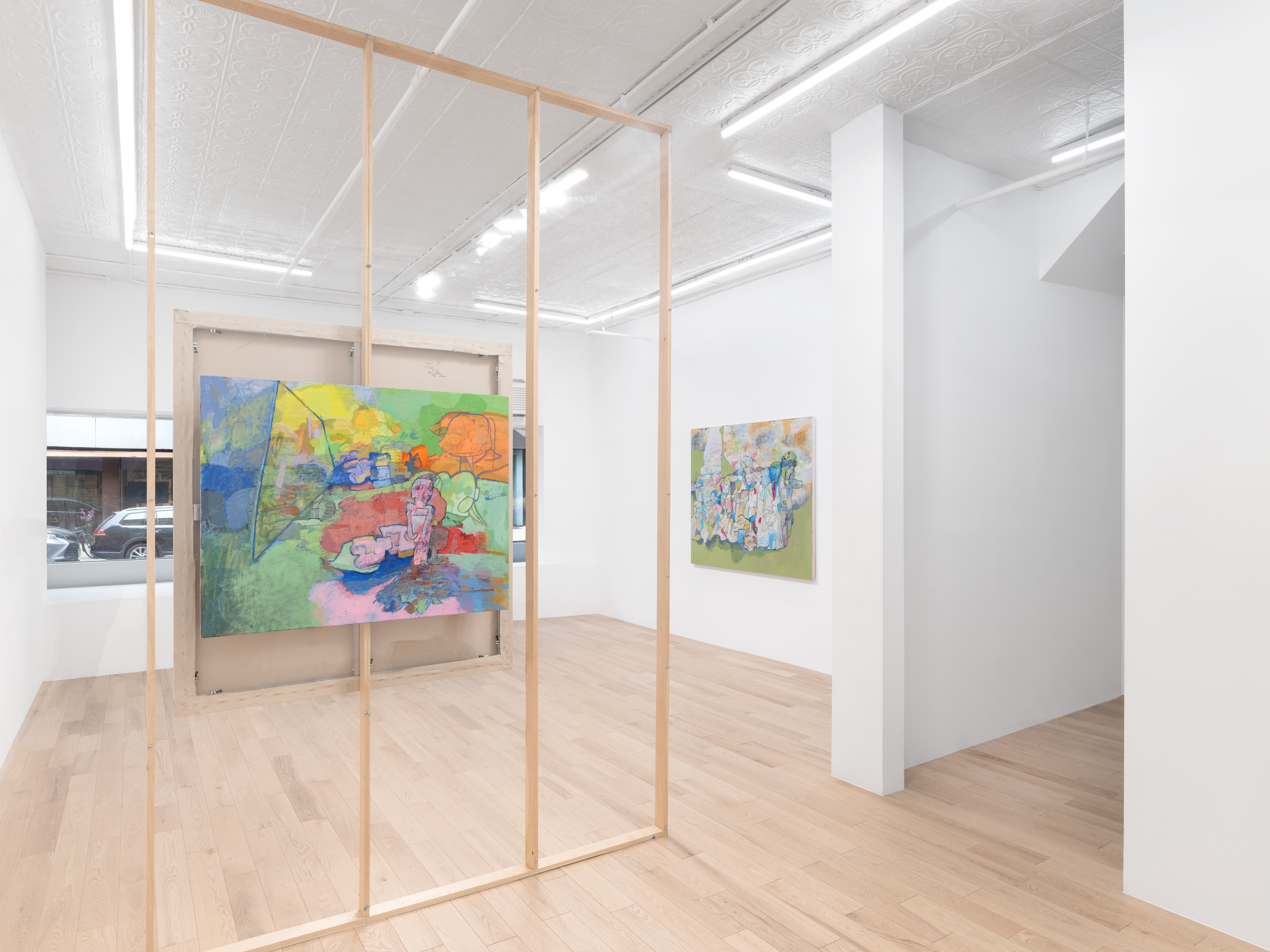
The East Los Angeles-based artist Julia Yerger’s new paintings at PAGE (NYC) and Dracula’s Revenge owe little to the screen these days, though she does make use of a computer for occasional sketches. As a teenager, and before studying painting at MlCA (Maryland Institute College of Art) she produced Photoshop art that she exhibited on the internet, which might be of little interest now were it not for the mobility and plenitude in the current paintings that seem, in some distant but related way, to stem from it. The installation here features a transparent wall—a wooden frame and plexiglass—that allows views of two paintings simultaneously, one, the nearer, appearing almost superimposed on the other. It may also signal Julia Yerger’s interest in another past technology, the slide projector. This interest in mechanical mediation, rather than frontier computer tech is, I could imagine, informing her very particular form of hybrid image making in these recent paintings.
Time and place, beginning and end, are not fixed in the paintings here, much less are any meanings preserved, safe from flux. Appearing to be mid-animation, images comprising shapes, colors, recognizable objects, one next to or atop another, resist recognition one moment and reprise familiarity the next. Different scapes emerge: landscape, cityscape, perhaps tablescape, and all unsettle the viewer’s sense of perception, which shifts endlessly. One thing corresponds to another or is subsumed, fractured, tessellated, jigsawed—the compositional moves of collage (or Photoshop). Each painting narrates its own becoming.
Across any given surface the color is febrile, smooth or marked at different velocities; here sharp, there soft. Bright and abraded, cloudy and layered, many parts of each painting both interlope and bind each other. The narrative sparks cross-contamination between paintings, alerting the viewer to iterations and differences between compositions hanging across from each other, or, as mentioned, suspended in front of each other, and so partially overlapping.
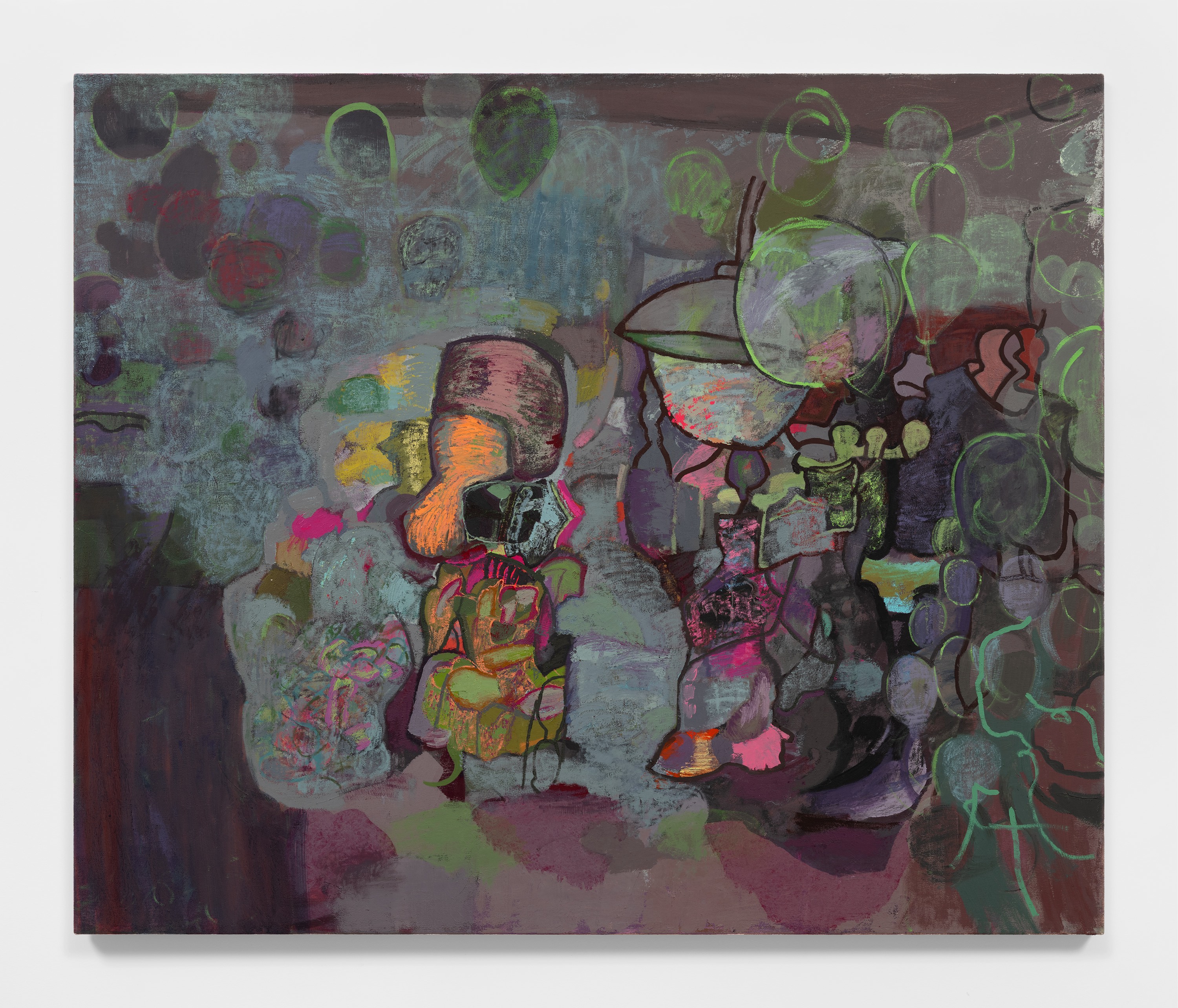
Starring Fizz implies arrayed lights, rising bubbles, motion, illumination. An event that may or may not be celebratory, but certainly is active, restless, unpredictable. So too are the paintings themselves, whose paradoxical momentum derives from their changeability. Take, Berlin Mural (2026), a 41 x 49 inches canvas. Deliberately at odds with itself, its methods are mixed: fragmentary figures, furniture, the corner of a room, outlines, profiles edge toward identification but don’t participate in it to the degree that anything can be comfortably grasped. The shapes within shapes jostle against each other; surface and space fluctuate and do not respect any real-world laws, like viewing through a dirty prismatic lens, the focus remains loose. Near and far, large and small are all negotiable, contradictory, as are time and sequence. Chaos and contingency are welcome guests, put to good use, prompting surprise and generating sliding-scale juxtapositions. Though indexing the accumulations on outside surfaces, scratched and graffitied over time and typical in parts of the city of the title, there is beauty and sensuality in the workmanlike rubbings and brushings of oil color. The repeated oval shapes and outlines float and are bubble- and cartoon-like; the numerous gray tones and flashes of acid yellow, pink, and orange add to a nocturnal feel: bar or street lights, dark corners, and shadows.
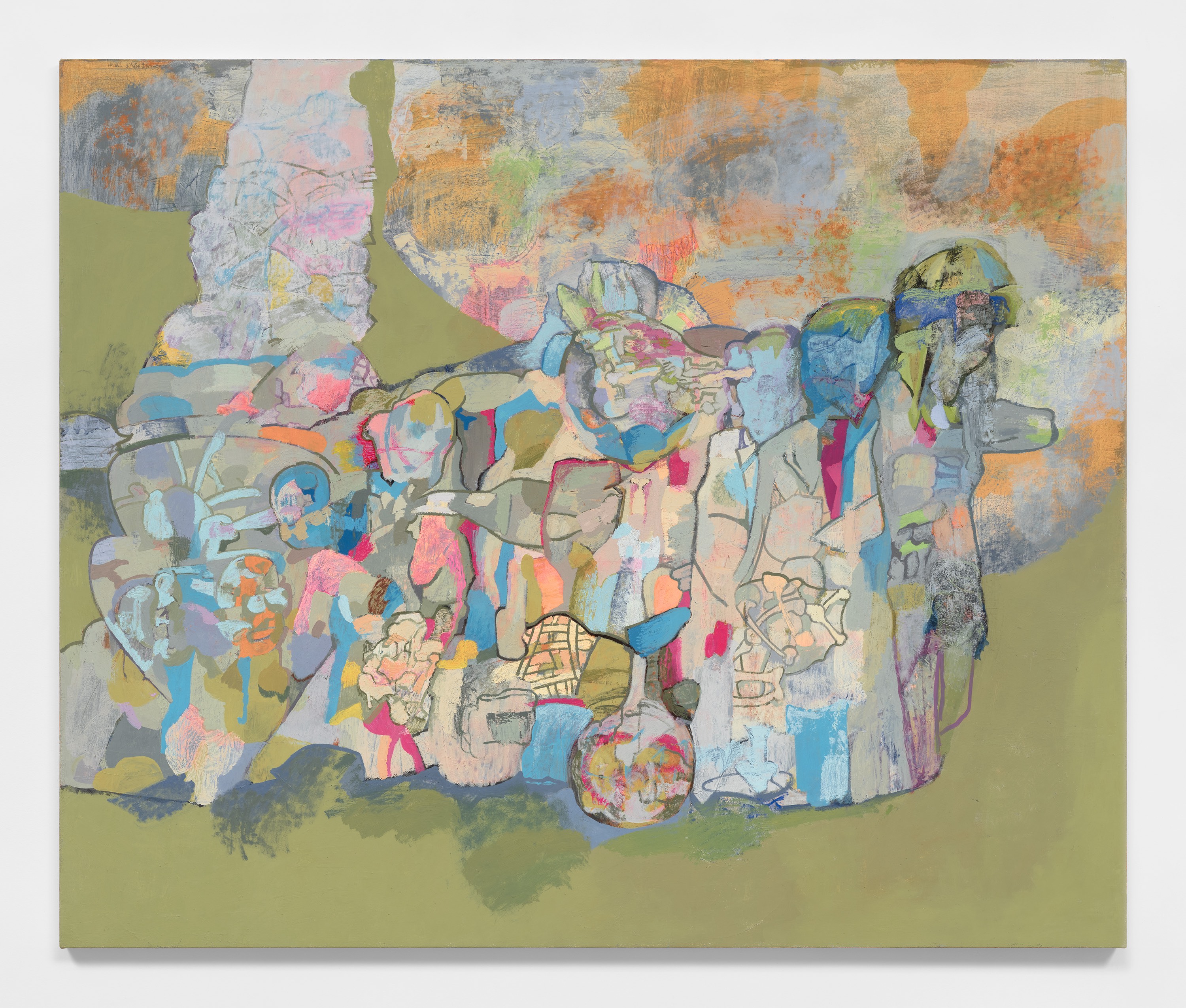
Cliff (2026) a horizontal painting, brings to mind some of the collaged works of Arturo Herrera, who also takes cartoon imagery into the tradition of painting. As happens not infrequently in viewing Yerger’s paintings, what appears clear momentarily soon exerts uncertainty. Momentarily, I was certain of a procession of figures moving left to right across the painting, but quickly faces, heads, arms—which reassert themselves from time to time—reconfigure into fragments, containing further details, and corrections that compose themselves, arationally, with unknown purpose. A clear shadow of gray follows under a bustling collection of graphic and atmospheric painterly notation, only to emphasize its arbitrariness as a visual sign: nothing is solid here and everything melts or melds with or into something else. The pale orange, grass green, and creams of the top third of the painting occupy a background shape that reads as an unlikely sky behind what I saw as figures, under which is a gray-green zone that reads possibly as lawn. It is a landscape only as the viewer’s mind is triggered by impossible but irresistible signs.
Yerger’s aggregates of pure painting, graphic sign, and perplexing image retain subtlety and pleasure while sustaining the contingencies that reward repeated viewing.
—
Julia Yerger (b. 1993, Rockville, Maryland) lives and works in Los Angeles. Solo and two-person exhibitions include Chamberlin, Zurich (2026); Chateau Shatto, Los Angeles (2024); King’s Leap,New York (2024); and Clearing, Brussels (2023). Group exhibitions include Chateau Shatto, LosAngeles (2026); Matthew Brown, Los Angeles (2026); Societe, Berlin (2025); Matthew Brown,New York (2025); Shore Gallery, Vienna (2025); Sebastian Gladstone, Los Angeles (2024);Bel Ami, Los Angeles (2023); and Paul Soto, Los Angeles (2023). Yerger received a BFA fromMaryland Institute College of Art in 2015.