
In Sinthome, Laurie Smith’s solo show at Wschód in Warsaw, the artist introduces a repertoire of close encounters that cut through the gloom of the night. Tenants, visitors, regulars, and voyeurs meet in the close installation as if they are ready to move as soon as they are unobserved, when we turn our backs to them. For an artist who has built his practice around the textures of queer nightlife, Smith has—with this new body of work—turned his attention to the night of the after-hours, the fluorescent hum of a bar at closing time, the awkward pause before someone decides whether to stay or to leave.
Smith’s first solo exhibition this year marks his Polish debut. In 2025, his gallery shows in London and Cologne introduced us to his practice of interpreting city imagery through the lens of queer desire, tenderness, and night-life community networks. It comes as no surprise that his repertoire is expanding. As he explores further into the aesthetics of his interest—namely the ephemera of metropolitan placemaking and sustaining its memory—the night fluctuates in his works, sometimes luminous, sometimes thick as tar.
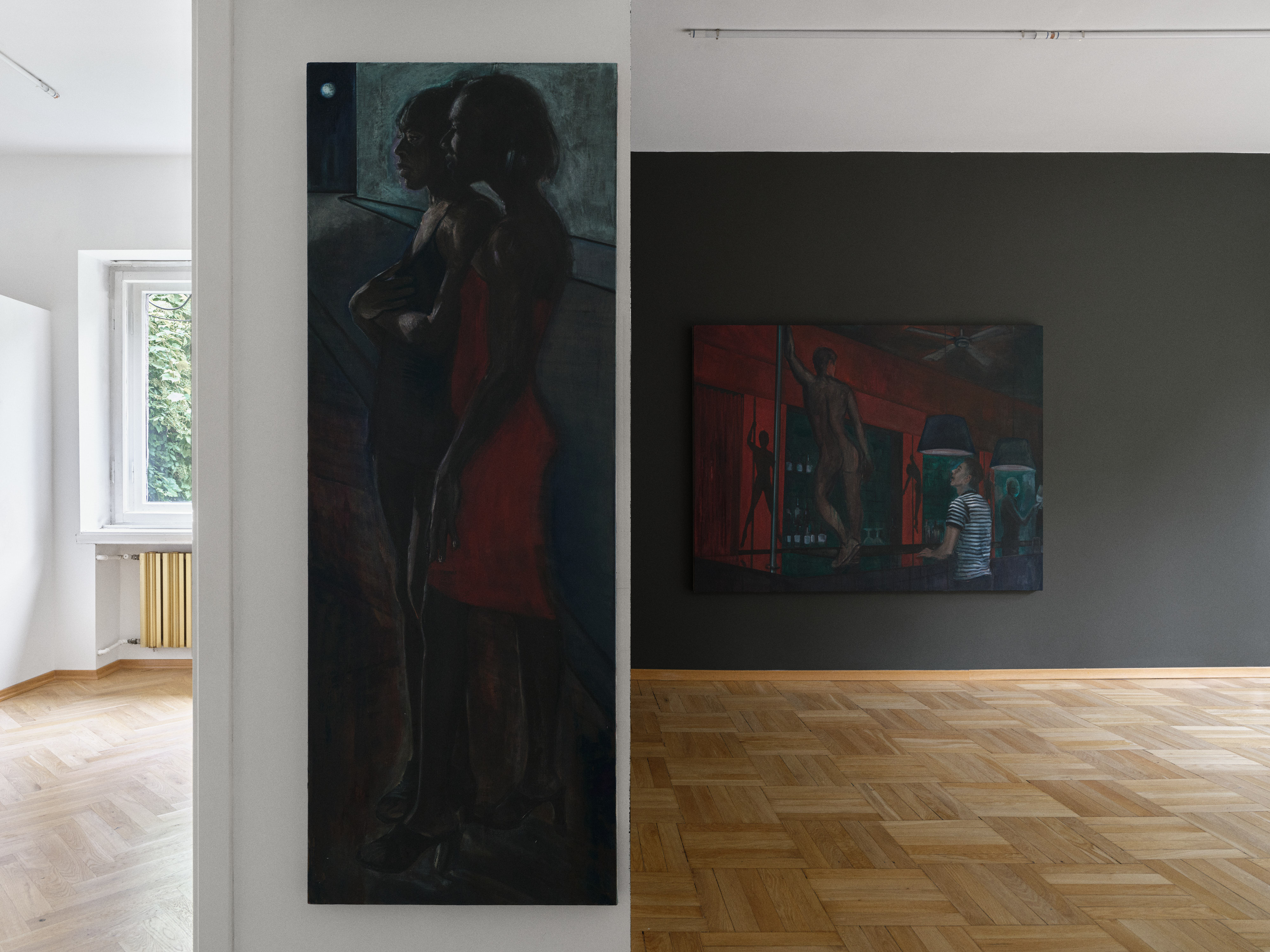
The exhibition comprises four canvases, each occupying its own wall, set against two newly darkened walls. Yet collectively they read as a single nocturnal narrative. The show opens with the painting Fairy tales, a narrow vertical painting that depicts a street scene under muted light. Two figures stand at ease, one in a vivid red spaghetti-strap dress that seems to pulse against the cold surrounding. Although fashion cannot designate a distinct time and space for this work, there is a clear hint of the late 1980s or early 90s. Yet, it could just as easily be the theme for a specific night in contemporary London. Their posture is casual, almost defiant, as if they have claimed this patch of pavement as their own. Both the proportions of this painting and its placement within the space—visible almost immediately upon entry—announces a commitment to encounter, perhaps even to participation. As if we’re embodying a passerby who has stumbled into someone else’s story.
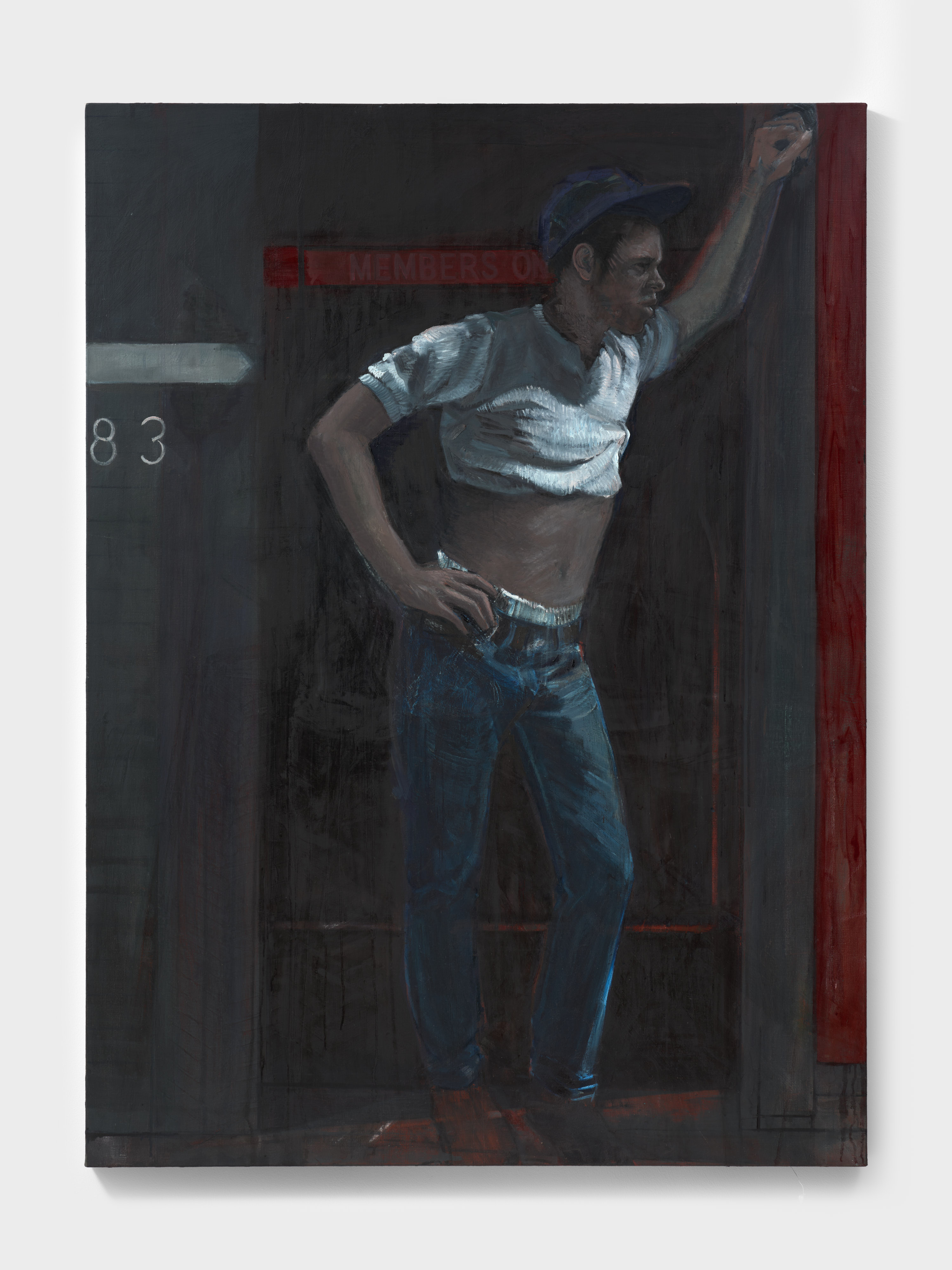
Across the room, on a perpendicular wall, All these lost boys offers a different texture. Here Smith’s brushwork sharpens into something almost ornamental: the body and garments are rendered with a precision. The painting shares its DNA with the artist’s earlier work, but there is a new attention to surface. It contrasts with the raw linen left exposed across sections of the large horizontal bar scene placed next to it, Dirty futures.
The largest canvas, My body a map of the city, operates on a register entirely distinct from the scenes that surround it. Steeped in muted greys, almost stripped out of colour, it presents a flat, board-like view of a pavement and a block of flats. The perspective is static, almost surveillance-footage, as if the scene has been flattened into a single unblinking frame. The two close-cuddled figures from Fairy tales appear again, anchoring the composition, but here they function less as individuals than as part of a larger whole. The repetition invites comparison, and asks us to consider what changes when a figure is lifted from one context and placed in another. Does a mere change of scale mess up our vision? Or do the figures themselves begin to direct our attention, steering the conversation towards image-making and representation, as though they were asserting a reflective agency of their own?

The presented scene compromises a few silhouettes of different intensity. The ones that made me linger longer in front of the canvas were, in fact, very sketchy, stick-like outlines, as if painted in chalk on the wall. I couldn’t help feeling that they were meant to be effortless, but that they seemed somewhat contrived. A rupture in the otherwise stable surface that forces me to question: what am I meant to examine, and why? It makes me reconsider whether being noticed allows one to claim control over the creation of one’s own image.
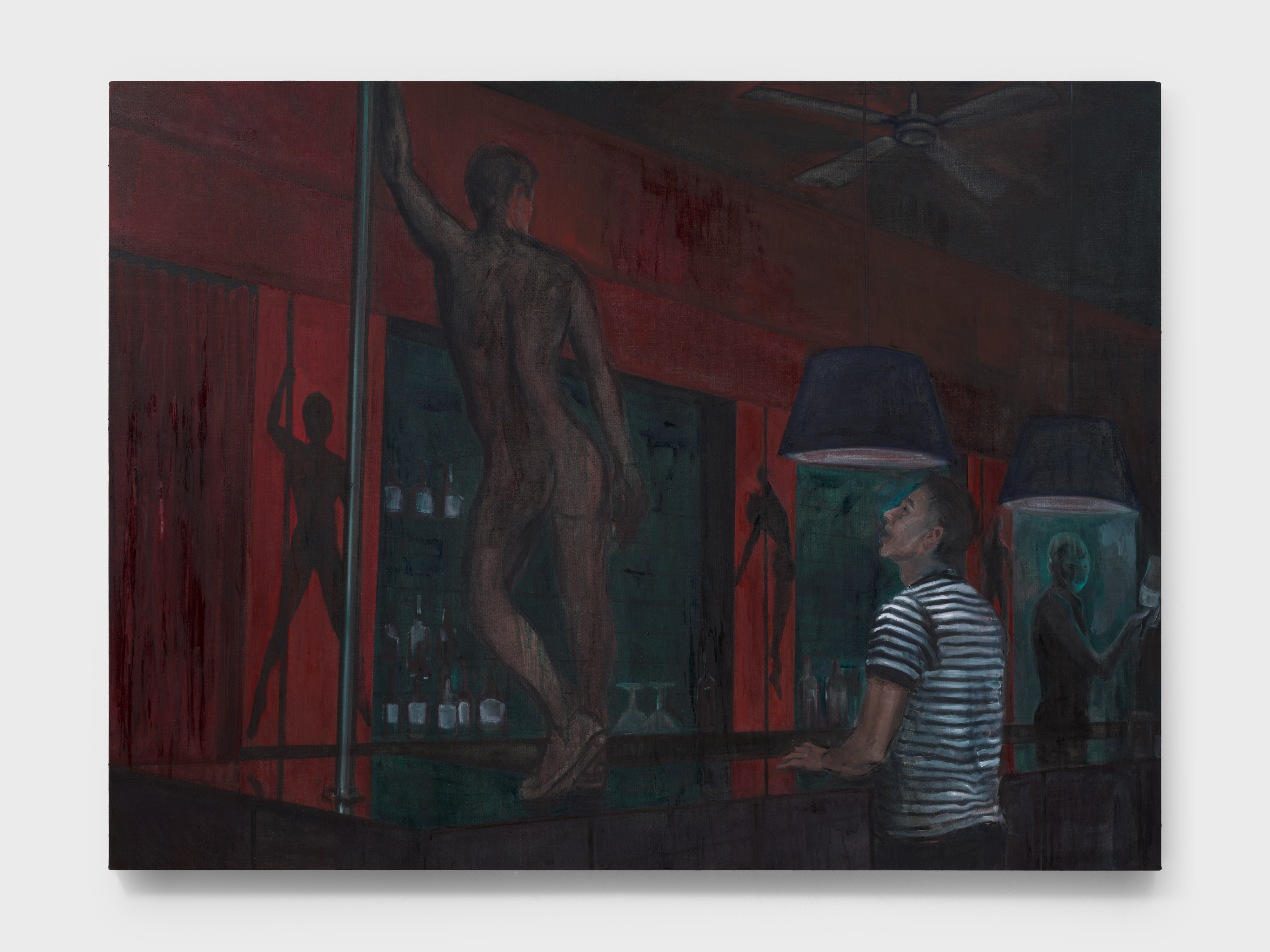
Across the room, Dirty futures offers a counterpoint in temperament. A horizontal scene bisected by the bar top, presents an encounter happening in a bar that is fading away, as dull as a slow-turning ceiling fan. Standing atop the bar, back turned, is the most prominent and yet the most simplified figure: a naked man gripping a dance pole. His body is reduced to an almost schematic outline, as if it was a leftover from the underpainting. Two additional figures fill out the scene. One, with his hands clamped on the bar top in a possessive grip, appears far too surprised to be a regular. Could it be the dim red highlighted windows, or the presence of a naked performer in close proximity to the rich liquor section? The spectacle has left him jaw-dropped. And I was left with being pulled back and forth to an afterimage of his slack, open mouth. There is nothing performative about that face, nothing ambiguous. Instead, there was genuine, almost embarrassingly human astonishment.
—
Laurie Smith (b. 1994) is a painter whose figurative works explore the complexities of contemporary queer life. Drawing from personal experience, art historical references, and the social landscapes of nightlife, his paintings navigate the intersections of memory, desire, intimacy, and community. Rendered in atmospheric palettes of deep blues and shadowed tones, Smith’s compositions capture fleeting moments and emotional encounters, positioning the personal as a site through which broader questions of identity, belonging, and queer history can be considered.
Jess Łukawska is a writer and curator based in Warsaw. A graduate of the Academy of Fine Arts in Warsaw, his work spans criticism, research, and curatorial practice.


