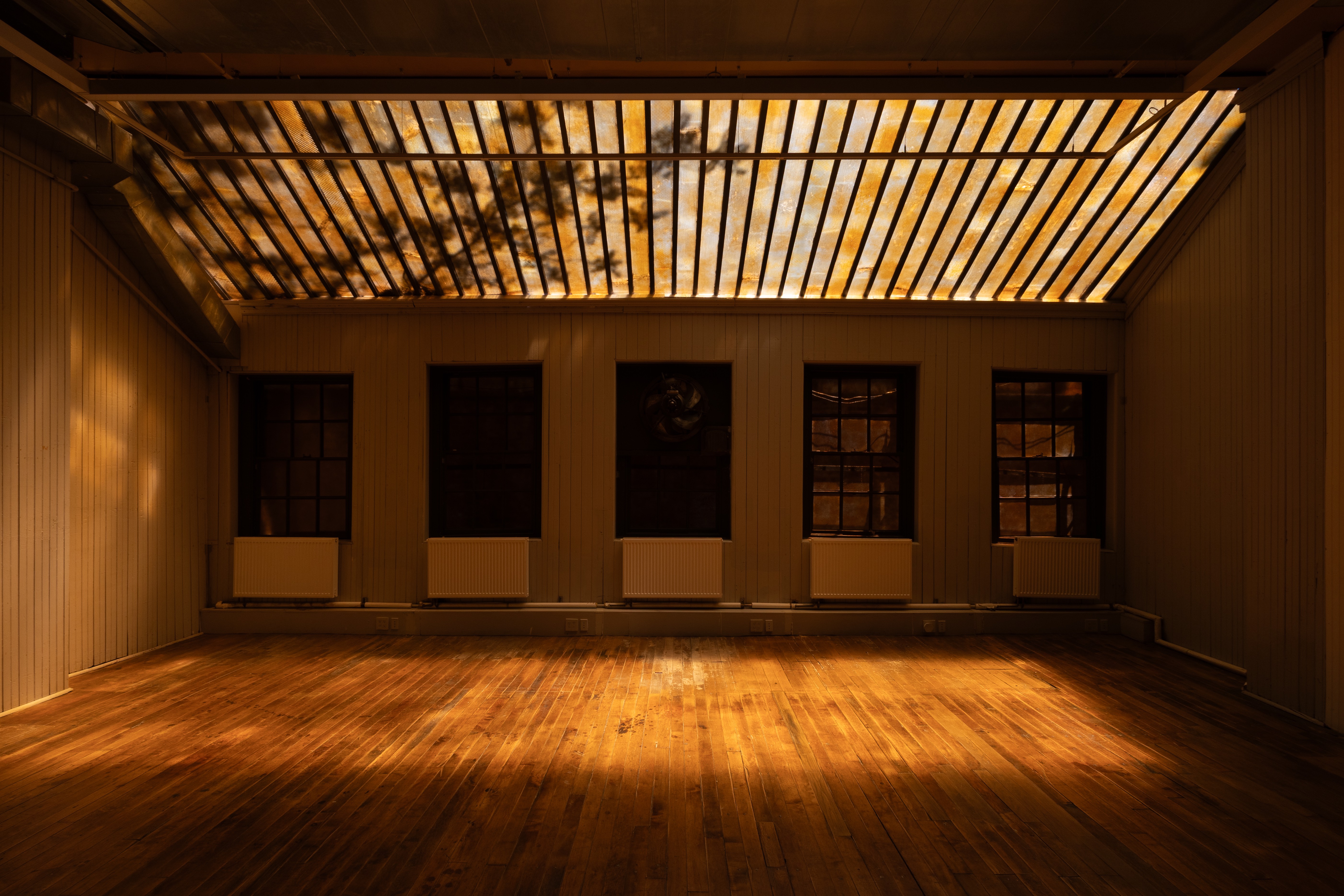
The starting point for Leyla Yenirce’s solo exhibition at Jeremy Scholar, Amplifier, is the artist Charlotte Salomon, whose life reads like a tragedy of epic proportions. Born into a familial social scene encompassing the likes of Albert Einstein and Erich Mendelsohn, Salomon was haunted by the hereditary trappings of mental illness, eventually poisoning her abusive grandfather before being murdered in Auschwitz. It is no surprise that Salomon’s story has been widely mythologised, but Yenirce is concerned more with her foundational work, the autobiographical Gesamtkunstwerk and proto-graphic novel Life? or Theatre? (1940-42). Spanning musical composition, self-portraiture, and hundreds of gouache paintings, Life? or Theatre? is the tale of a life narrated on its own terms. Salomon’s presence across the four large canvases that form Amplifier is literalised only once, yet it provides an overture of sonic presence: an ode to the power of the female voice.
This is the heart of Yenirce’s work. Though her paintings sit firmly in the realm of visual art, they are inextricable from the sonic. The artist, who also releases music under the moniker Rosaceae, treats her subjects like the components of a song: repeated as rhythm, enlarged or obscured like elements heightened or muted. In Amplifier, both paint and sound are channeled through the lives of women to become radically disruptive and anti-authoritarian. “I am concerned with the power of sound! and what it can do to the body and the mind,” the composer Pauline Oliveros wrote in 1973. “Sound is everybody’s material. Women’s music is inside women.”
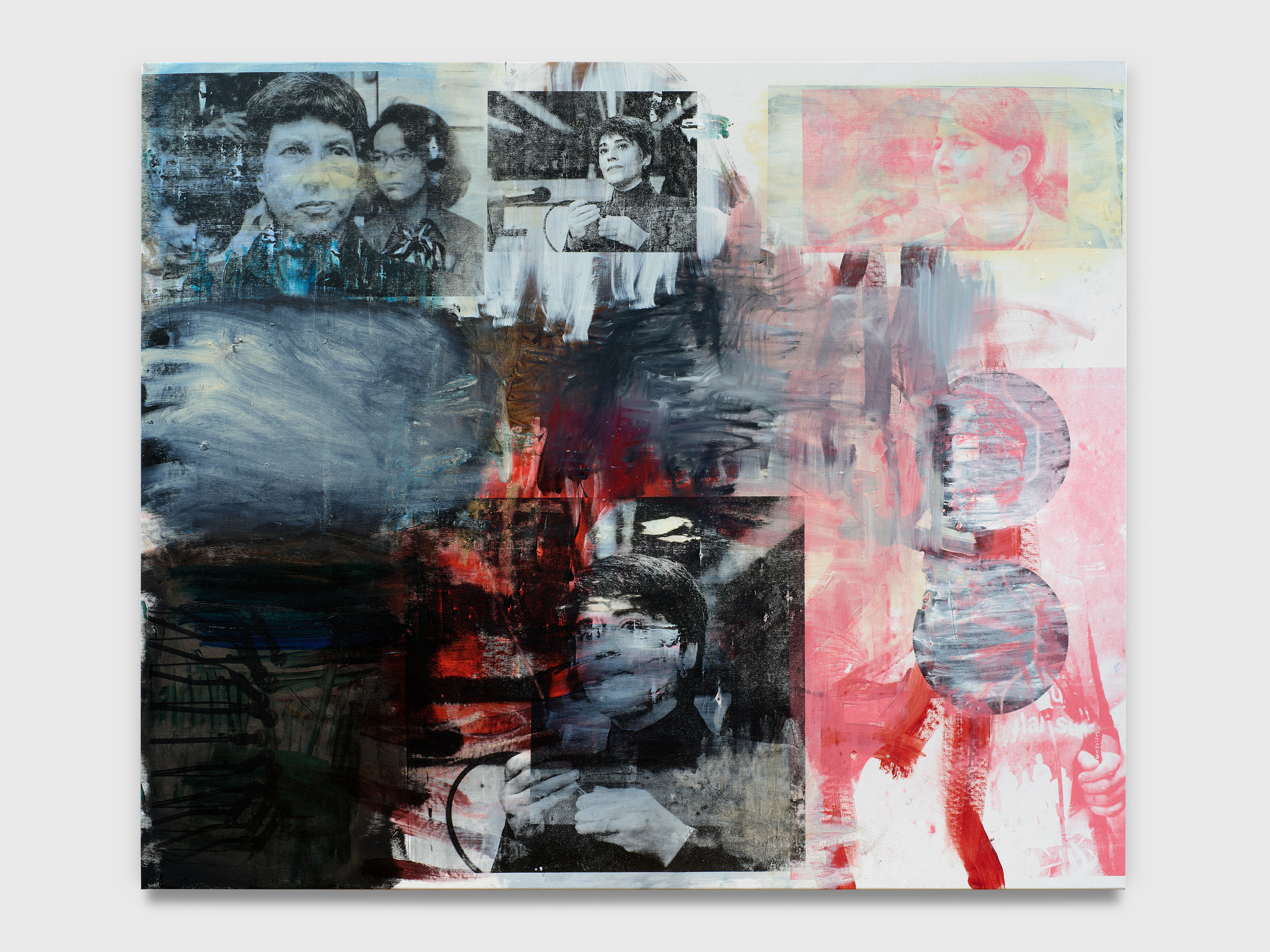
The show’s central works are a pair of paintings hung in close proximity on the largest wall of Jeremy Scholar’s intimate gallery space. In one, the ghostlike silkscreen portrait of Salomon is partially obscured by mossy green scribbles that cut across her eyes in a violent, visceral gesture. An inky concentration threatens to subsume the canvas’s open expanses–though confined to a semi-rectangular corner, its frantic brushstrokes capture a perpetual state of movement. One might imagine the paint vibrating–an effect heightened by the elemental diagram sitting dead centre on the canvas, bluntly staging the tension between order and the chaos that threatens to encroach.

In the second painting, a motif of microphones can be faintly discerned beneath a swathe of black paint. They point to an image of Leyla Zana, the activist and politician after whom the Kurdish-born Yenirce is named. As the first Kurdish woman elected to the Turkish parliament in 1991, Zana spoke a single sentence in her native language during her oath, at a time when it was illegal to speak Kurdish in public. Shortly thereafter, she was imprisoned–an attempt to censor her words, perhaps, but one which could not curtail her vocal support of Kurdish women’s rights. Zana’s portrait appears twice across this canvas–a decision which feels like an assertion of visibility, her identity and message reverberating across geographies and mediums.
Yenirce’s cast of revolutionary women are variously withheld and revealed by her painterly interventions, both anchoring and politicising the energy built up through the artist’s expressionist markmaking. Alongside Salomon and Zana are figures such as the Italian antifascist Natalia Ginzburg, the folk musician and activist Helin Bölek, the singer Aaliyah, and the Kurdish cultural advocate Hozan Mizgîn. Even Yenirce’s own German teacher, Christiane Haselier–from her upbringing in Oldenburg as the child of Yazidi refugees–makes an appearance, as a kind of parallel figure to the music teacher in Life? or Theatre?, teaching the protagonist/Salomon to express herself through song.
The uniting factor of these subjects is their refusal of silence, and therefore subservience. In The Gender of Sound, the poet and essayist Anne Carson invites us to reimagine what “women’s music” might sound like, untethered from its historical suppression. She writes: “Every sound we make is a bit of autobiography. It has a totally private interior yet its trajectory is public… The censorship of such projections is a task of patriarchal culture that divides humanity into two species: those who can censor themselves and those who cannot.” Yenirce’s paintings call to mind this rejection of censorship, through the women they foreground and the boldness (loudness) of their markmaking.
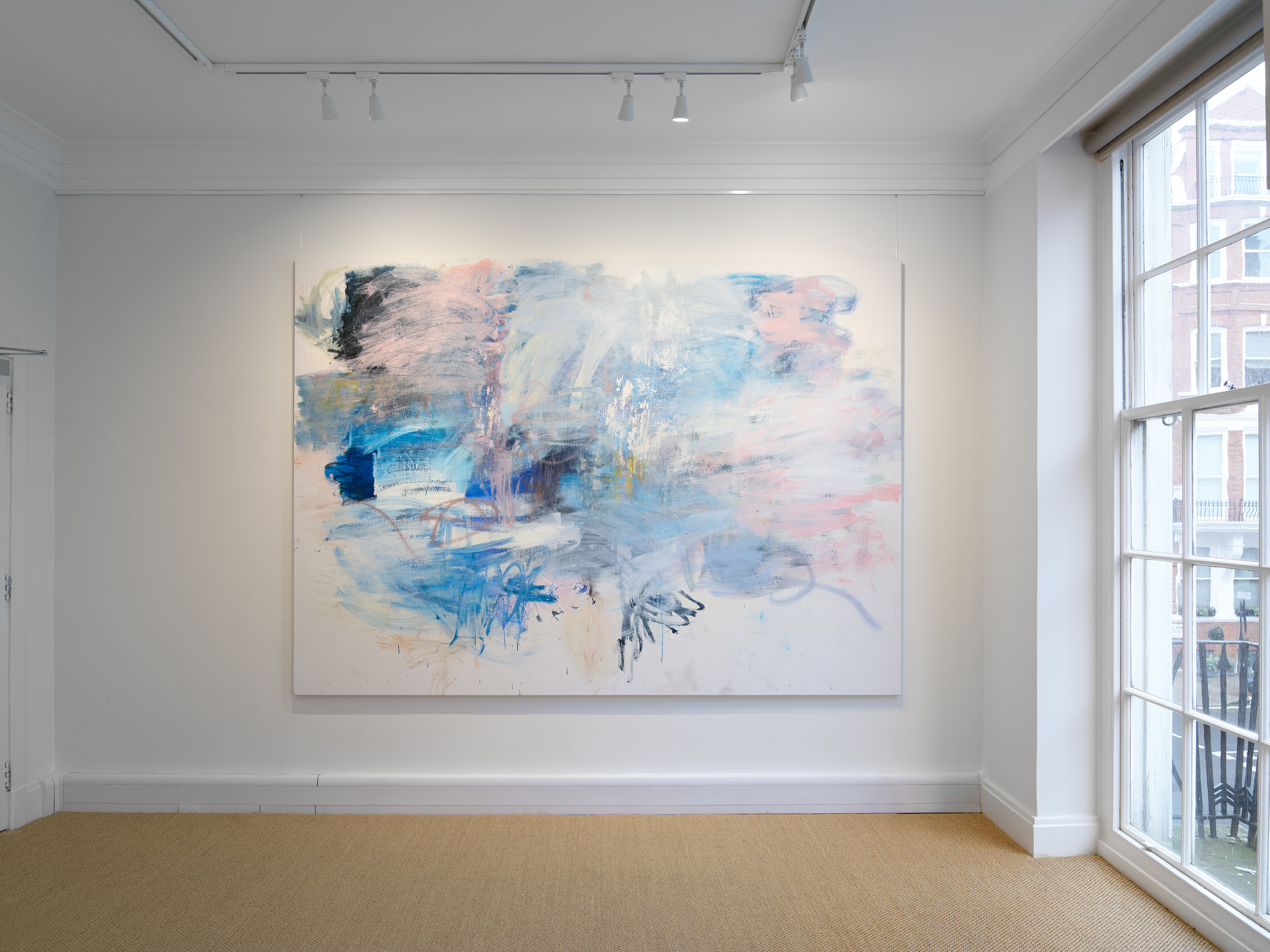
Notably, the largest work in Amplifier is a canvas devoid of photographic interventions. Instead, it is awash with a richly textural blanket of jewel-like blues and ballet pinks. It is in these expanses, which veer between a thin haze and the dense, dripping application of pure colour, that the influence of Yenirce’s own musicality is most pertinent. The artist’s background in noise music–a genre often characterised by its abrasiveness and discordancy–has previously manifested as sonic interventions alongside exhibitions. In this show, however, it is implied rather than explicit, observable in Yenirce’s energetic wielding of paint–a mastery borrowed from a lineage of artists like Joan Mitchell and Mary Abbott, themselves challenging the traditional machismo of Abstract Expressionism.
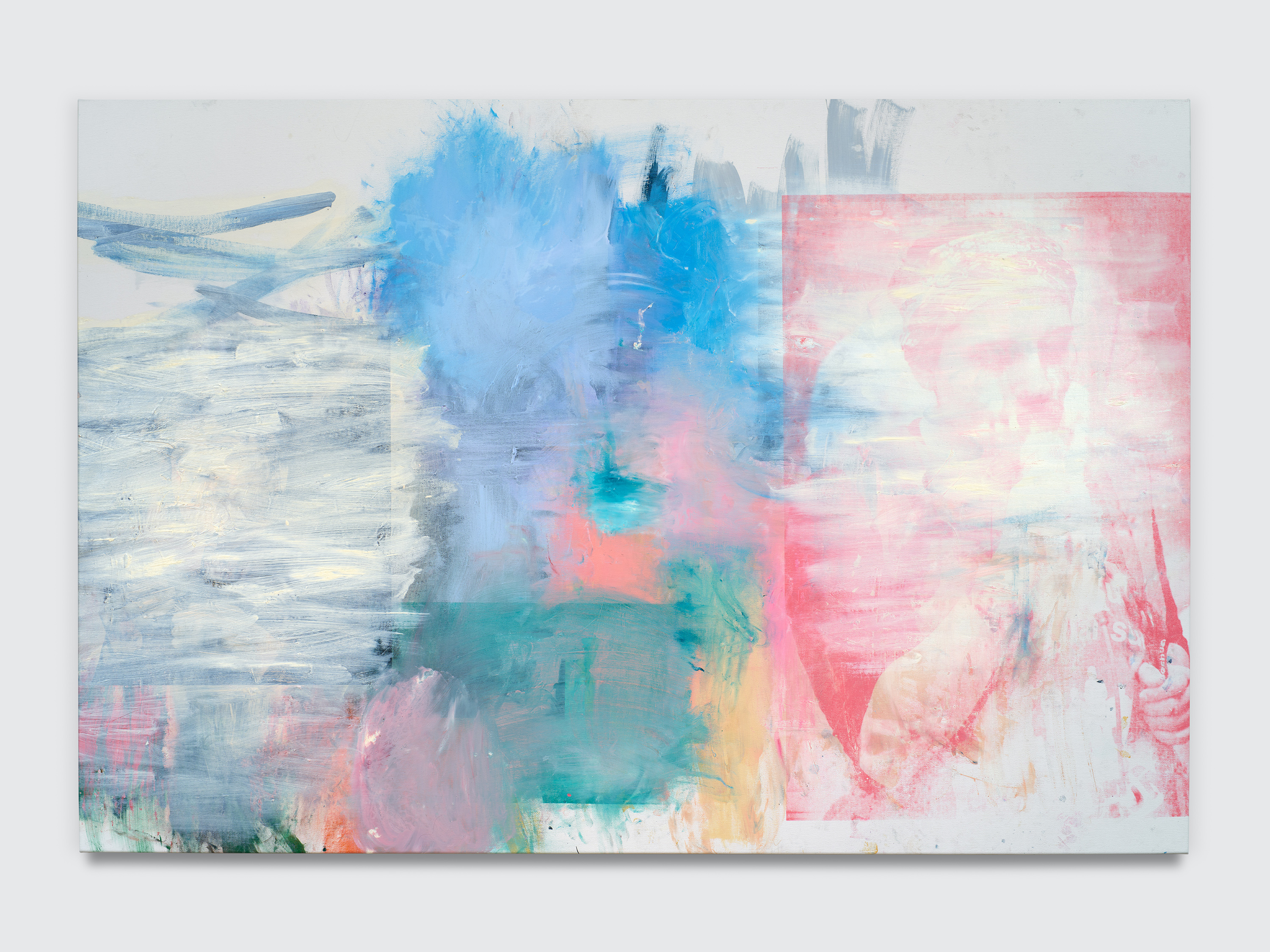
Insofar as Yenirce’s brushstrokes evoke a sense of movement and vitality, experiencing these works is akin to a haptic experience rather than a purely optical one: a kind of embodied vision in which we are reminded of the presence of the artist’s own body, as well as those embedded in the very surface of the canvas. As Claudia Barnett wrote in a 2003 essay on Salomon’s Life? Or Theatre?, “One cannot sit still and observe Salomon's paintings; one must read, listen to (or hum) music, and move from one painting to another.” The same could be said for Yenirce’s work, which dances between obscuring and revealing its subjects in perpetual movement, and in doing so speaks to a feminist audacity which spans generations, borders, and bodies.
—
Leyla Yenirce was born in Qubînê in 1992 and grew up in Oldenburg as the child of Yazidi refugees. She studied cultural anthropology and fine arts in Hamburg and Bryn Mawr (USA). Since then, she has been working across media on the figuration of feminist resistance. Today, the visual artist lives and works in Berlin.
Ella Slater is a writer and editor based in London, UK. Her words have appeared in Frieze, Flash Art, Family Style, Elephant, The Toe Rag and more. She also writes Beautiful Gowns, a Substack newsletter about art and style.