As you enter Marfa, Texas, a sign at the city limit reads “Population 1,788.” The town’s main north-south artery is Highland Street, and on it sits the Brite Building (1931), a roughly 4,000-square-foot former department store built in a Deco-cum-Western style.
Inside the Brite, and at two outdoor sites in Marfa, lies the second iteration of Christopher Wool’s See Stop Run. The first edition ran from March to July 2024, when Wool rented an entire, gutted-to-the-studs floor of a New York Financial District office building to showcase the last 15 years of his work.
In Marfa, the exhibition takes on a new life. With ample space afforded to the works, the addition of four large outdoor sculptures, and the backdrop of the Chihuahuan Desert, it brings into focus Wool’s ability to weave drawing, painting, printmaking, photography, bookmaking, and sculpture into a practice that meaningfully moves beyond his well-known word paintings.
When you walk into the exhibition space, three paintings silkscreened on canvas immediately capture your attention. They depict what seem to be giant abstractions of black paint–originally applied to another surface by hand, scanned or photographed, filtered, and printed on a white background–and register as a study of line, pressure, and weight from a painter best known for the stencil.
My first question to Wool, who guided me through the exhibition with his assistant, was whether these works had appeared in the New York show. They had, he said, but their power was cut off by the compression of low ceilings, windows overlooking lower Manhattan, and the distractions of a construction site. I simply did not remember them.
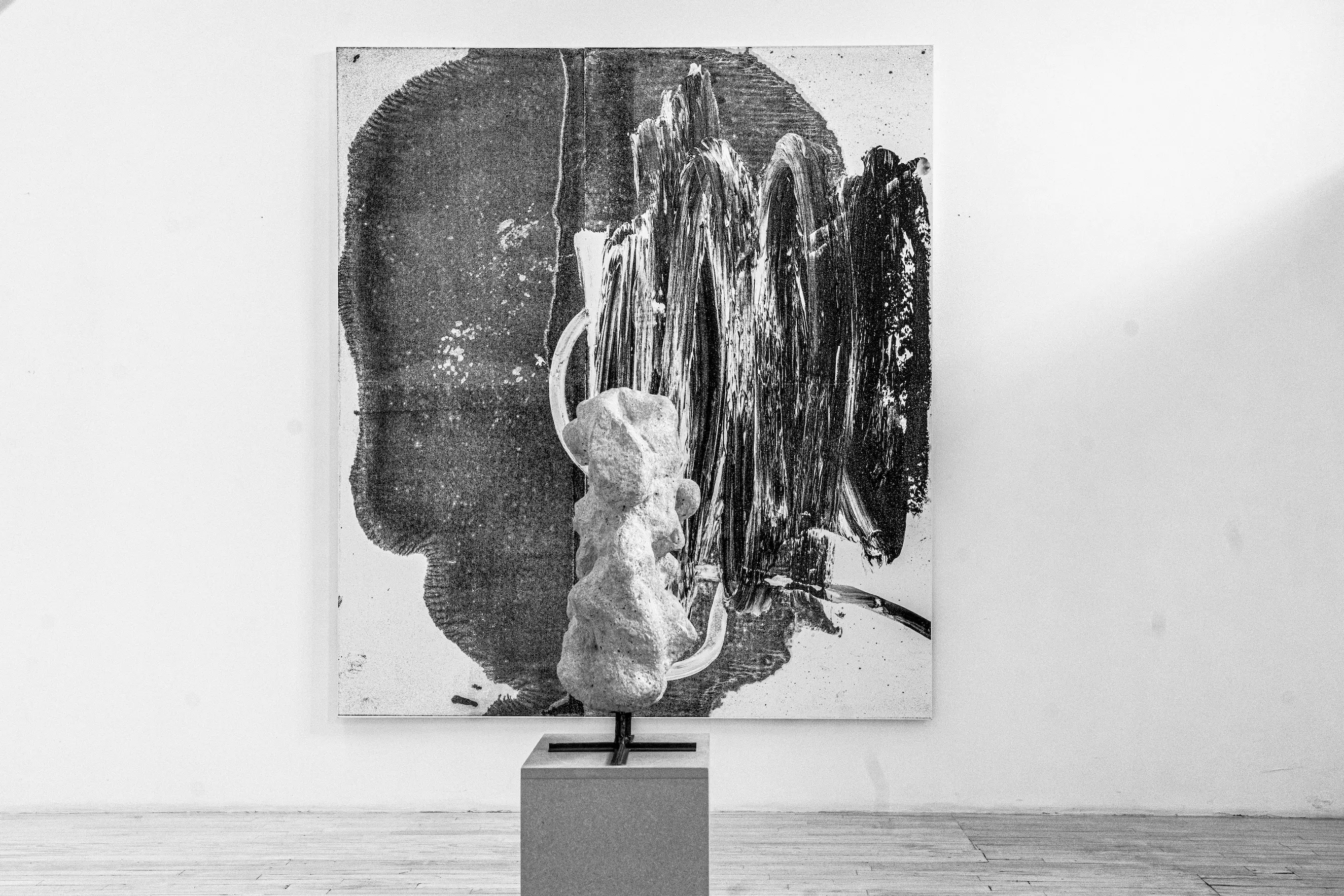
What I did recognize was a mosaic that hangs opposite the paintings. Over 15 feet tall and about 10 feet wide, it was installed horizontally in New York. Its outer edges are composed of white tiles that mimic gessoed canvas, while the center of the picture plane is filled with black, white, and pink circles and swirls rendered in Italian stone. The mosaic is the largest piece in both iterations of See Stop Run, filling the height of the wall, yet its power has little to do with scale. There are several other factors.
Most contemporary mosaics exist within craft or public art contexts. Wool’s work, by contrast, adapts a folk vernacular and places it in dialogue with the best postmodern painting, including his own work as well as that of Brice Marden and Albert Oehlen. It recalls an era when mosaics were as mimetically rigorous as oil painting, deeply engaged with brush and canvas. While mimesis is not Wool’s concern, the work immediately reminded me of the anonymous 11th century mosaics in the Cathedral of Santa Maria Assunta in Torcello, Italy which are as good, if not better, than painting of the same era.
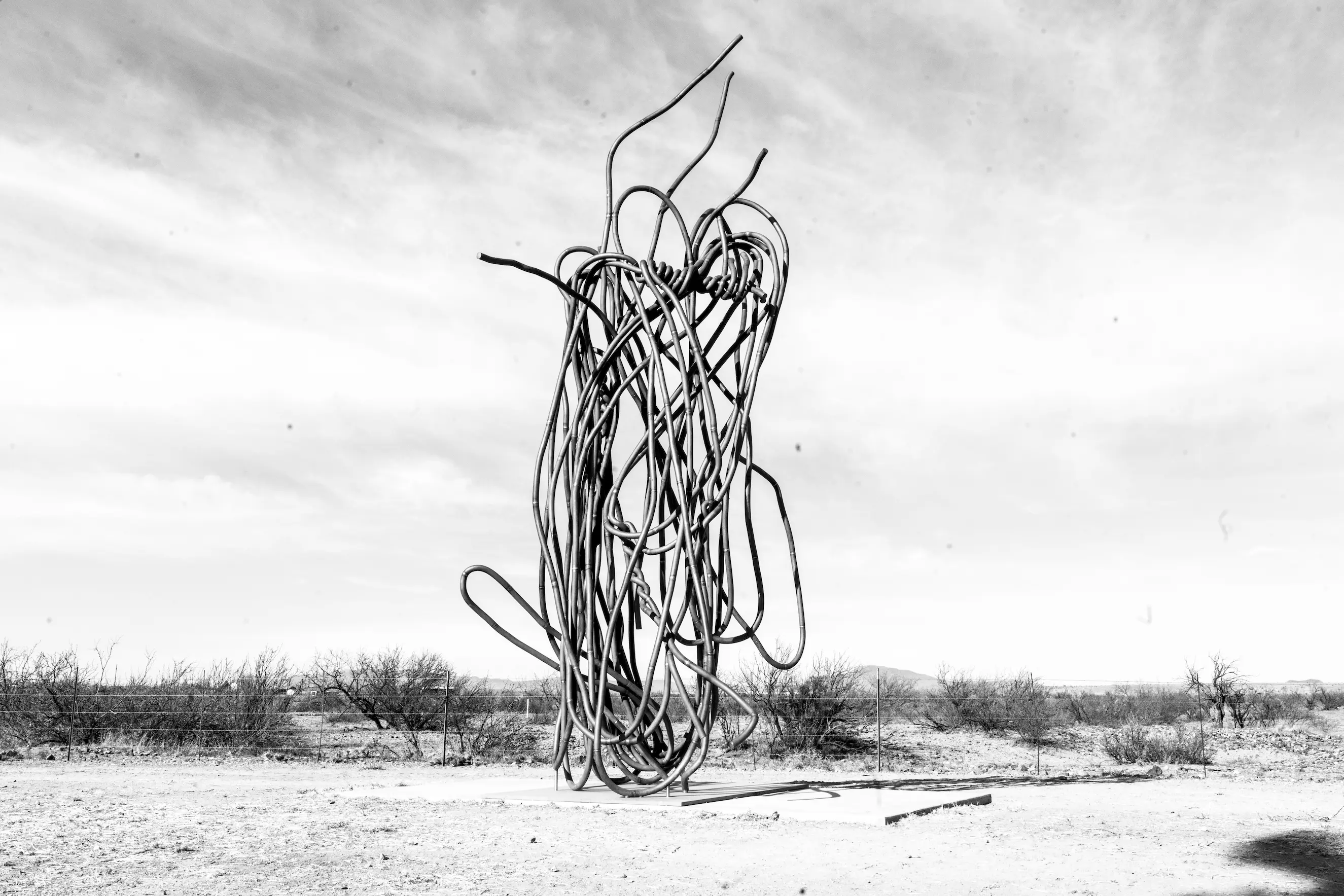
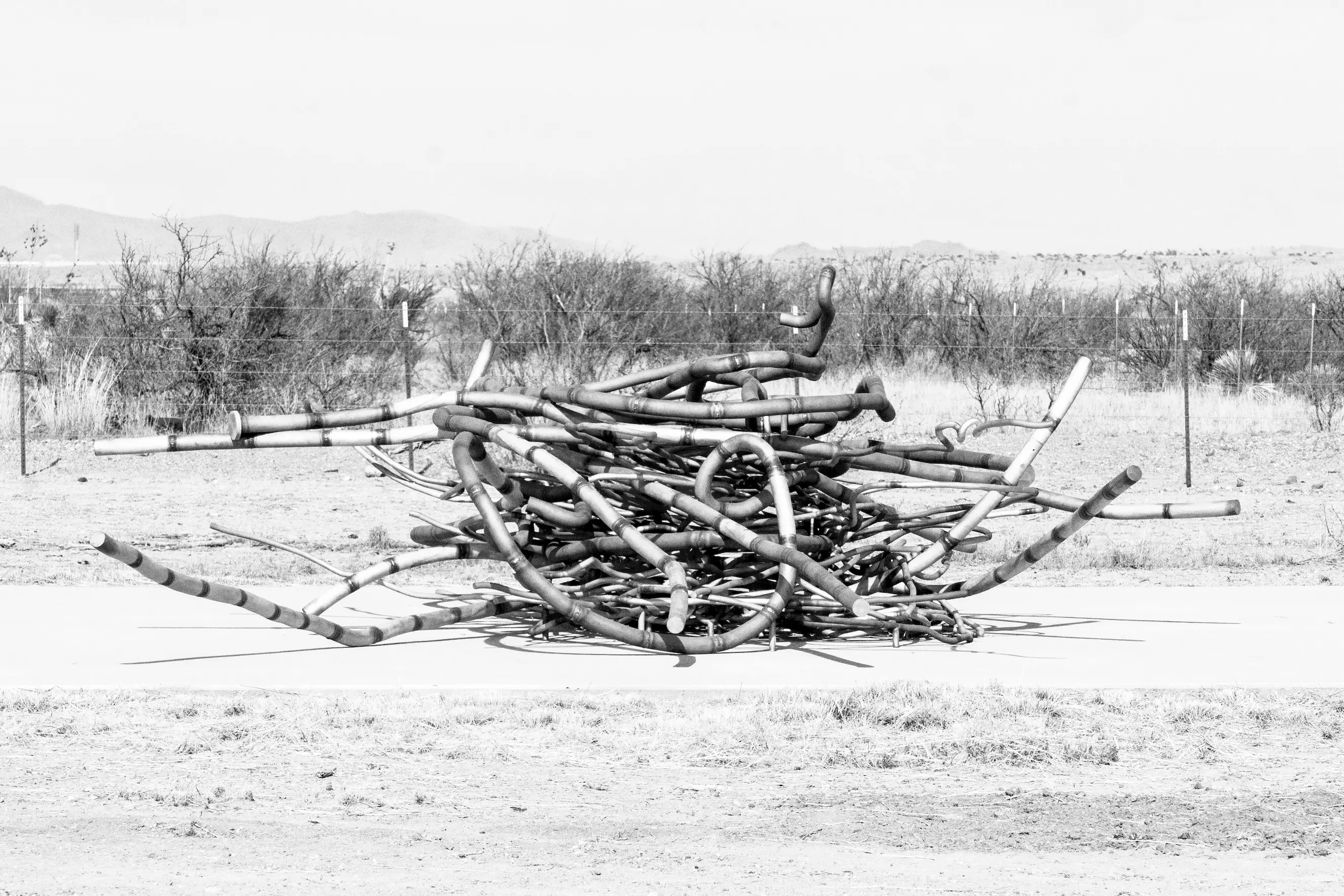
The swirls on the mosaic and the paintings are echoes of large pinkish bronze sculptures that are found throughout the exhibition, twisted amalgamations of tubing that resemble the aftermath of a giant battering the insides of a cooling system.
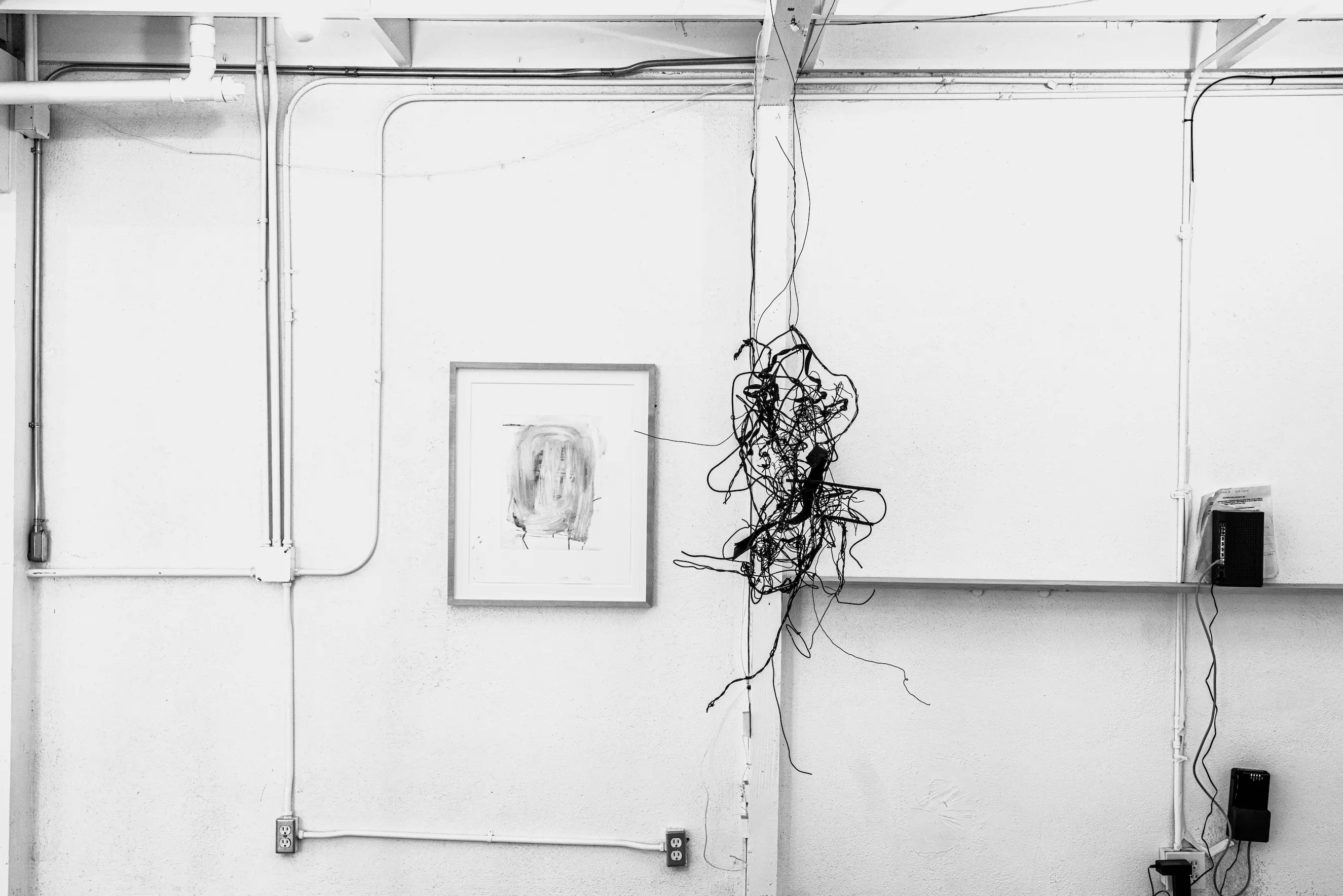
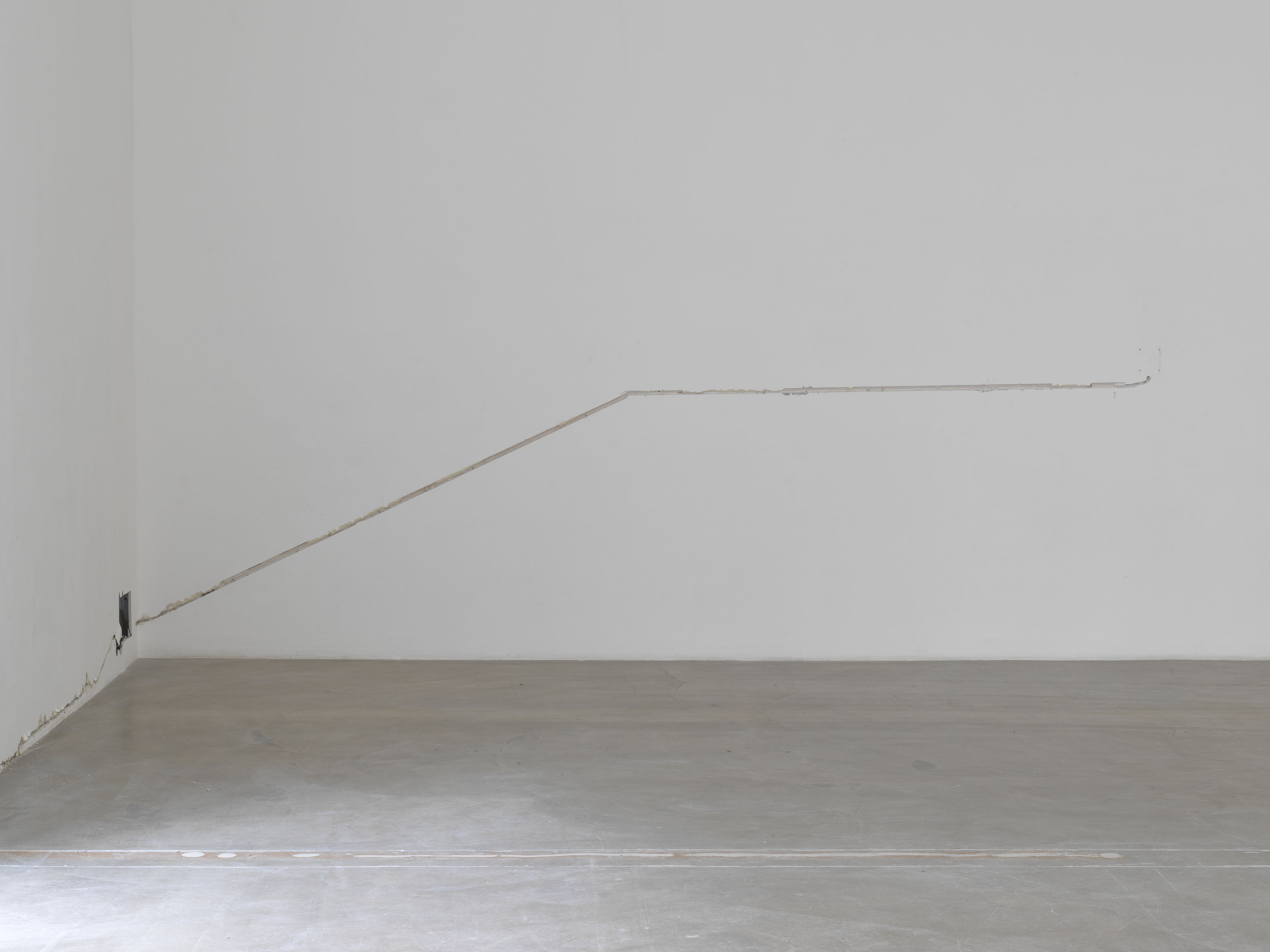
Deeper into the exhibition, it becomes clear that the materia prima for all of Wool’s recent works is Marfa itself, and that nothing is truly abstract. The predominant form throughout the exhibition, appearing as squiggles in paintings, drawings, and mosaic, are pieces of wire fencing that Wool collected throughout the town and its environs. Some fencing hangs as assisted ready-mades, underscoring the risks–both aesthetic and physical–that Wool took to arrive at the corpus on view. With more than 93% of Texas land privately owned and ranching dominating the landscape, property is often fenced.
In a small room that connects the two large exhibition spaces are books that Wool has produced documenting the streets, fences, ranches, and cacti that inspired See Spot Run. Seeing the sheer volume of troughs, trash, and dirt roads he considered is a singular experience, one that shares more with poetry than mere documentation.
The final room in the Brite has a floor plan that mirrors the first. On the left wall are black-and-white double exposure photos of the objects and places that form the exhibition’s threads. Opposite, photos of small fragments of wire have been manipulated in Lightroom to the point where it is impossible to tell if you are looking at a photograph, a drawing, or a “screen capture” of an Etch-A-Sketch. The visual intrigue of these works lies in this ambiguity of medium.
After leaving the Brite, I was led to the outdoor sculptures, the first of which sits beside Johnson’s bookstore, gallery, and publishing house, Marfa Books. Installed several years ago, it is a large loop of metal doubled over with a few simple twists. It is satisfying to encounter what was likely once a wire sketch, something akin to bending a paper clip when bored, magnified to the size of a minibus. The confidence of the gesture and its placement without explanation or ceremony held my gaze.
For the duration of See Spot Run in Marfa, Wool has opened his property on the edge of town, only on Fridays and Saturdays from noon to 6:00pm, where three elaborate sculptures stand. Their forms are so complex they required 3D modeling before fabrication. One can easily get lost in the tangles and feats of engineering. Their power, like that of the show itself, is rooted in their placement.
Viewing Wool’s work in Marfa gives us a vivid idea of how the artist successfully retreated from the constraints of New York and his canonical word paintings into a sustained exploration of the blurry line between figuration and abstraction. In the case of See Spot Run, New York ain’t got nuthin’ on West Texas.
—
Note: The work on view in the North Gallery has been changed since the time of writing.
Christopher Wool was born in Chicago in 1955 and lives and works in New York and Marfa, Texas.
Myles Starr is an artist based in New York. His most recent solo show "I Can't Read" took place in November 2025 at Interrobang in Brooklyn.