
Hermetic is the adjective most often attached to Jasper Johns, not to his art, but to the man himself. Interviews are rare; explanations rarer still. Johns is famously laconic, his reticence becoming part of the mythology that surrounds him. But Hermetic carries another more archaic meaning which is seldom used but which makes it all the more appropriate when paired with Johns. It describes the esoteric tradition of Hermeticism, a philosophy of inner alchemy and hidden knowledge. Johns possesses an inner alchemy, in both his techniques and in the themes he explores in his work. There isn’t always an explicit capital M magick on the canvas but there is certainly an ambient mysticism that permeates through his life and his art. Meaning is never withheld so much as encrypted, embedded in symbols, repetitions, and private systems that resist definitive interpretation.
Johns, whose own lips are tightly sealed, prefers to let his work speak for itself, which it does ardently and volubly. Night Driver, the new major retrospective at the Guggenheim, walks you through nearly 140 works, spanning over seven decades worth of paintings, sculptures, drawings, and prints.
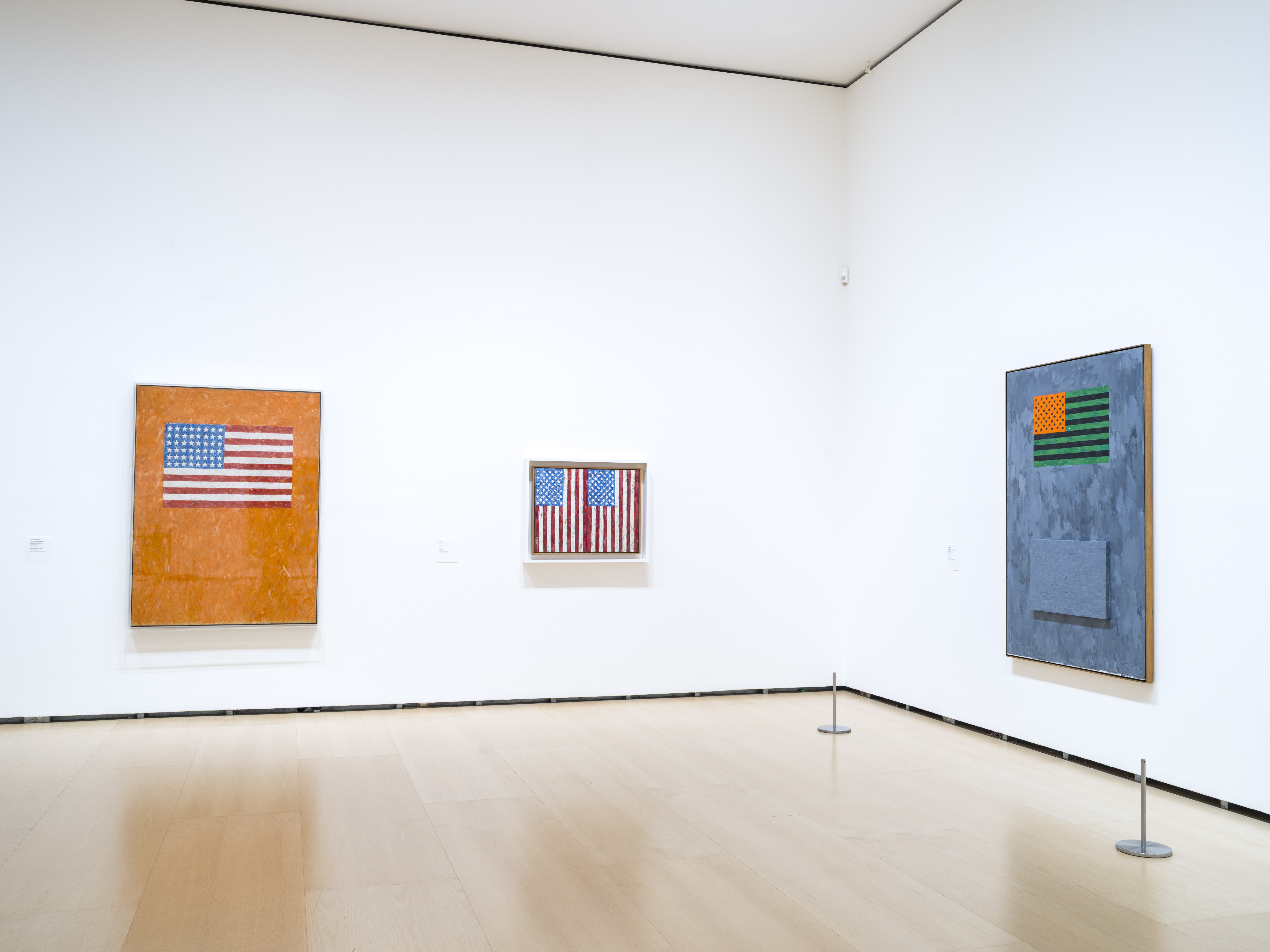
Night Driver chronologically walks us through Johns’ lifetime output. The rooms are generally separated by decades and eras, although with the scale of work this impressive and vast it may be more appropriately dubbed aeons. There is a fine-tuned balance between the temporal, biological chronology of his work and the emotional, artistic chronology, which of course is not always linear. Subjects like death, grief, and longing rarely are. Motifs and themes disappear and then are resurrected decades later, adding to the strange, uncanny hall of mirrors effect his oeuvre has on the audience when roaming through 70+ years of work.
We start at the start. Well, the tangible start. Johns did create art pre-1954 but he destroyed it all following his return from the Korean War, where he was stationed in Japan. If his often archaic techniques could be described as antediluvian then his existing catalogue can be considered post-flood, after destruction, AD. So we begin in 1954, with the work that is most synonymous with Johns, Flag. One of the most recognisable pieces of art that has also divided opinion and classification for decades. Is it a painting? Is it a collage? Is it a flag? Can something be a representation of the thing itself while also being the thing itself? Does a simulacrum have to be altered, worse, an ersatz copy? Johns takes the motif of the flag, reuses it, repurposes it, and modifies it so often throughout his whole career that the flag is like a familiar friend by the end of the exhibition.
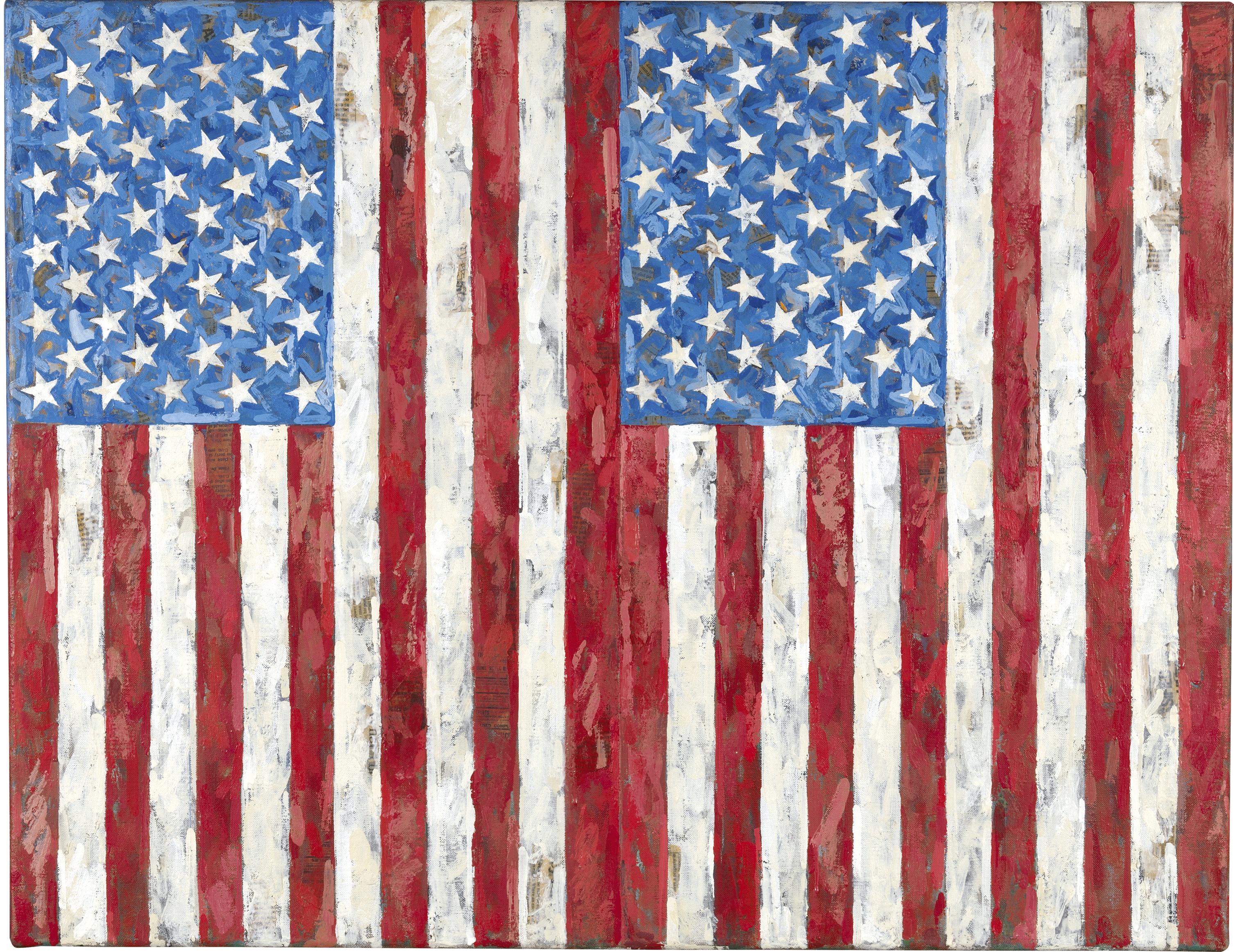
Is there any flag more evocative than the Star-Spangled Banner? All those stars and stripes crammed into an absurdly dense rectangle. Johns takes the flag, deconstructs it and alters it to a point where it can often appear as a psychedelic magic eye illusion. He utilises the red, white, and blue throughout his work, and like a Where’s Wally? (or Waldo) book, spotting the more hidden references can be like a game or treasure hunt while walking through the galleries. Johns often crosshatches the colours in his more abstract austere pieces such as Dancers on A Plane and Corpse and Mirror II. Here he takes colours and stripes of an American flag and kaleidoscopically mutates them into a mirrored, woozy painting. The frame is embedded with cutlery and the painting wouldn’t look out of place as tablecloth in an American diner, acting as dazzle camouflage to hide the barf of a North American glutton.
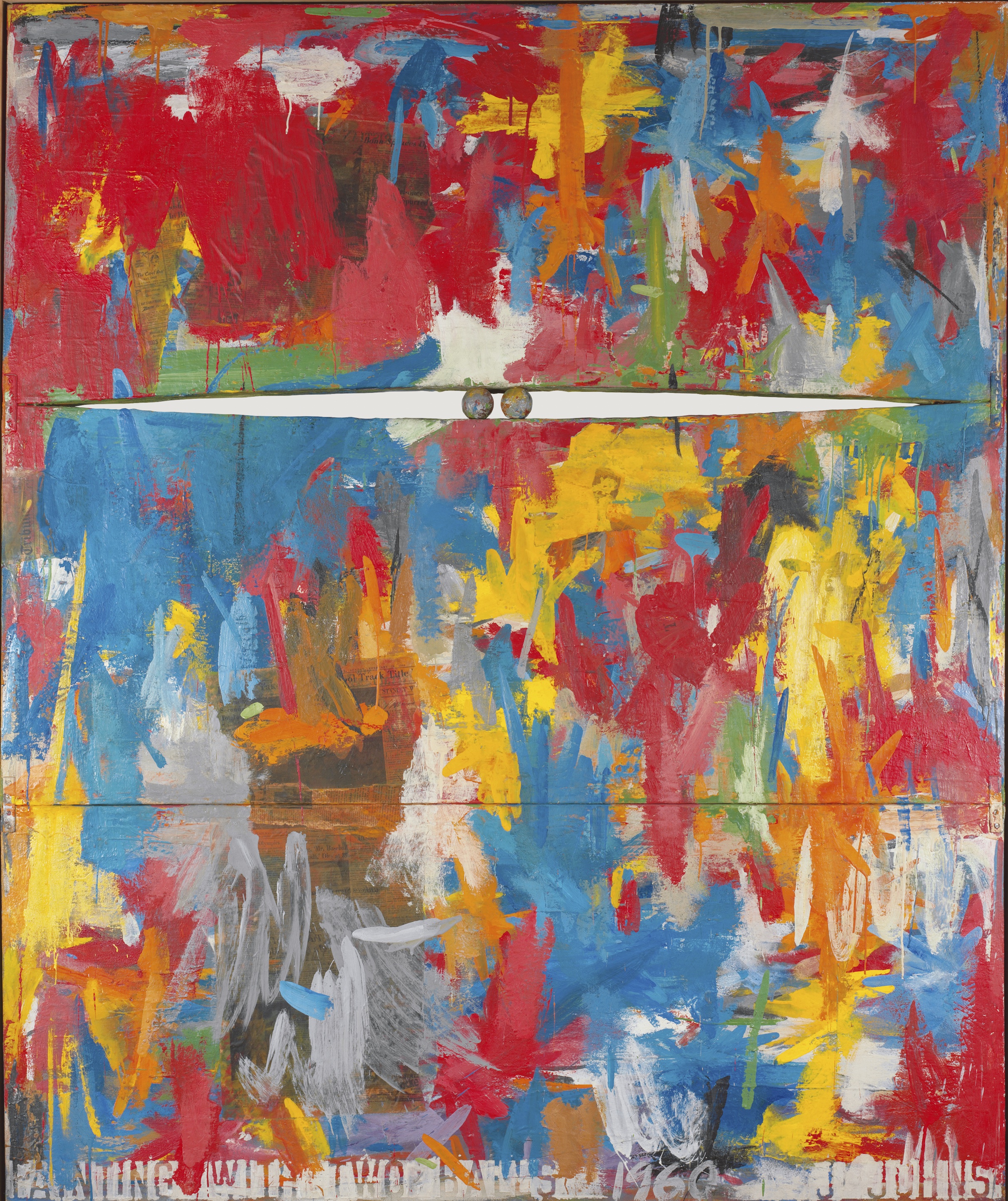
Johns did away with the Abstract Expressionist conventions, partly on account of the humourless masculinity of the scene. He openly mocked the hyper-macho stylings of the AbEx crew with his 1960 work Painting with Two Balls, an encaustic collage of what would be an otherwise standard action painting had he not also included two wooden balls lodged in the painting’s borders, parodying the boys’ club by letting them know that what they’re doing is essentially painting with their unmentionables. Johns’ use of (en)caustic wit, provocations, and sardonic irony is splashed all throughout Night Driver. In Tantric Detail (1980), an even more overt reference to genitalia is used, with a pair of castrated testicles hanging above a skull. Tantric philosophy refers to a spiritual liberation, an enlightened clarity. Naming the painting Tantric Detail is another blink-and-you’ll-miss-it quip. In the petite mort, the little death, the orgasm, your life will flash before you, all will be revealed.
Johns frequently uses the famous optical illusion My Wife and My Mother-in-Law in his work. Some see a crooked old hag, others spot a delicate young lady, both are true, both are false, it all depends on how you look at it. Johns’ work can occupy simultaneously serious and silly worlds, but the onus is on the audience to interpret. Laconic does not equate to humourlessness, reticence isn’t necessarily a negative. Let other people talk, let other people think. Over-explanation kills the fun, there is more mystery and allure in the shadows, when art is over-explained, it becomes sterile and dull.
Johns’ works are full of references to the arcane, in both subject matter and techniques used. His frequent use of words, numbers and letters hint at a geometric alchemy and mysticism. One can wax lyrical about his atavistic use of encaustic application. It is an ancient technique, but the usage of the technique in Johns’ catalogue isn’t the entire feeling, or rather the feeling is greater than the process. This is no tea bag stain and burnt edges for a primary school treasure map. The process shouldn’t define the piece. If the only interesting aspect of a piece is the outdated technology then the artist is doing something wrong. Anyone can imitate a process but the beauty and delicacy lies with the artist to use these techniques in conjunction with a primal alchemy. What Johns does so well is combine the contemporary and the antique. He uses colour as if it were a material and technique as if it were a colour.
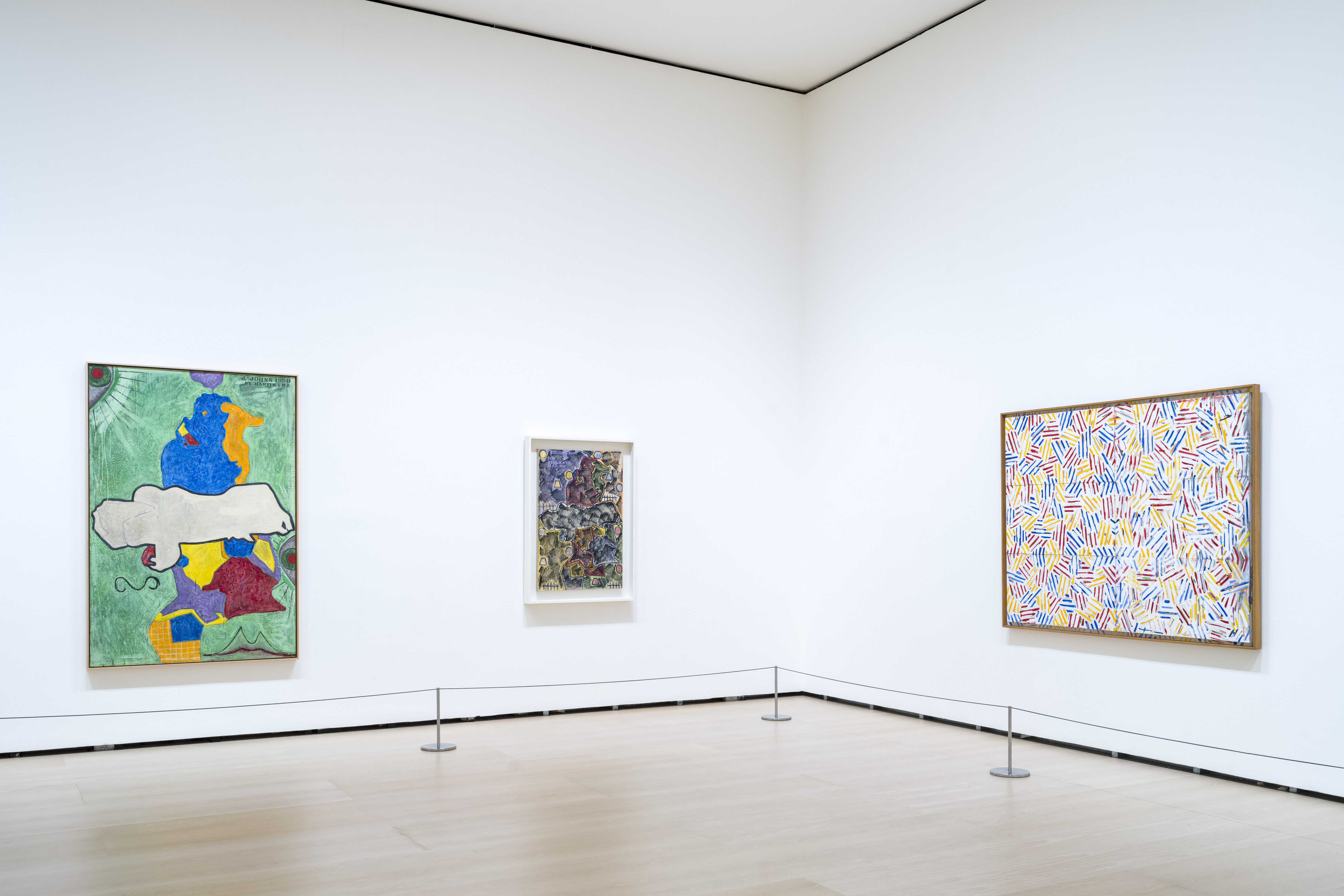
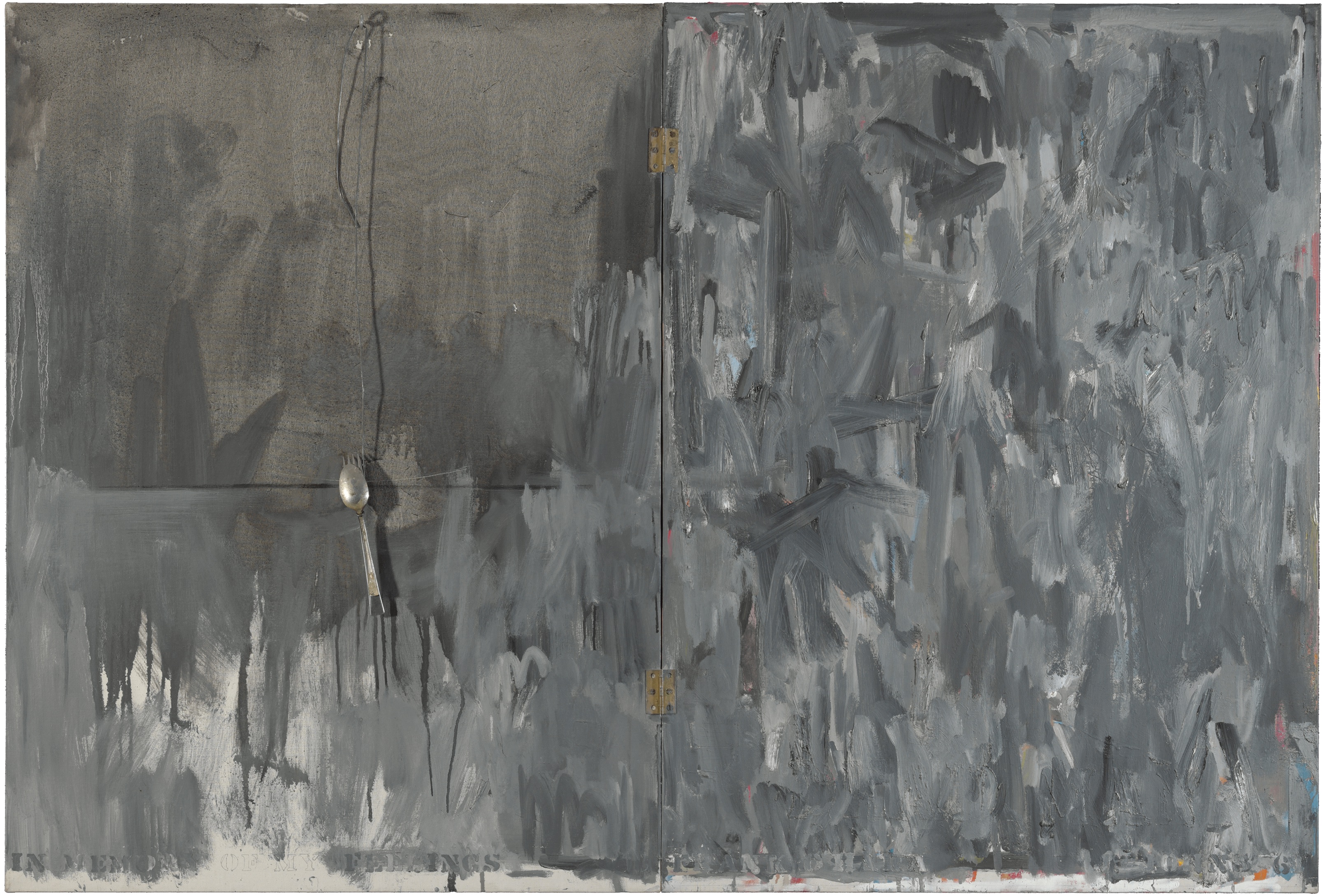
The physical patina of Jasper Johns’ paintings, collages, and encaustic works doesn’t tell the whole story, it quite simply doesn’t scratch the surface. There is a psychic pentimento to Johns’ work that cannot be ignored. Layers upon layers of context and influence and acclaim and retrospective analysis must be peeled away every time you look at a piece. There are facts and there are truths to his works, but there are also the in-between cracks, the Proustian memories, the Lacanian language, and the shadows of existence. There is a space between solid, liquid, and gas that permeates in his works, plasma terra firma of mensur scars and hidden messages.
For such a reticent man, it is almost a gag in itself how frequently Johns uses the imagery of words in his works. Words to him are more important than small talk fodder. They operate as a structure, as a base, as something that can be considered universal as with numbers and shapes. Words after all, are just strange shapes and symbols we have sculpted meaning out of. In Johns’ collaborative book with Beckett, the texts have no connection with the images. Beckett himself saw the frivolity of the spoken word, infamously accepting his Nobel Prize with a mute interview in 1969. Beckett was a writer who famously believed that “every word is like an unnecessary stain on silence and nothingness.” I believe Johns, Cage, and Rauschenberg would have all smirked at that, the ultimate display of reticence.
The further one journeys through Night Driver, the more you notice the work referencing itself, folding and melding into a single organism, with traces, lineage, and origins blurring constantly. The flags become disfigured, discoloured, and shifting in size. The first flag is used as a composition, in a context where a figuration was an aberration. There then appears a flag that is smaller and altered, all the stars are twisted. Flag (Moratorium) is an American flag with the wrong colours used, commissioned by the Committee Against the War in Vietnam. There are two black American flags from 2002 that are shrunken and murky and made with ink on plastic, with an evil sheen to them. The most recent American flag is from 2010, which is almost burnt to a crisp. One can only assume the size and vantablack nature of an American flag he might create in today's world. The flag can become a landscape, the image of the flag is as powerful as the meaning of the flag. Johns’ layers of embalmed plasma, waxy and gooey, preserve America like a scarab in sap, dug up and unearthed like an ancient artefact, sooty and dirty, burnt and bloody.
There is a nocturnal, melancholy quality to many of Johns’ works. His paintings are often haunted by ghosts of his life. As a compos mentis nonagenarian, he has had to witness most of his friends, family, and lovers all disappear, so it is no wonder his work is riddled with memories and exorcised by traces—both physical and metaphysical, tangible and psychic—much like his work, much like his life. Rauschenberg has his white paintings, Cage has his silence and Johns has his secrecy and reticence. They are all marching to the same muted beat of a skinless drum and they all changed the artistic panorama of the United States forever. Talking is the slowest form of communication, anyway.
The most recent artwork included in Night Driver is Slice, made in 2020. Slice features a mostly black oil painting of a galaxy and an anatomical diagram of a knee. Slice featuring constellations is fitting. Johns’ world is an artistic galaxy, his life is a cultural universe. Duchamp as the Big Dipper, Cage as Orion’s Belt, Rauschenberg the Great Bear, Cunningham the Teapot, Beckett the Sickle. Music, art, dance; Johns is the astronaut connecting all these shining stars together.
—
Born in Augusta, Georgia, in 1930, Jasper Johns is widely considered one of the most significant figures in 20th and 21st-century American art. His early career marked a bold departure from the macho ethos of Abstract Expressionism. Instead of emotional, gestural brushwork, he famously turned to recognizable, “pre-formed” subjects like the American flag, targets, maps, and numbers.
Daniel Breuer is a writer and filmmaker based in London.


