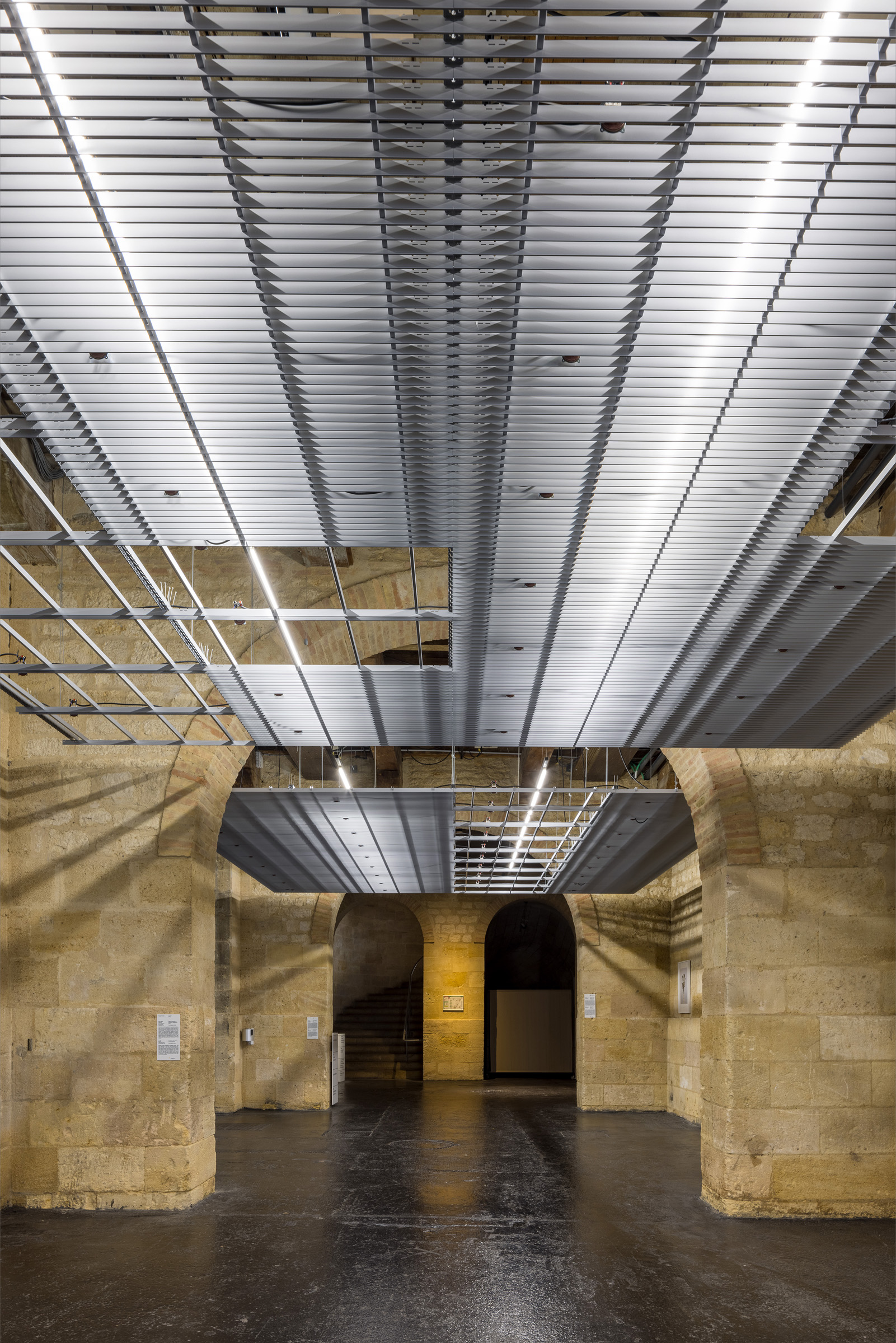
Can we experience time without turning it into something else? The moment we describe it, time becomes a concept shaped by beginnings and endings, memory and anticipation. This paradox lies at the heart of La terra piatta è una dimensione lirica del luogo come se regredire fosse inventare, curated by Paolo Zani as the inaugural exhibition at Sala Effe, a new contemporary art space within Cremona’s Museo del Violino. Its name refers to the f-shaped openings carved into a violin’s body, which allow its voice to resonate beyond the instrument. Bringing together works by eighteen artists, the exhibition approaches time not as a subject to represent, but as a condition informing objects, images and our encounters with them.
Drawing on French philosopher and writer Clément Rosset, Zani argues that “the real has no double”: nothing lies behind an event to offer a more definitive explanation of it. “Time is time.” Tautology becomes not an empty repetition, but a recognition of experience’s irreducibility. Yet the real is never entirely separable from the ways in which we perceive and interpret it. Every act of looking is shaped by memory, language and history, leaving the boundary between what we see and what we believe we see perpetually unstable.
In the entrance hall, Tarik Kiswanson’s Nest (2020), a large ovoid sculpture in fibreglass and resin installed high above the ground, welcomes visitors and evokes an origin suspended between fragility and transformation. By contrast, Racheal Crowther’s HS Code 04022911 (2026), a synthetic fragrance that recreates the smell of powdered milk, introduces an invisible, olfactory dimension, summoning memories that precede conscious recognition. Together, these works frame beginnings not as fixed points, but as experiences continually reshaped by what follows.
In the first room, Pietro Roccasalva’s Fanfaro (2014) compresses disparate histories into an improbable image: a child bites a monitor lizard holding an arancino, bringing Caravaggio’s Boy Bitten by a Lizard (1594-96), Bernini’s Putto with Dragon (c. 1617) and Chinese dragon imagery into play. The incongruous scene collapses disparate temporal and cultural references into a single composition, while the arancino becomes a metaphor for the sun. Here, different visual histories coexist rather than unfold in linear succession. Caleb Considine’s Trestle (2017), Postcard (2019) and Eddie, is your hate pure? (2019) offer a quieter counterpoint. Their abrasions and revisions register painting as duration, the surface bearing the traces of a process rather than merely depicting a subject.
Time becomes palpable in two video works deliberately displayed to expose their technical apparatus in operation. In Paul Kos’s Lightning (1976), waiting is the subject: the lightning seems to appear precisely when the viewer looks away. Attention becomes a precarious negotiation between anticipation and chance, exposing the limits of our desire to witness an event as it unfolds. In Fischli and Weiss’s The Way Things Go (1987), objects are set into a prolonged chain reaction, each movement triggering the next. Its apparently continuous sequence remains vulnerable to interruption, revealing how easily causality can give way to contingency. While Kos foregrounds the elusiveness of an event, Fischli and Weiss examine the fragile mechanisms through which one occurrence appears to determine another.
Giorgio de Chirico’s five paintings, displayed in a row – Cavalli in riva al mare (Les deux chevaux) (1926), Cavallo e zebra (1929-30), Cavallo e figura (1939), Cavallo bianco in riva al mare (1952) and I cavalli di Achille (1965) – return to the classical world at different moments in the artist’s career. Their recurrence shows how myth persists through successive reappearances, acquiring new forms while retaining its evocation of a distant past. Positioned behind Fischli and Weiss’s work, Diego Perrone’s Senza titolo (2016), a glass sculpture that encloses and distorts familiar elements, similarly unsettles recognition. What appears familiar is transformed by the material that contains it, displacing perception from the certainty of the immediately recognisable.
In the next section, Alighiero Boetti’s four drawings from Cimento dell’armonia e dell’invenzione (1969–70) record repeated gestures within grids, holding discipline and freedom in suspension. Repetition operates both as a rule and as a means of variation, allowing differences to emerge within an established structure. In Jason Dodge’s In Turin, Cristina Donato wove merino wool yarn that is the color of night and a length equaling the distance from the earth to above the weather (2013), a wool blanket gives material form to a cosmic distance through patient labour. The immeasurable is translated into the intimate scale of a hand-crafted object. A second work by Dodge, a suspended guillotine blade, introduces a radically different register: the possibility of an abrupt and irreversible ending. Together, these works move between duration as accumulation, distance as a measure of the immeasurable, and the prospect of interruption.
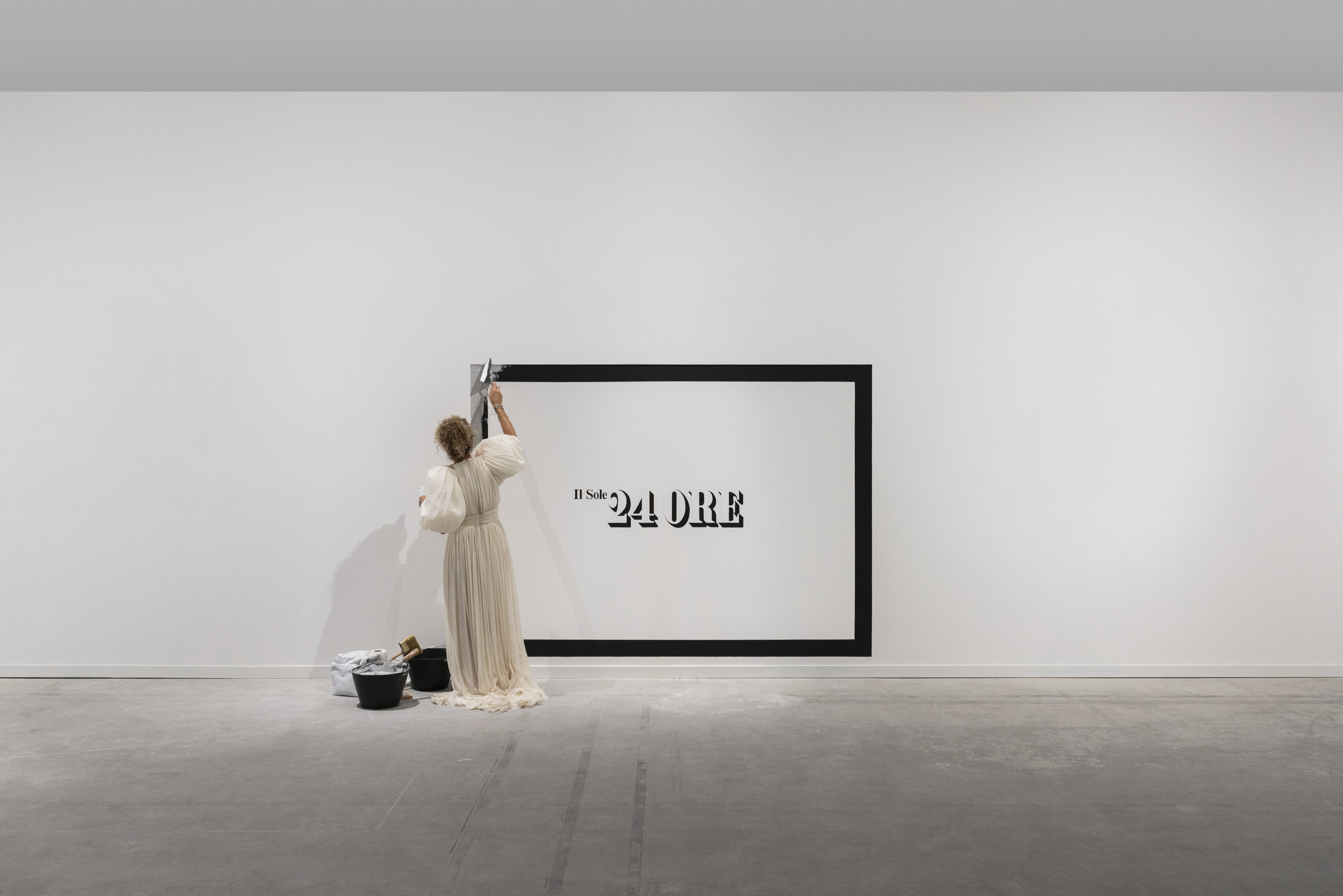
John Gerrard’s Exchange Table (2026), made from local cherry wood and metal, is conceived as a gathering place for members of the Associazione Agricoltori Cremonesi to discuss the future of agriculture. Its companion, Corn Work (Corrib) (2020), stages a digital choreography of performers in straw costumes, evoking agricultural cycles and the changing seasons. Time extends here beyond individual experience to encompass land, labour and collective practice. A different relationship between time and agency emerges in Roccasalva’s L’uomo formatore di mondo (2006), revisited for the exhibition. Over the course of a twenty-four-hour performance, a woman covers a sinopia with plaster, preventing the fresco from being completed. The gesture turns creation into erasure, resisting the expectation that an artwork should reach completion and become visible. If Gerrard’s work proposes dialogue as a means of imagining a shared future, Roccasalva’s performance suggests that agency can also lie in the decision to withdraw.
The final room brings these concerns into an intense sensory encounter. Paola Pivi’s Leoni (1998), an installation of powerful lamps, registers in the body before it becomes an image. As Zani describes it, the work produces “a dazzling flash of light, appearing momentarily in the space.” Rather than clarifying what is seen, illumination disorients, altering the conditions under which perception takes place. The impact is immediate, yet resists full comprehension: the intensity of the encounter exceeds the image it leaves behind.
Nearby, a polished replica of the Etruscan statuette Ombra della sera – the original, dating to the third century BCE, is held at the Museo Etrusco Guarnacci in Volterra – embodies the layers of interpretation accumulated around an object whose meaning remains uncertain. Its presence introduces another mode of temporal persistence, in which an ancient form survives through reproduction and successive acts of looking. Hans Schabus’s 186 cm (2026), a candle cast to match the artist’s height, offers a quieter counterpoint. As it burns, the body’s dimensions become the measure of a gradually vanishing presence.
The exhibition’s temporal logic also extends to its structure. Selected works will be replaced every two months, progressively transforming the arrangement and making the exhibition itself subject to duration. Damon Zucconi’s Multiple (2026), a web-based counter whose display changes according to the moment and device through which it is accessed, extends this logic beyond the gallery. Set in relation to a date associated with On Kawara’s Date Paintings, scheduled to appear in a subsequent section, Zucconi’s work turns a fixed date into a continuously recalculated present. Whereas Kawara’s paintings preserve a particular day as a completed, unrepeatable image, Multiple makes that date the starting point of an ongoing process. The exhibition’s evolving constellation will also include an intervention by Mariia Andreeva and works by Rineke Dijkstra, further expanding the range of artistic approaches brought into dialogue.
Here, Zani’s claim that “the works do not illustrate time. They enact it” finds its most compelling expression. In works that make duration physically or perceptually tangible, time ceases to be an abstract philosophical problem and becomes something to inhabit, observe or witness as it recedes. Bringing together such diverse practices under a shared conceptual premise, the exhibition opens up a space in which different approaches to time can resonate with and illuminate one another. Its richness lies in the connections that emerge between the works, as well as in the ways individual practices expand, nuance, and sometimes complicate the curator’s proposition. The exhibition’s central question thus finds a more productive formulation: not whether time can be experienced without interpretation, but whether any interpretation can fully contain what an encounter makes perceptible.