
Over beers, I try to explain the exhibition to my fiancé. “It’s the kind of show where you wouldn’t know it was art if no one told you,” I ventured.
“What, it’s just like a rock on the ground or something?” he joked.
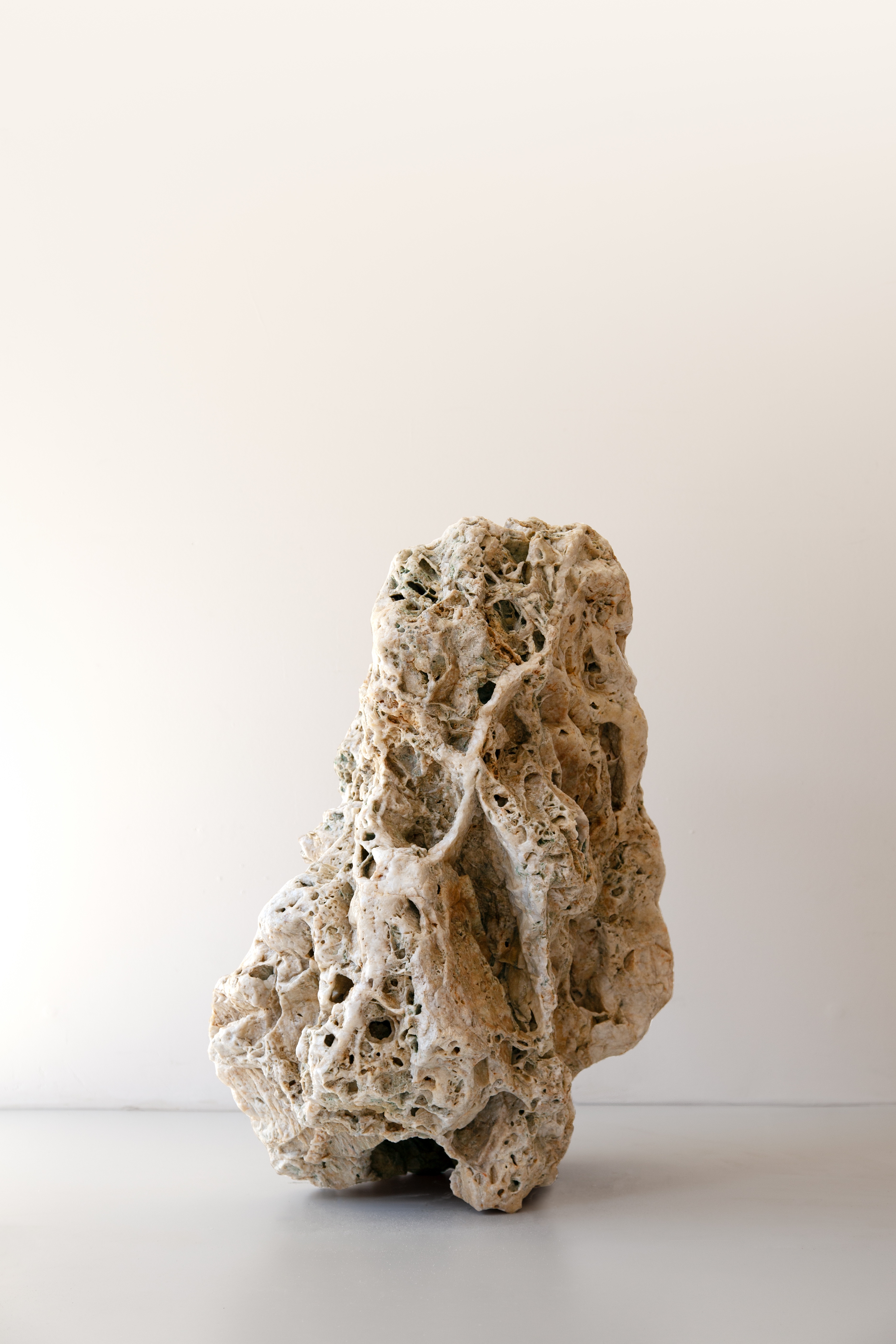
“A rock on the ground” is, in fact, one way to describe Stone, a pocked piece of quartz that serves as the centrepiece of Ghost Stone, Stephen Lichty’s solo exhibition at YveYANG Gallery in New York. The three-piece show is so minimal as to be monastic, a quality reinforced by the simplicity of the works’ titles: Stone, Bell, and Forest (all 2026).
Since the show is designed to be viewed in natural light, the gallery recommended I visit midday for the optimal visibility. Instead, I arrived at 5pm, at which point the sun had begun to set, throwing half of the space into a pensive dusk. In the first room, Stone emerged from the dim light. All joking aside, the sculpture is a rock, but it’s also more than a rock. The trypophobia-inducing object stands at less than hip-height, but with an otherworldly presence and subtle, fleshy tones. Lichty sees his material as an entity worth knowing in and of itself, not only as a resource to be mined. His intervention involved a long and laborious process of man-made erosion using dental scrapers, water guns, tiny vacuums, and other tools that carefully removed mudstone, chlorite, and minerals, revealing the skeleton of the underlying quartz.
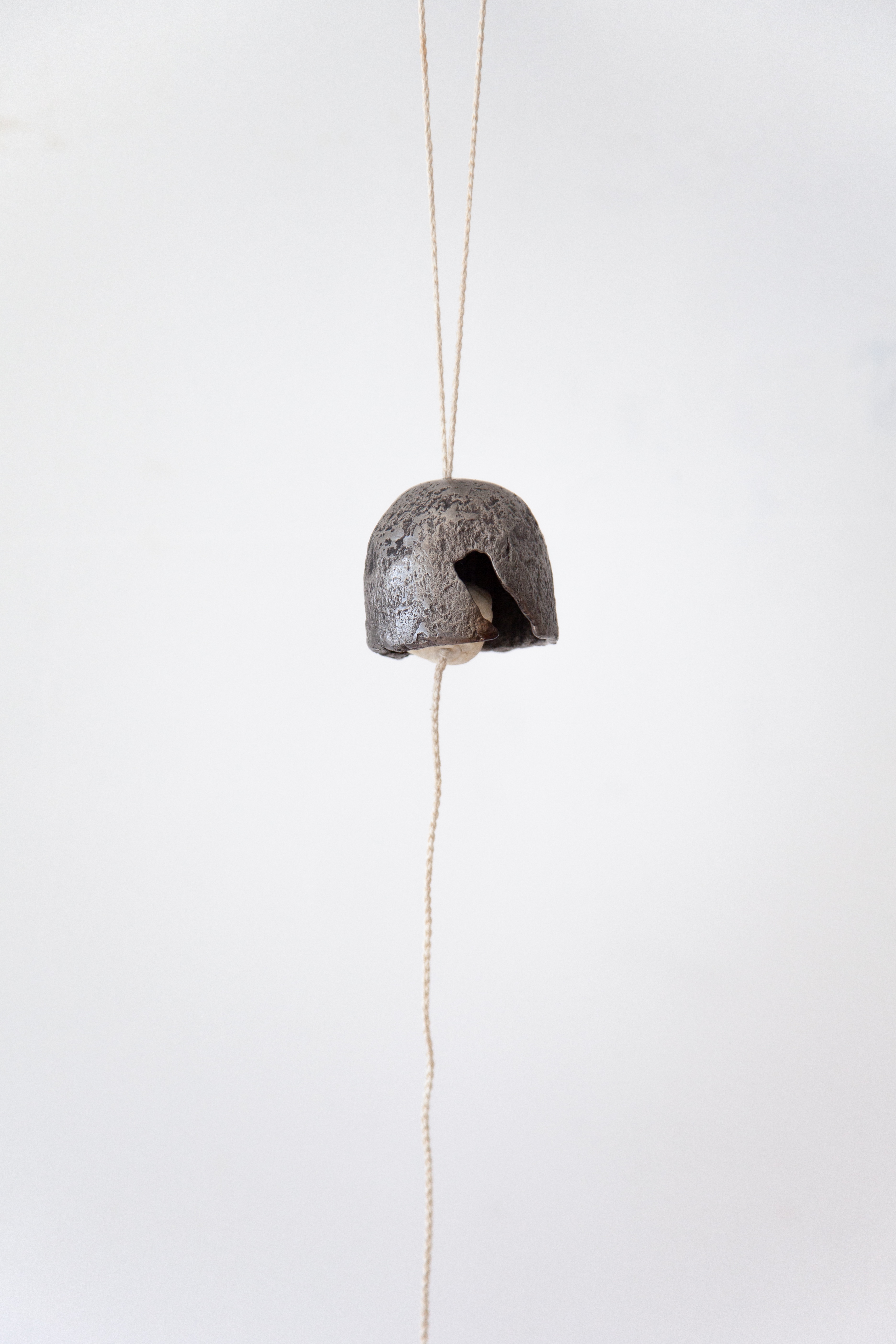
Anthropologist Daniel Miller wrote that “Objects are important not because they are evident and physically constrain or enable, but often precisely because we do not ‘see’ them.” Stone, Bell, and Forest are exactly such easily-overlooked objects. They are the titular ghosts, both present and absent in space, literally visible but metaphorically translucent. By placing them in the gallery, Lichty insists upon their recognition. Take Bell, which I had, in fact, walked right past as I entered the gallery. The small inverted bowl hangs by twine from the door knob, a fact that only became apparent after minutes of active searching. With some coaxing it emitted a pleasant tinging—not especially resonant, but beautiful nonetheless. In our post-industrial world, an object like a bell is unremarkable, but Lichty has gone back to a history and craft worth closer study. The bells (created in an edition of thirty, though only one is on view in the gallery) were made in a complex process in which iron sand was gathered from the shores of San Francisco’s Ocean Beach, refined in the studio of Jeff Pringle—a metallurgist keeping pre-industrial processes alive—and shaped, polished, and assembled with quartz clappers and cotton embroidery floss. Bells are often found in commercial thresholds, but only in the context of the gallery is the object elevated to art, the way a church transforms bread to body and wine to blood. In this way, the work demands an active viewer, willing to embrace a slippage between the mundane and the sublime.
Lichty’s insistence on the spiritual importance of objects perhaps stems from his early religious experiences. “I went to church a lot as a kid,” he said during a 2025 panel discussion with Ester Partegàs at the Wattis Institute. “I was in a church with stained glass, carrying crosses, and holding candles, swinging incense and stuff… so that was an early aesthetic and poetic education in some form.” Ghost Stone carries on that heritage.
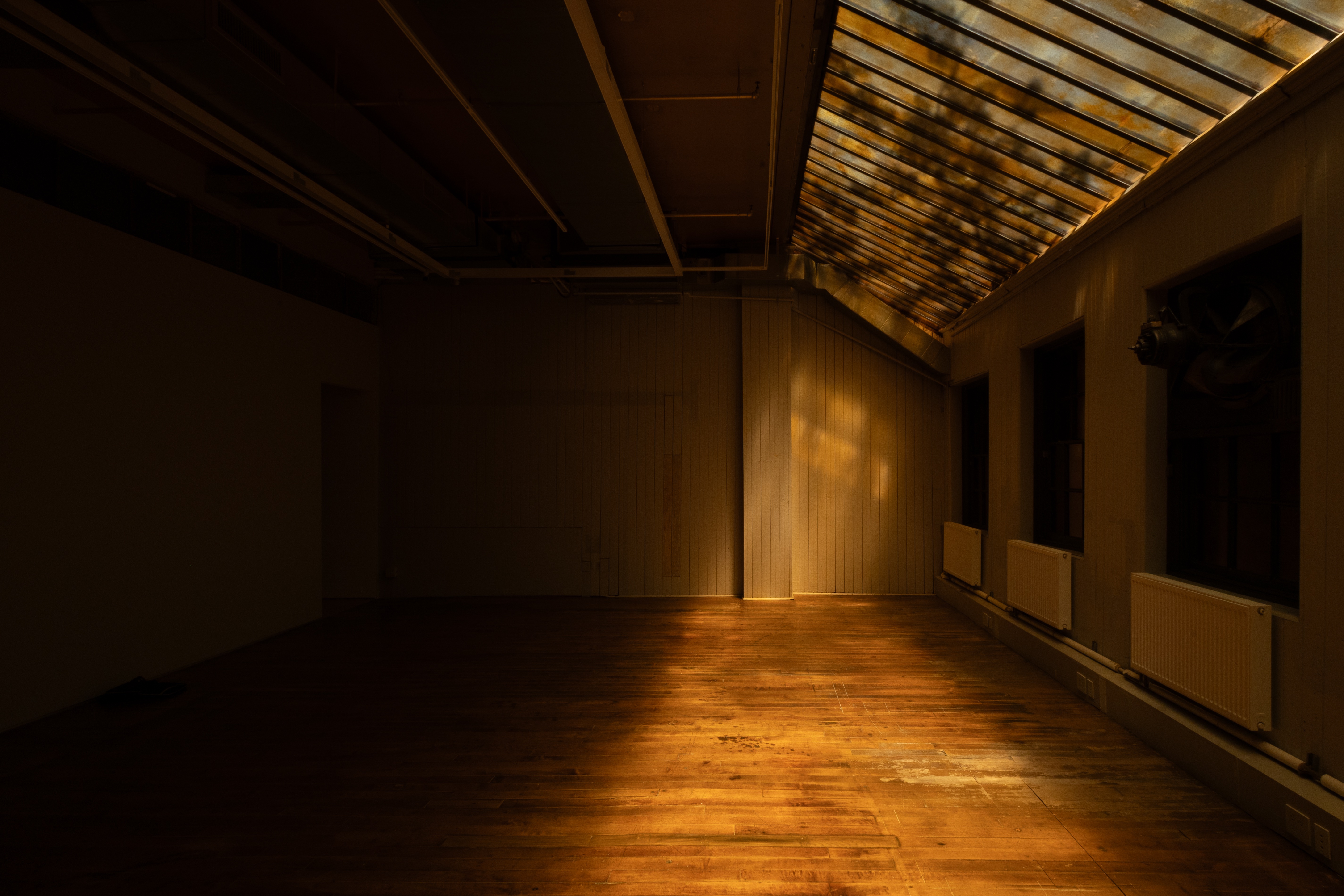
Forest, for example, can be read as Lichty’s interpretation of stained glass. The site-specific work was crafted from hand-sourced pine resin and custom-fitted into the gallery’s skylight slats and windows. The resin, fused with glass, casts a diffuse orange glow over the wood floors and white walls of the gallery’s vacant back room. The atmospheric shift in the space, combined with the scent of incense and a single flickering votive, creates the impression of a yoga studio before anyone arrives, which is to say, a space borrowing the markers of the sacred to evoke an atmosphere of solemnity. The room becomes part of the art, disrupted only by the muffled sirens on Canal Street.
Ghost Stone represents the visual residue of Lichty’s engagement with masters in traditional techniques and with the earth itself. Lichty’s primary interest seems to be the materiality of the work; as such, he is closely involved in every step of the process. An artisan sensibility leads to a sort of anti-industrial, anti-assembly-line approach. The quartz for Stone was acquired from Liberty Hill Diggings, a defunct mine near the foothills of the Sierra Nevada Mountains, an area that Juliet Jacobson describes as “a veritable emblem of irresponsible extraction.” Lichty participates in the extraction process in his own way, albeit framed as a creative collaboration rather than an exploitation of the materials and their contexts. Indeed, his art echoes artist Robert Smithson who, in a 1972 interview with Gianni Pettena, discussed the potential of becoming a “geological agent” by working in tandem with, rather than in opposition to, the natural processes that shape our environment.
While Ghost Stone is not the most self-evident exhibition, time spent with it reveals something simmering beneath the surface, impossible to grasp yet worth contemplation. To me, this something exists in all materials—natural, man-made, or some combination therein—that are granted close observation and care. And maybe this is Lichty's point. We are haunted by that which is present yet neglected. Perhaps in attending to the material of our world, we will better see what is, what might have been, and what still remains to be.
—
Stephen Lichty (b. 1983, Kansas City, MO) lives and works in San Francisco, California. Recent solo exhibitions include Foxy Production, New York (2021, 2016, 2014); Veda, Florence (2020); and Adams and Ollman, Portland (2019). Recent group exhibitions include the Sky High Farm Biennial, Germantown, NY (2025); Michael Benevento Gallery, Los Angeles (2024); Sweetwater, Berlin (2024); Palazzo Fortuny, Venice (2017); and The Noguchi Museum, New York (2016). Lichty’s work has been exhibited through performances at The Noguchi Museum, New York; Socrates Sculpture Park, New York; House of Seiko, San Francisco, along with a public art commission in collaboration with Jim Woodfill for a library in Shawnee, Kansas.
Kate Silzer is a writer based in Brooklyn, NY.
.jpeg)


