
The Fluentum building sits at the end of a long, imposing driveway; a former Luftwaffe military facility, constructed by architect Fritz Fuss in the era of National Socialism. After World War II, American forces used it as their military and intelligence headquarters until 1994. The American Embassy, I am told, still surrounds the building, evidenced by a prevalence of fences and corrugated iron. This layered history of surveillance and containment is a fitting prelude to an exhibition concerned with movement, porosity, and its conditions.
Inside lies Demolition/Escape, a tripartite exhibition centred on a recently reconstructed work by pioneering British multimedia artist Tina Keane, Escalator (1988). Following an extensive reconstruction and digitisation, the piece is on display for the first time in over 30 years. The presentation, however, is not a purely historical affair: co-curators Dan Kidner and Raoul Klooker create new pathways through the work via commissions by British artists Hilary Lloyd and James Richards. Their responses are framed as contingent, with both the structure and title of the exhibition borrowed from another of Keane’s works.
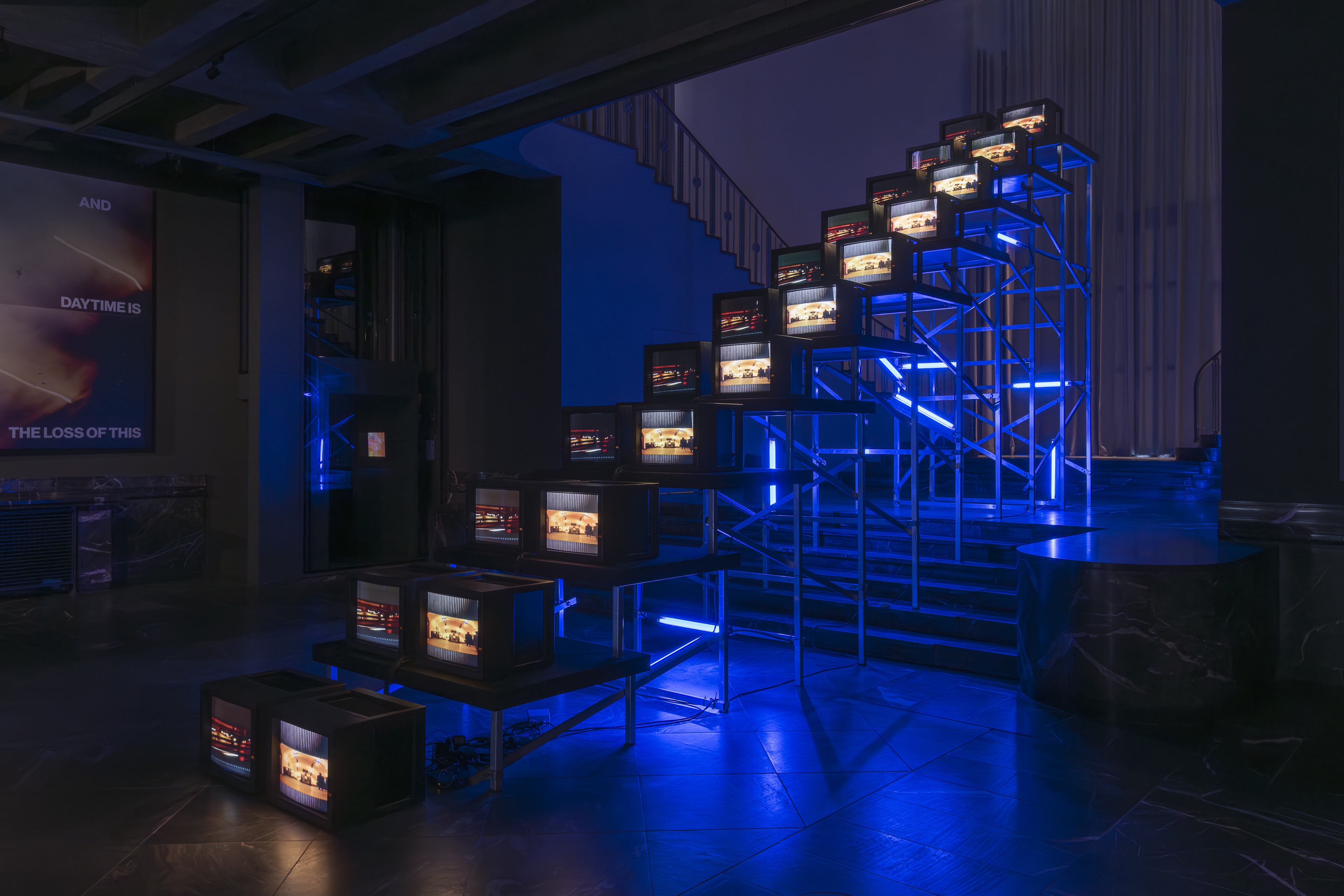
Inside, it is dark and slightly hot, with stormy, veined marble columns. It is a bit like being inside a mouth. Escalator resonates with the sweeping staircases structuring the Fluentum space and is set slightly to one side. The work holds eleven pairs of TV screens in a metal lattice, the left-hand side showing a different video to the right. They are staggered, with both sets of videos showing fleeting clips of London, captured mainly from hip height – a peculiar angle which estranges the scenes. On the right, the people who go up: reflective peels of glass and metal, mirrored skyscrapers, businesspeople commuting; on the left, fragmentary shots of the Underground bathed in artificial yellow light, and its homeless – the people who never go up. The result is a commentary on social inequality after a decade of Thatcherism. Though lifted from another work, the title Demolition/Escape here is fitting, speaking to this dualism.
The videos are visually parenthesised by clips of escalators in motion. As such, within the static structure there is a constant sense of movement: an infinite commute without arrival. Beyond this, the work has broader implications about the passage of life, recalling the constantly turning wheel of fortune, the idea of stairs to heaven and final judgement, suggesting not only the presence of inequality, but its persistent and circular nature.
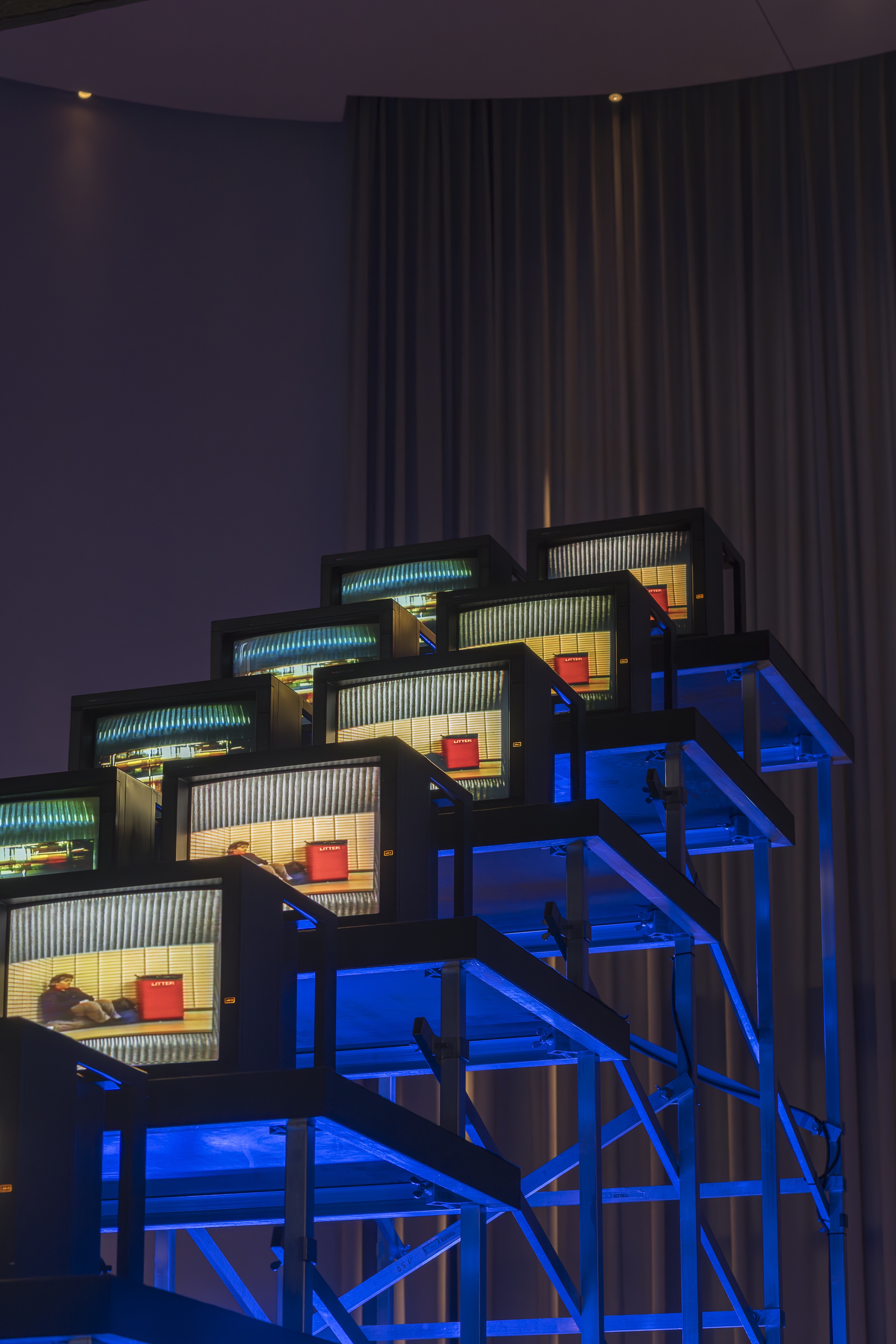
At its centre, the work thematises circulatory movement: a tension between life and death, movement and endings. Lloyd and Richards, with characteristic absurdist impulse, expand this gap in different directions.
Hilary Lloyd takes up the chronic movement of Escalator. Come up and see me (2026), her restless, multi-channel video installation, peppers the space: pigeons and puddles, birds of paradise, dogs in pubs staring adoringly. They operate across different registers of production and transience, from handheld footage of roadside greenery being removed by builders to a high-fidelity video of a dog gazing at the viewer, set to the upbeat and orchestral Herb Alpert’s “This Guy’s in Love with You”. There are flickering parallels to Keane’s footage: a cat filmed on a phone running up and down cat stairs, a burnished city reflected in a wine glass. Much like Keane’s, too, many of these clips are so quotidian you’re not really sure what you’re looking at. Their trivial nature seems to riff upon the same latent impotence present in Escalator.
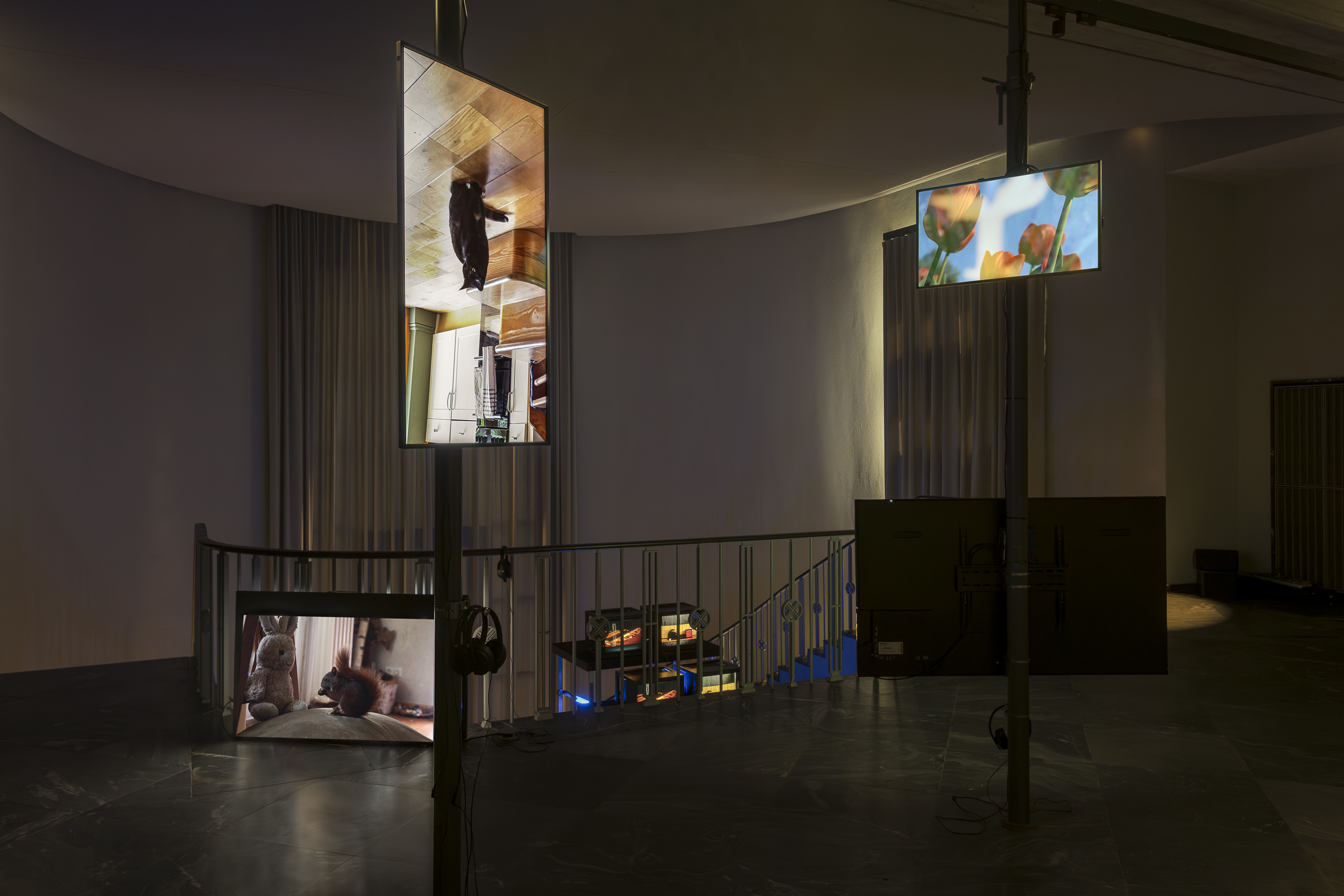
James Richards’ sound piece How different different kisses are (2026) extends not only the movement of Escalator, but also the sound. The four-channel work acts as a shifting, pseudo-soundtrack across the space, a kind of sonic holding pattern. Composed from field recordings made with artist and sound designer Max Bloching in Wedding and along the Schöneberger Ufer, it ranges from roaring mechanics and hinged doors, a hoarse generator, croaking, the tinny, rising ring of a boiler being switched on, flutes, singing, and the sound of objects being dropped. The noise of production stages an itinerance, creating a meandering piece that rises and falls throughout the exhibition depending on where you are standing. The shift from Lloyd’s interior pockets of experience to Richards’ more exterior soundscapes is stark.
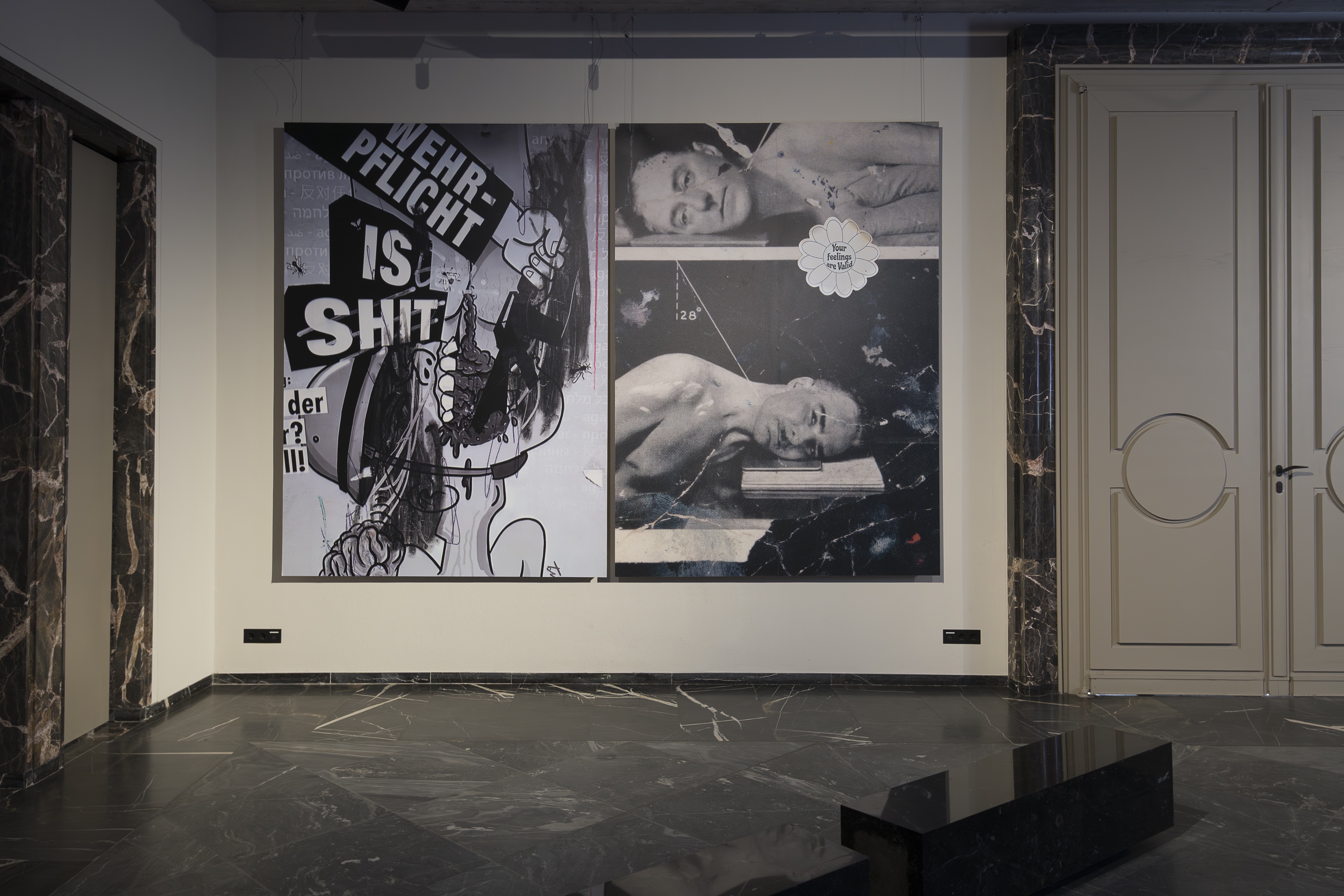
Travellers (2026), also by Richards, is composed of eight billboard-like posters around the space. They present disquieting, composite imagery: a little girl, champagne glasses, sourceless slogans (‘And Daytime / Is / The Loss of This’), a dog searching for a ball underwater. The exhibition pamphlet describes them quite wonderfully as ‘sentinel-like’, which feels apt: they seem to bear witness to the exhibition while standing slightly apart, nodding to Keane’s subterranean setting. Their matte surface, in contrast to the sheen of the screens, renders them peripheral, like background noise. And perhaps that is the point.
The landscape in which Escalator is staged at Fluentum is seismically different from that in which it was first shown. Here, in the context of Lloyd’s and Richards’ works, Escalator seems to undergo a kind of metaphorical drift, coming to both encompass and protest the logic of a 21st century image economy: fragmentation, totalising advertisement, distraction, a flattening of hierarchies, circulation over resolution. Here, cyclicality and impotence jostle, with Keane’s same, eschatological spectre present.
—
Tina Keane (b. 1940, London) is a British artist who has been a forerunner of multimedia art in the UK. A pioneer of live performance art, multimedia and electronic art: she has worked with film, video, installation and neon sculpture. Keane has won awards from the Arts Council, Channel 4, the British Council, and was presented with the Paul Hamlyn Award in 2015.
Hilary Lloyd (b. 1964, Halifax) lives and works in London and is an artist working across video, sound, sculpture, painting and installation. Engaging directly with their sites of production or of exhibition making, the films resist conventional notions of duration, instead representing filmic tableaux to be encountered, or forming a portrait, at times of the self. Some are almost devoid of movement or incident, while others employ a rapidly panning or shifting point of view. The work involves a tension between an ambiguous, seemingly casual subject matter and a precise arrangement of images and installation equipment.
James Richards (b. 1983, Cardiff), lives and works in Berlin. His expanded practice examines themes of obsession, desire, and technology through archival research, found footage, and extensive collaboration. Addressing the relentless flow of imagery in the twenty-first century, Richards’s work carves out a space where personal politics and digital materiality meet.
Lydia Earthy is a writer based in Berlin.


