
Ruin, Henrike Naumann and Sung Tieu at the German Pavilion, Giardini
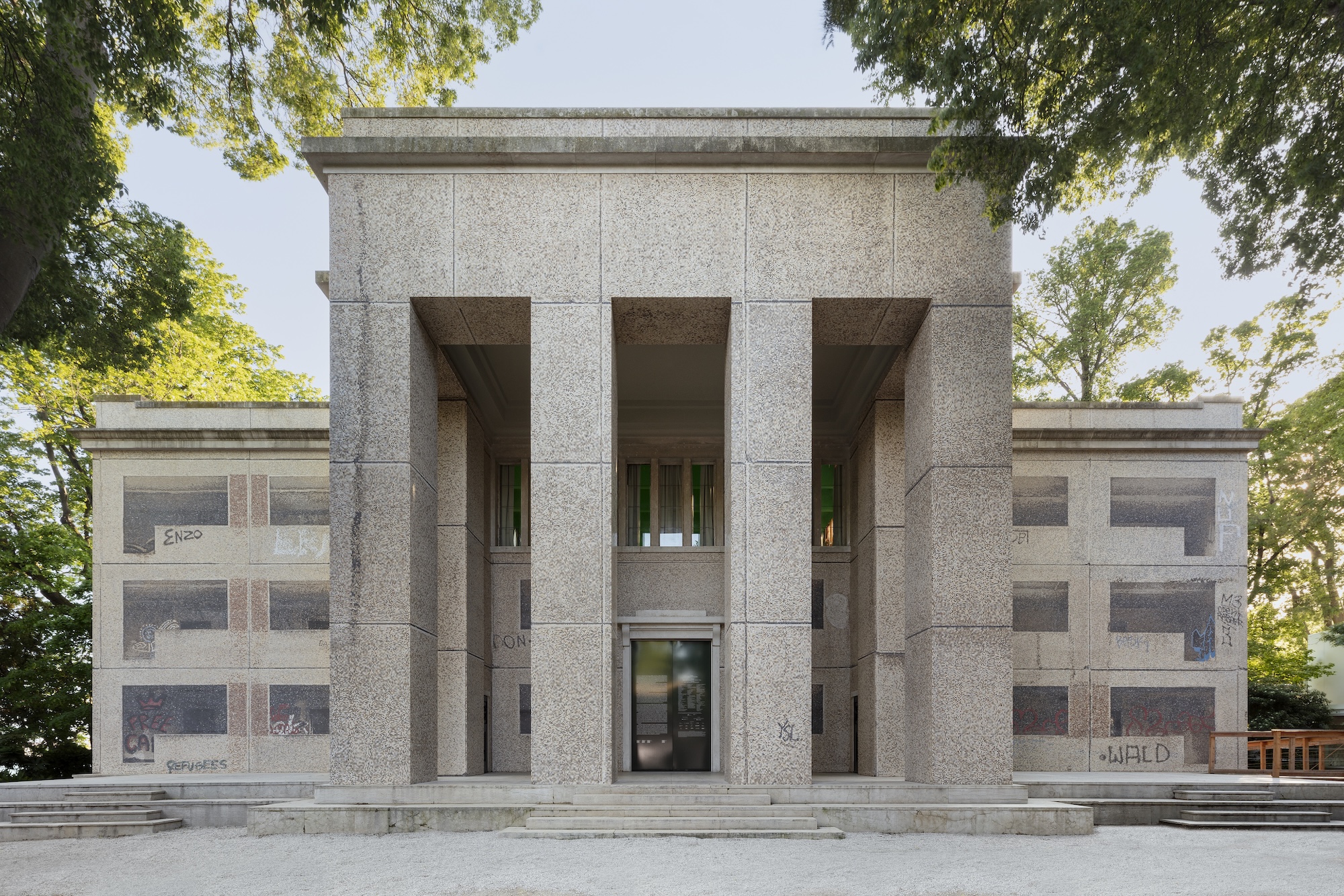
The German Pavilion in the Giardini has never been a neutral space. Its monumental architecture was commissioned by the Nazi party in 1938. In this year's Biennale, its fascist portico has been enveloped with Sung Tieu’s vast trompe-l'oeil mosaic, recreating graffiti tags and the remains of a 1:1 reconstruction of the façade of the Gehrenseestrasse housing complex in Berlin-Lichtenberg, the GDR's largest dormitory estate for foreign contract workers, where Tieu lived with her mother in the 1990s. The building is currently being demolished in Berlin as the Biennale opens. Titled Human Dignity Shall Be Inviolable (a direct citation of Article 1 of the German Constitution) the mosaic presses two incompatible architectures against one another: the fascist monumentalism of the pavilion and the crumbling egalitarian housing of the socialist east. The work is both personal and urgent. Tieu is simultaneously mourning a real place and forcing it into confrontation with the structure it now encases. These are two incompatible versions of German history pressed against each other.
Inside, the walls are painted a distinctive mint green (the colour of former Soviet army barracks in the GDR) and against them, the late Henrike Naumann has assembled an extraordinary interior with furniture climbing the walls, chairs arranged as a kind of chronology of twentieth and twenty-first century German history. Curtains, objects, and readymade domestic pieces accumulate into what Naumann called an “archaeological prehistory of the present.” In a side room, chocolate ladybugs (a recurring motif in Tieu's work, used as a symbol to represent childhood) are scattered climbing up the exhibition walls and throughout the space.
Seaworld Venice, Florentina Holzinger at the Austrian Pavilion, Giardini
Florentina Holzinger trained in choreography at the School for New Dance Development (SNDO) in Amsterdam and has long made work that tests the limits of what an audience can bear. Seaworld Venice, her commission for the Austrian Pavilion, is no exception, and it is, by some distance, the most talked-about pavilion at this year's Biennale. It is confident and garish, but its starting point is more considered than it first appears.
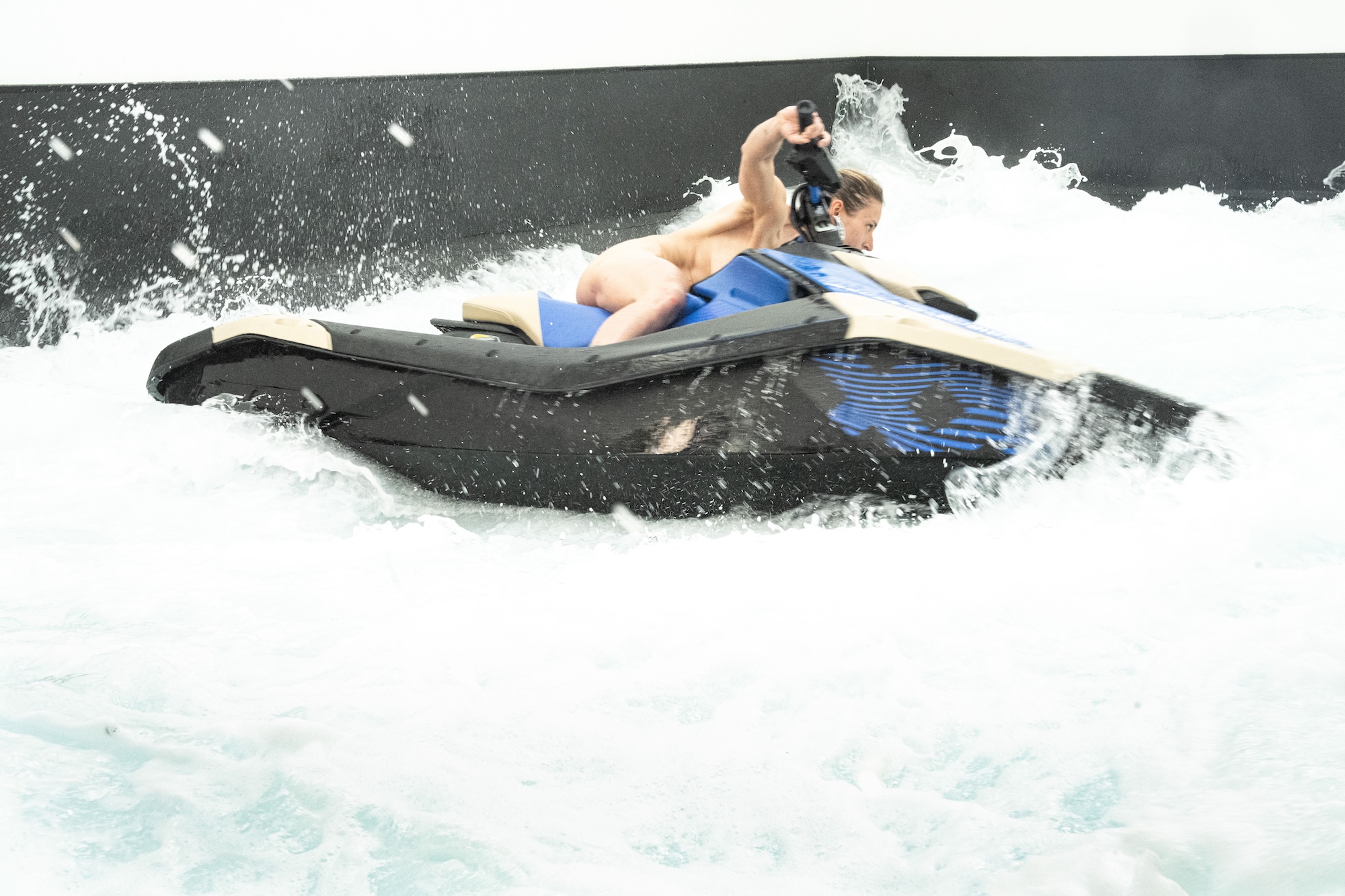
Holzinger's premise is Venice itself, a city, as she puts it “caught in a profound and precarious relationship with water,” she explains. “My ongoing fascination with this element will take on new dimensions. Here, the body will play a central role in exploring the interdependence and interplay between nature and technology.” What she has built from that premise is something between an underwater theme park and a sewage treatment plant. A vast bronze bell hangs above the pavilion, inscribed with the words TEMPORA O MORES - O the times, O the morals. Inside it, a naked female performer hangs upside down, using her own swinging body as the clapper, the sound rolling out across the Giardini through sheer physical force. Inside the pavilion, visitors are invited to use one of two portable toilets flanking a central glass tank. Their urine is filtered and pumped through the pavilion's chambers, in a closed loop that mimics the tidal exchange of the Venice Lagoon. In one tank, a naked woman breathes through a scuba mouthpiece, immersed in that same circulated water. In another room, a nude performer rides a jet ski in continuous circles, sending arcs of filtered urine water splashing towards passing visitors.
The mechanism is precise. Visitors use the toilet before they understand what they're part of; by the time they do, they are already inside the system. The disgust that follows is entirely self-generated. In this way the work makes a double argument: about how Venice is consumed and polluted by the tourists who claim to love it, and about how the female body is circulated by systems it does not control. Holzinger walks the line between spectacle and exploitation with uncomfortable confidence, which is, of course, exactly the point.
Fanfare/Lament, Matt Copson at Fondazione Sandretto Re Rebaudengo
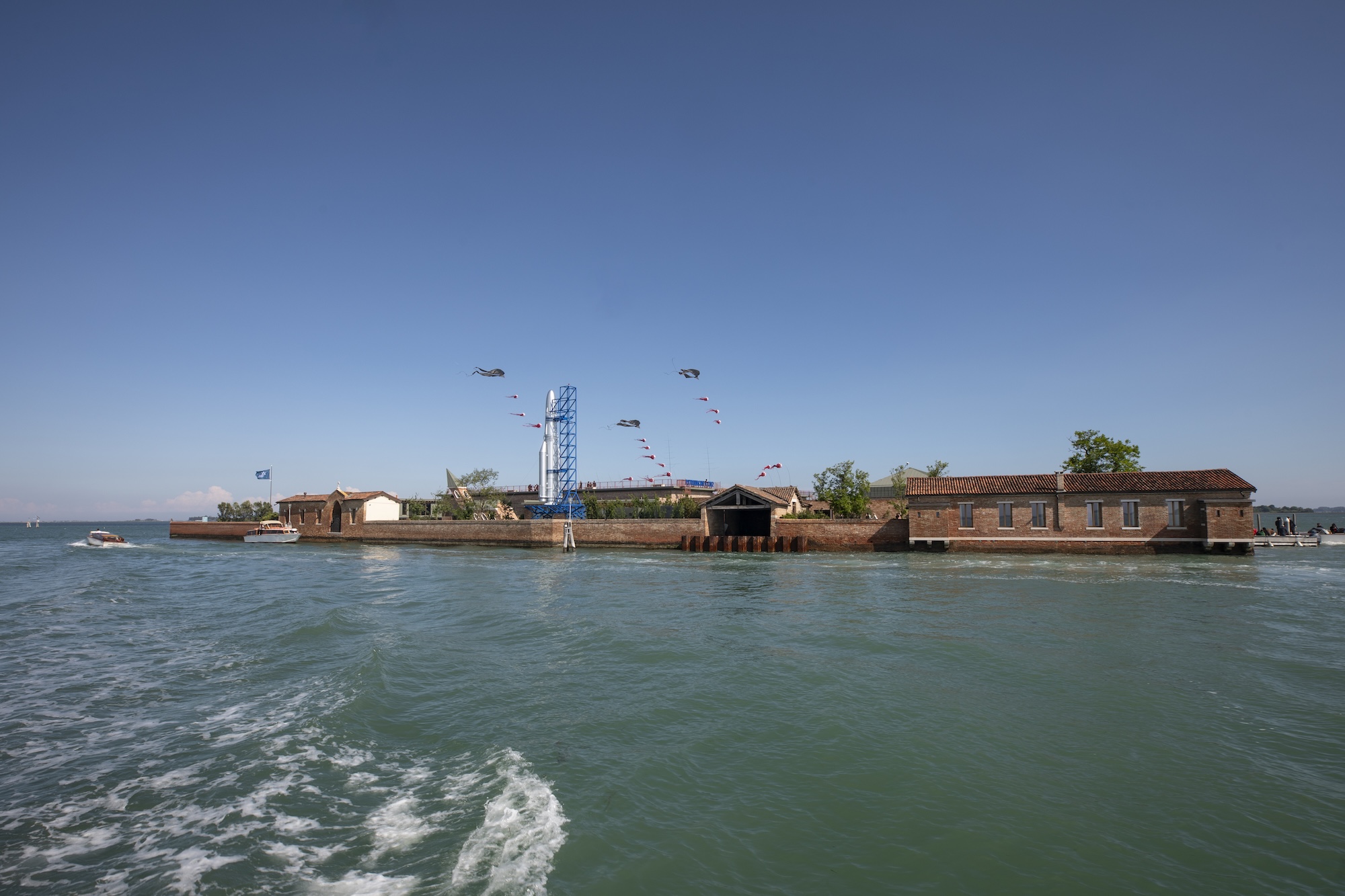
Approaching the island of San Giacomo, the feeling is somewhat medieval. Swirling bulbous, vein-threaded eyes kites fly above the Fondazione Sandretto Re Rebaudengo's newly renovated exhibition space. They billow and flap in the lagoon wind alongside an amorphous dark form suggesting a cave or void. The installation is durational: as the day progresses, the kites climb higher and multiply, so that by late afternoon the sky above the island is dense with these unsettling, organic shapes. It is an arresting spectacle. Descending downstairs into the long, darkened exhibition space, Matt Copson's laser drawings are etching into the exhibition walls. The intricate, luminous line drawings fill the room with a green glow, accompanied by a commissioned score from composer Oliver Leith. A brass band accompaniment that is simultaneously ceremonial and sinister, evoking the something film scores of a Pier Paolo Pasolini film in its ability to render the familiar strange. It’s immersive, disorienting, and slightly sincere.
It rests to the bones, Marina Xenofontos at The Republic of Cyprus
A tiny carved paper mache sparrow twitches its wings and tail, lying upside down on a small wooden table in a state of suspended mechanical repetition. Nearby, copper cylinders from Threads (2026), turn continuously on their axes, their low hum competing with recordings of folk songs sung by the artist's grandmother and great-aunts. Overhead in the entrance, hangs a replica of the ceiling of the Perroquet, a nightclub in the ghost town of Varosha, a resort district of Famagusta evacuated during the Turkish invasion of 1974 and sealed ever since. Xenofontos based the work on a photograph taken during the controversial partial reopening of Varosha in 2020, an act condemned by the US, the EU, and the UN as inconsistent with international law. Crucially, she chose to replicate not the club's celebrated cement reliefs by Christoforos Savva of abstract figures of women dancing, among the most significant works of Cypriot modernism, and themselves the subject of an ongoing ownership dispute between the original commissioner and the building's Greek Cypriot owners, but the wood-panelled ceiling above them.
The Perroquet opened in 1965, five years after Cypriot independence. By 1970 it was hosting what is now documented as ABBA's first ever performance, a detail that speaks to how cosmopolitan Varosha had briefly become. In 1974 it was over. The north was occupied, Varosha evacuated, its residents expecting to return within days. They never did. Xenofontos's relationship to this history is inherited rather than lived, and the work is honest about that distance. The presentation is fragmentary and second-hand, held together by family memory and archival images, handled with compassion and care. The pavilion asks what it means to represent a nation whose modern identity was foreclosed before it could fully form — and whose division remains unresolved.
Grass Babies, Moon Babies, Ei Arakawa-Nash at Japan Pavilion, Giardini
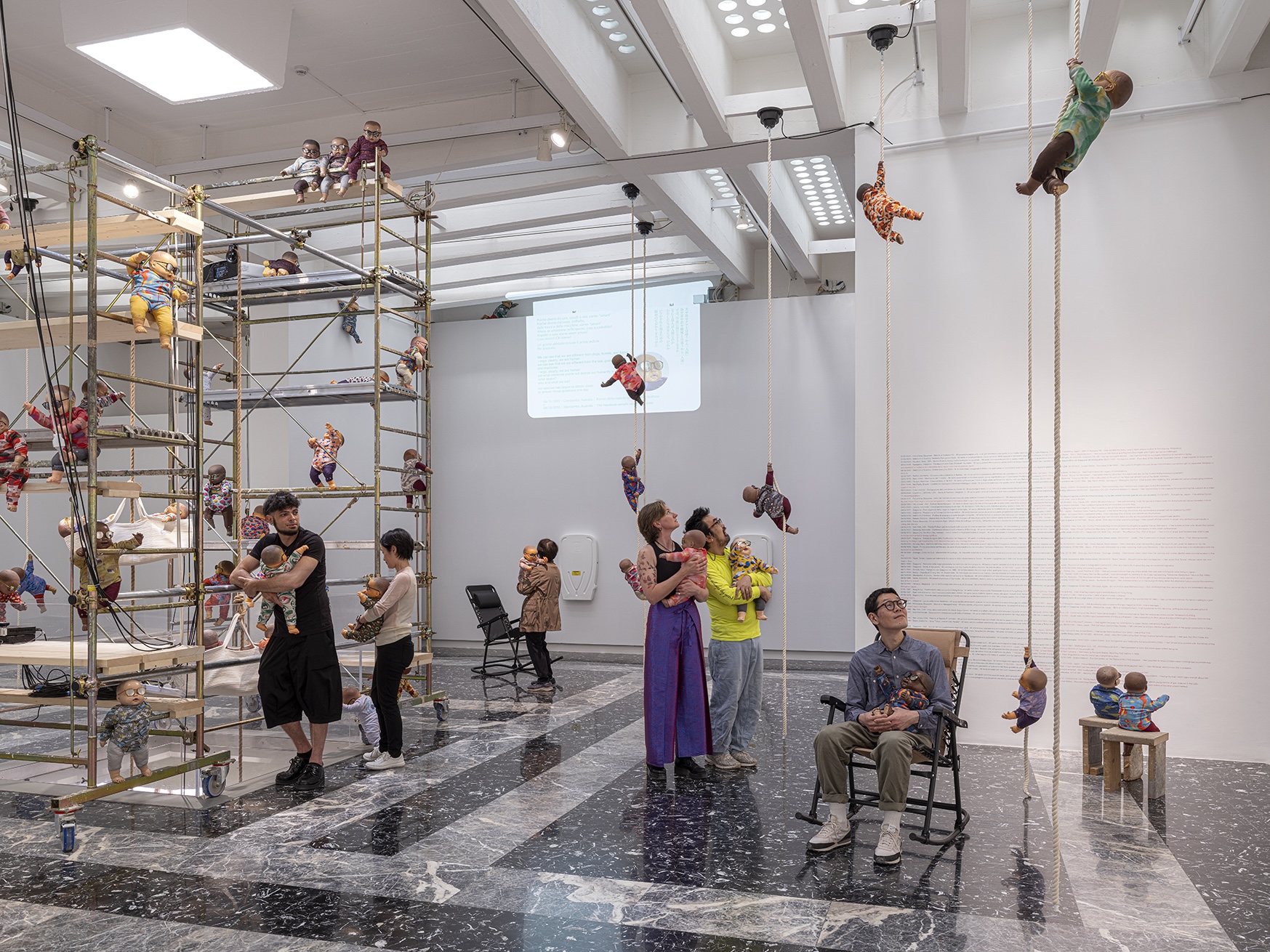
The exterior of the Japanese Pavilion is lined with prams. It is the first signal of what awaits inside. Grass Babies, Moon Babies by Japanese-American artist Ei Arakawa-Nash, brings together 208 weighted dolls, each wearing mirrored sunglasses, arranged throughout the space. Visitors are invited to pick one up and carry it with them, adopting the role of a parent. Care, here, is not metaphorical. It is a physical demand the work makes of you, however briefly.Each doll has been assigned a birth date, and a QR code unlocks a poem tied to that date which you can read whilst changing the baby's nappies. What makes the work so distinctive is the behaviour it draws out of people. Some visitors cradle their dolls instinctively, adjusting their hold, supporting the weight with the attentiveness of a new parent, whilst others carry them at arm's length, stiff and self-conscious. The mirrored sunglasses reflect these responses back at you, implicating the viewer in their own discomfort. The pavilion asks, without ever quite stating it, whether we are adequate custodians of what comes next.
Untamed Assembly: Backstage of Utopia, MAREUNROL’S, Bruno Birmanis, at the Latvian Pavilion, Arsenale
.jpg)
At the Arsenale, a room almost entirely filled with empty, interlocking clothing rails, with some of the metal poles twisted and warped, and clusters of wire clothes hangers held by sculptural birds in flight, sets the scene for the Latvian Pavilion's exploration of the Untamed Fashion Assembly (UFA) archive. The UFA festivals were acts of radical self-determination in a society only just released from Soviet control and the installation immediately sets up the extravagant, carnivalesque spirit of the original festivals that took place in Riga from 1990 to 1999. Founded by designer Bruno Birmanis, Riga turned into an unlikely avant-garde fashion capital. The annual festival was an extravagant affair, presenting installations and runways shows of alternative, experimental fashion and drag performance, drawing a young Baltic designers including Juozas Statkevičius, Sandra Straukaitė, alongside international fashion figures such as Paco Rabanne, Vivienne Westwood, Zandra Rhodes, Viktor & Rolf and Andrew Logan.
Folded chairs line one side of the exhibition walls are upholstered in archival imagery, whilst full length mirrors with stickers from the archive line the other. A side room screens newly digitised footage of the runway shows themselves, revived by interdisciplinary duo MAREUNROL. The archive becomes a lens through which to examine themes that feel significantly urgent today. What remains of this utopian, experimental vision today, especially whilst under threat from neighbouring powers. Carnivals like these were rarely just parties. In a society newly released from Soviet control, where identity had been suppressed, borders had been closed and self-expression had been policed for decades, the act of dressing up, and gathering together and making something excessive and beautiful was extremely political.
Helter Skelter, Richard Prince & Arthur Jafa at Fondazione Prada
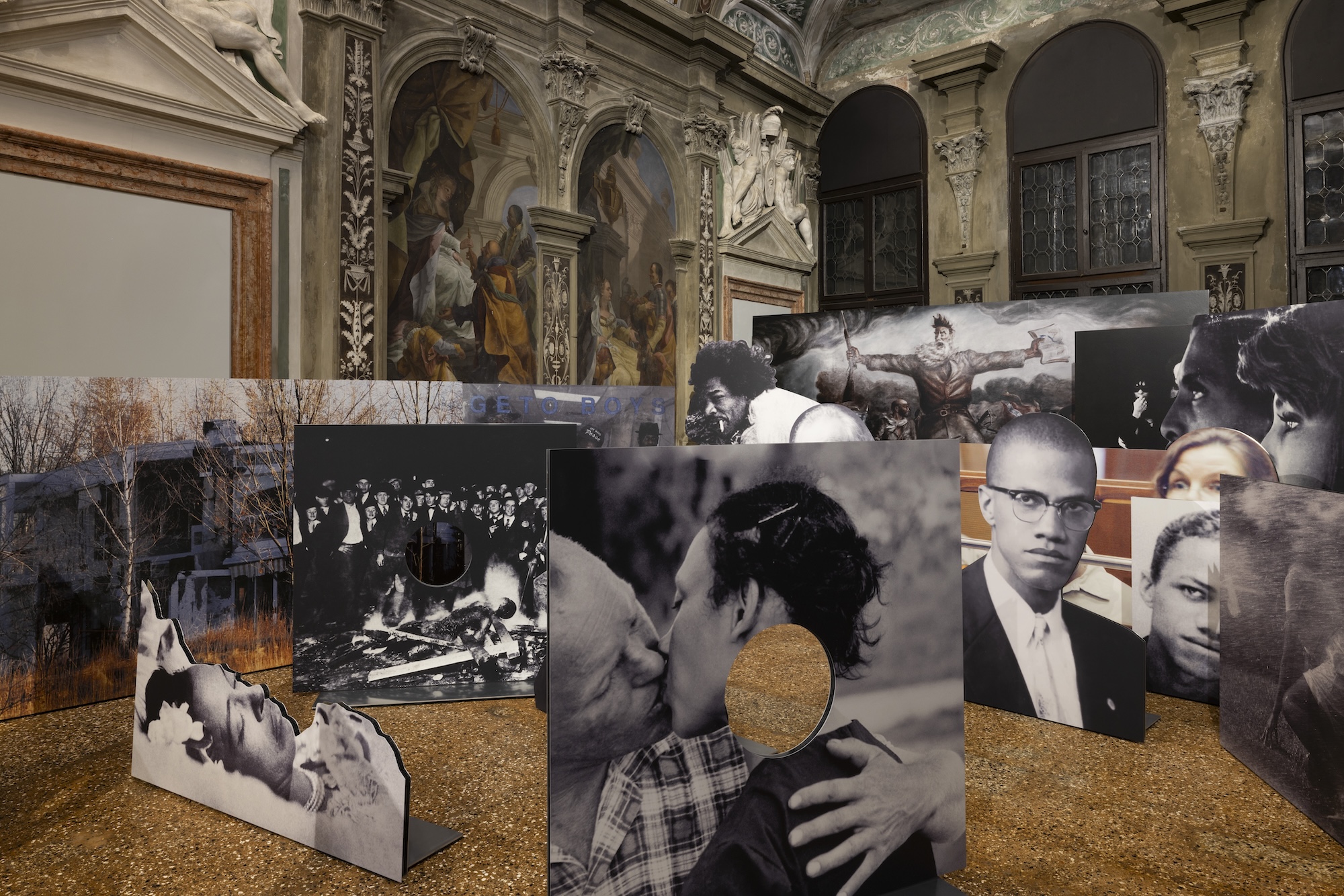
Walking into the Fondazione Prada's Ca' Corner della Regina, one of the courtyards is filled with black car tires, cut to near-equal size, stacked, threaded and hung like a chunk of meat in a butcher's window. Around the corner, another tyre is truck-sized, wrapped in a chainlink jacket, whilst upstairs, a motorcycle stands alone in the centre of a room. This is Helter Skelter, a visceral opening to a show about race, cults, sexual exploitation and subculture. And, in a way that feels almost perversely seductive, the decline and fatal fall of the American dream.
Arthur Jafa and Richard Prince have never been formally paired in an exhibition before and the friction between them is difficult to ignore. From the late 1970s, Prince rephotographed and appropriated other people's images. In one photo series, Marlboro cigarette adverts of cowboys are stripped of their logos and reframed, almost revered in admiration of white American masculinity. In another photoseries Girlfriends images are lifted from the back pages of biker magazines like Easyriders, where readers submitted amateur snapshots of women posed on Harley Davidson motorbikes. The photo series brings about many different questions: who owns images? Is Prince exposing the male gaze, or indulging it? Many of Arthur Jafa’s major video works are displayed, including Love is the Message, the Message is Death (2017), which collapses the Black American experience into seven minutes of found footage. Police shootings, alongside footage of Barack Obama speeches, historic violence and gospel ecstasy is set to Kanye West's Ultralight Beam. Both Prince and Jafa produce a friction in their appropriation of imagery, twisting the meaning or perspective of images that already exist, and in doing so, reveal an honest reflection about America than either could produce alone.
5 Works, Lydia Ourahmane at Nicoletta Fiorucci Foundation
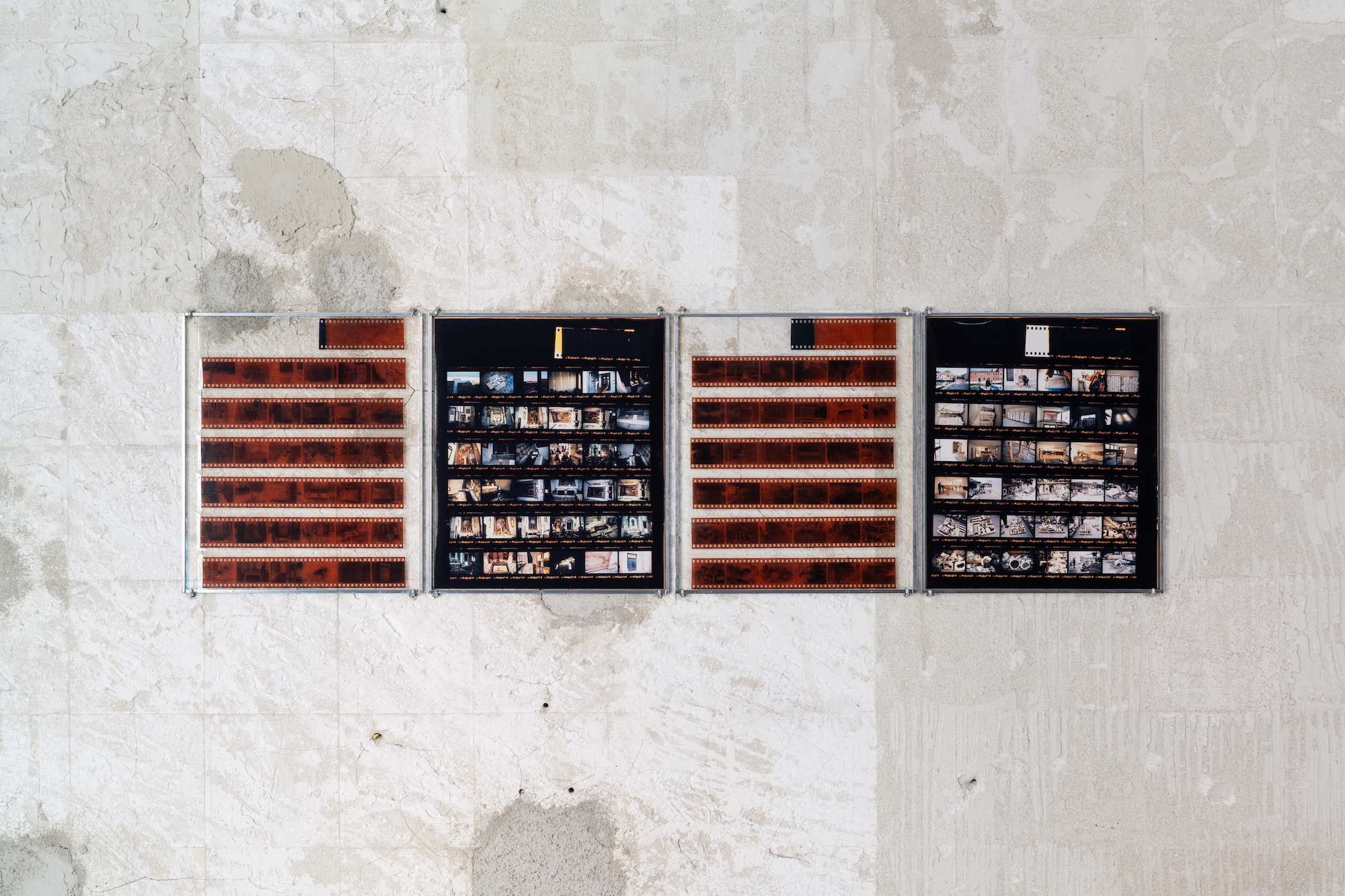
Just off the canal walkway in the Dorsoduro district of Venice, in the first room of the Nicoletta Fiorucci Foundation, visitors come face to face with an ominous, empty pier. It is a fully functioning structure that was commissioned by Lydia Ourahmane and built with Venetian craftspeople, which will eventually be transferred to the largely inaccessible island of Poveglia, an island on the outskirts of the Venetian lagoon. Abandoned since the late 1960s, the island was once a medieval military outpost, then a place to quarantine during the plague, then later housed an asylum. Ourahmane became fascinated with the island – a haven for local Venetians to sunbathe and escape from the city during the summer – and by a grassroots movement called Poveglia per Tutti (Poveglia for All), who mobilised in response to the Italian government threatening to auction off the island. Over 4,500 citizens donated to the cause, raising €460,000 in just 40 days in an attempt to keep the island in public hands. After more than a decade of legal battles, the association finally won a six-year concession in August 2025. Ourahmane's pier, for now, stands still, an object charged with a purpose it cannot yet fulfil. Once the show ends, it goes to Poveglia, making access to the island finally possible from the water.
This collapse of art object into political gesture is characteristic of Ourahmane's practice, which consistently refuses to merely illustrate displacement or inaccessibility, preferring instead to enact it. In the next room, a curtain of Murano glass beads taps and shivers as visitors pass through. Nearby, cast negatives of architectural columns and a cherub titled Angel (2026), press their imprints into the wall, facial features and body legible only in absence. The work evokes what Duchamp termed the inframince: his deliberately undefinable concept for the imperceptible trace left between two things, like the warmth on a seat just vacated, the barely-there difference between objects cast from the same mould. Here the logic runs in reverse: where the object once was, the space it occupied remains. The negative becomes the subject. Nearby, cast columns stacked on shelves evoke civic architecture and the infrastructure of power, but hollowed out, their authority is revoked.
The next room contains a bubbling pot of soup, its aroma drifting down the corridor is made in collaboration with TOCIA! Cucina e Comunità, a Venetian community kitchen. Further along, a room is packed almost full with decommissioned white bed linen stacked in industrial metal trolleys. The trolleys and sheets are immediately legible as the back-of-house store rooms of Venice's vast hospitality industry, the infrastructure of a city that hosts millions of tourists a year. Stripped of use now, stacked and stored, they are a monument to all the bodies that passed through, visited, left their trace, and moved on. Together they pose a sharp question: what is Venice actually for? The community or transaction?
Canicula, Fondazione In Between Art Film

The dog days of summer conjures up feelings of that overwhelming sticky, exhausted oppressiveness, which turns out to be an unexpectedly apt metaphor for the present moment. Canicula is the final iteration of the Fondazione In Between Art Film's Trilogy of Uncertainty series. Eight site-specific video installations are spread across the Complesso dell'Ospedaletto, a former hospital, with each work engaged with themes of control, political (mis)information, war, collective memory, and the administration of truth. The exhibition opens in Santa Maria dei Derelitti, a Renaissance-style church, where a large-scale freestanding screen cuts across the nave and a red tinge light bleeds across the room. Janis Rafa's Baby I'm Yours, Forever (2026) is screened and sets the temperature to the exhibition immediately. Shot inside a meat refrigeration facility, it uses the mechanics of the food industry as an allegory for sacrifice. Upstairs, Lawrence Abu Hamdan and Wang Tuo hold a quietly insistent dialogue across the former hospital's rooms. In the frescoed Music Room, Abu Hamdan's 450XL: The Story of a Fugitive Sound (2026) reconstructs the sonic traces of a dispersed peaceful vigil in Belgrade on 15 March 2025, voices and sounds distributed across screens of differing heights. Across the way in the former pharmacy, Wang Tuo's The Experimental Paradigm of Ownership and Autonomy (2026) approaches the same territory from the opposite direction. An invented narrative documents the tension between the individual experience of events and organised forms of political life. Together they ask what remains when power sets out to erase not just the evidence of collective experience, but the very impulse to gather.
Counterforms, organised by Neue Alte Brücke + Matt Williams at A Plus A Gallery
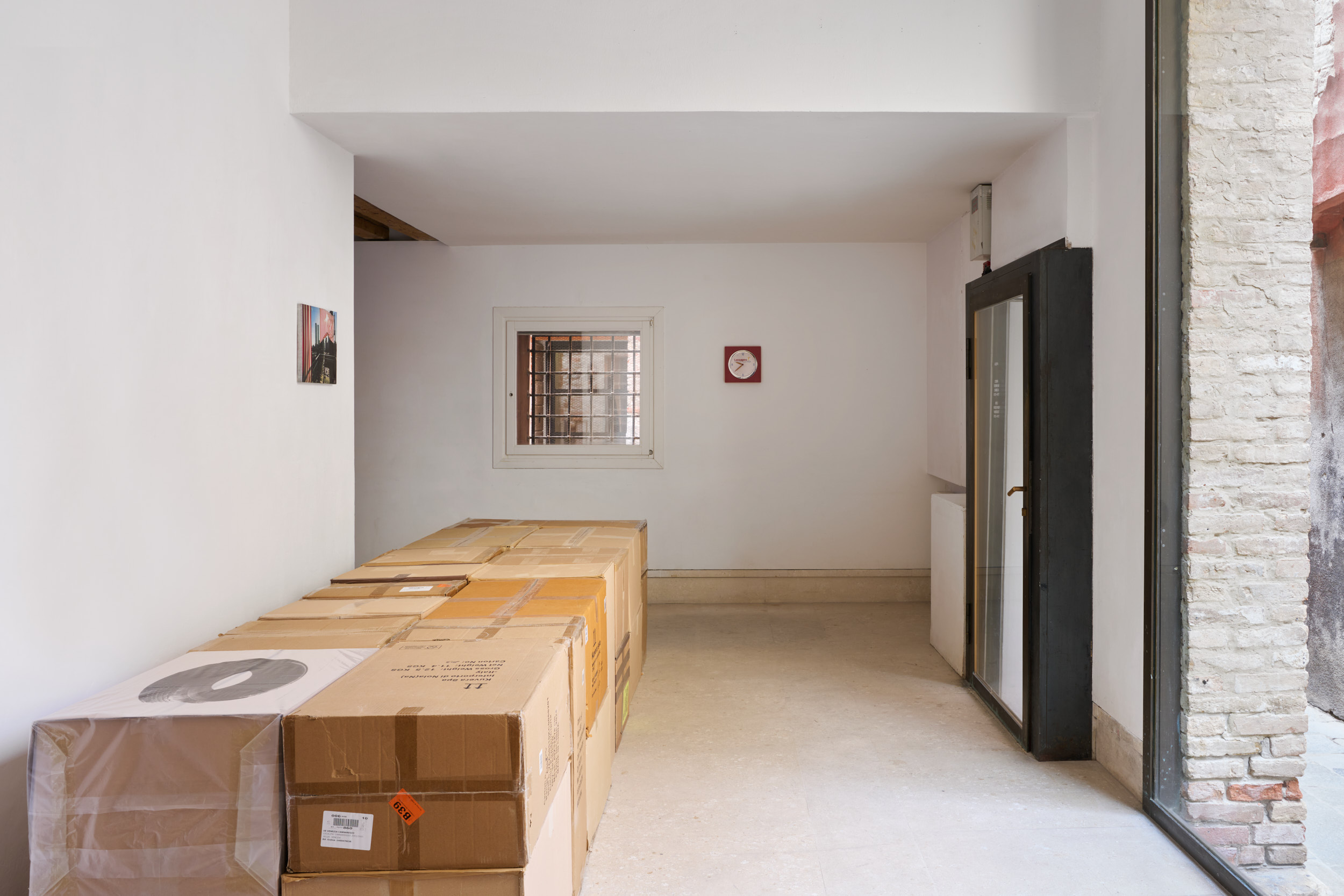
Taped cardboard boxes line one wall of the gallery. This is the administrative infrastructure of art-making rendered as a sculptural object in Anna Howard's Glitter (2026). Above them, Racheal Crowther's small pharmaceutical clocks branded with antidepressant names punctuate the walls above, their hands fixed at different times. Opposite, Nat Faulkner's large-scale photograph Untitled (Cast) (2026), depicts a jar holding dried flowers. The image is split in two. One half sepia whilst the other black and white, In a way that is distinct from Faulkner's, there is little separation between image and the material processes that produced it. The image, resting on the ground, incorporates tape, dust and the residue of handling directly into the photographic work. The exhibition's title borrows from typography, where counterforms name the voids within and around letterforms. Counterforms are spaces that make a character legible, and that give proportion and rhythm to the page. This logic extends into the gallery, where what surrounds or precedes a work, (i.e. its packaging, apparatus, duration, distribution) operates as an active condition rather than neutral support. Other works locate significance in what was never intended to carry it. Anna Clegg's Exterior 10 (2025) depicts a bell once coupled to a tidal sluice system, a mechanism for marking time through water and sound.
__
Sofia Hallström is a writer based in London.


