In Conversation with Lydia Ericsson Wärn
Words by
Lydia Earthy

Basically, the last couple of finished paintings I’ve made – whether it’s one, two, or more in the studio always serve as the starting point for the next work. It’s a kind of call-and-response process: certain things from the previous group of paintings feel like there’s more to explore, and other things feel finished for the moment. For example, I had just been working on a group of pieces for a show in Stockholm. That work then became the foundation for the next paintings I made. So, in that sense, everything I just completed informs what comes next.
The Stockholm show had a wide range of works, in many sizes, so for the Brunette Coleman show I felt a clear impulse to do the opposite: something much more condensed. Early on, I thought about making probably five works for that space. I also felt a need – or desire – for more colour. The previous show had been more subdued, grey, and while that’s still something I’ll continue coming back to, for Cocoon I wanted something more vibrant.
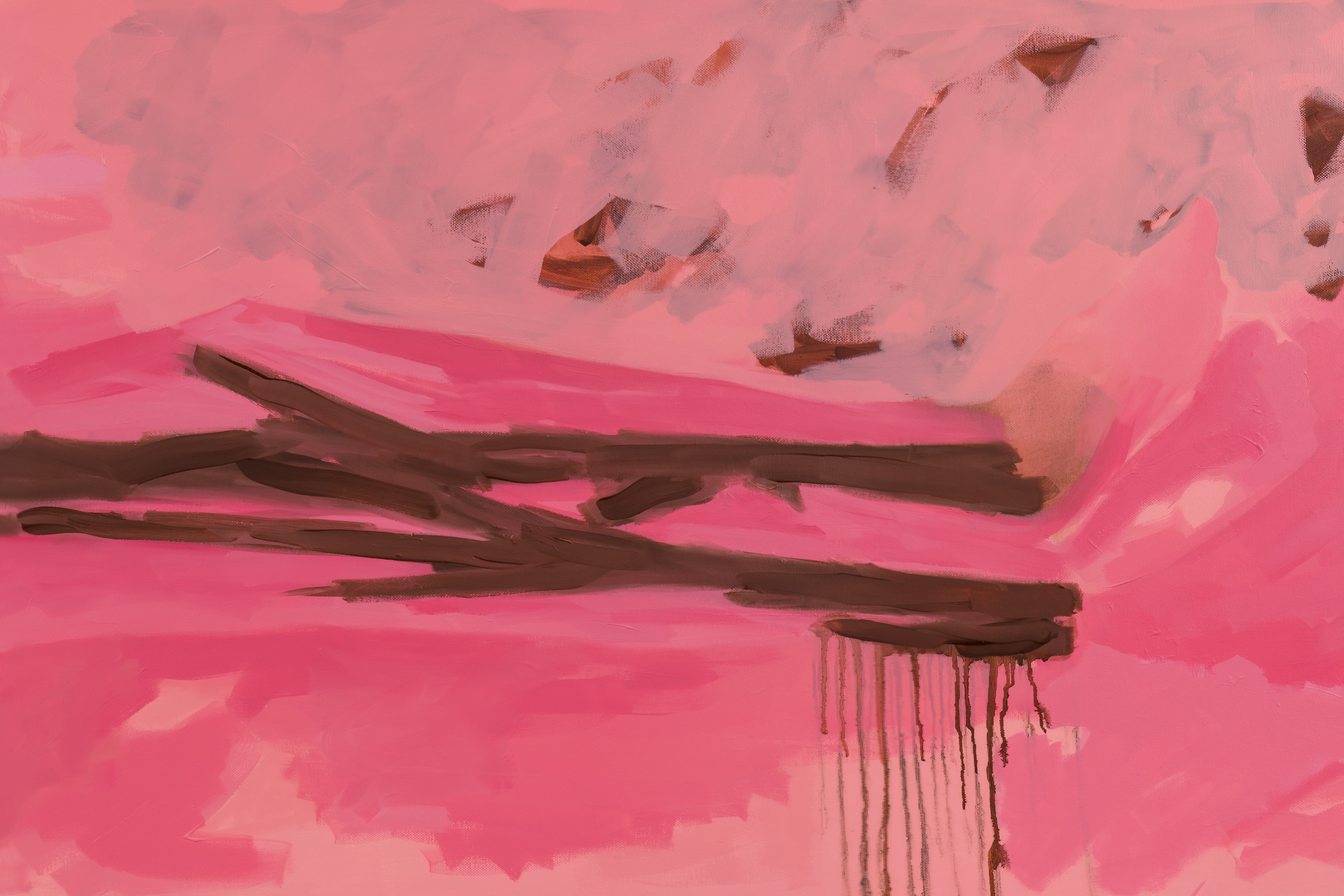
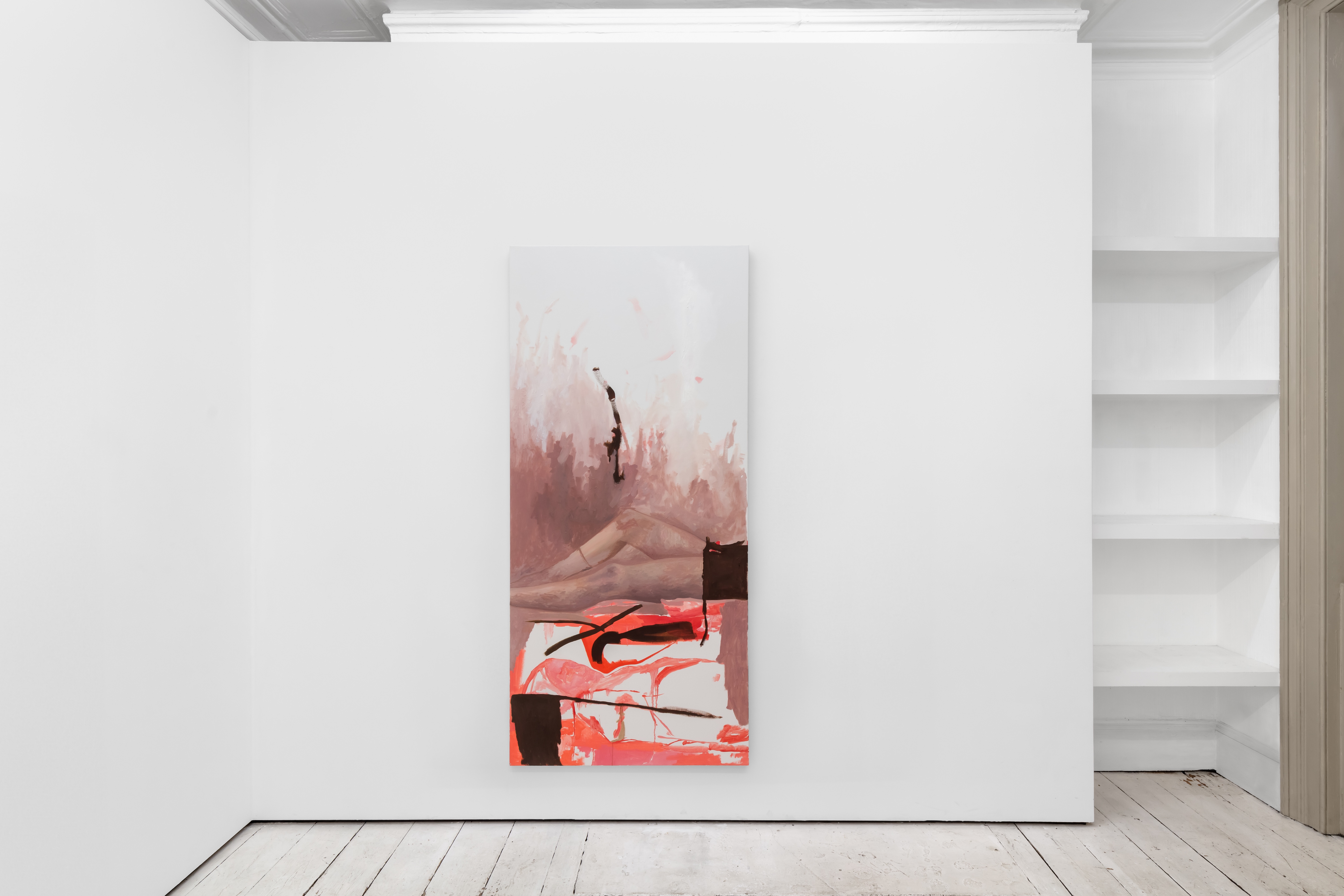
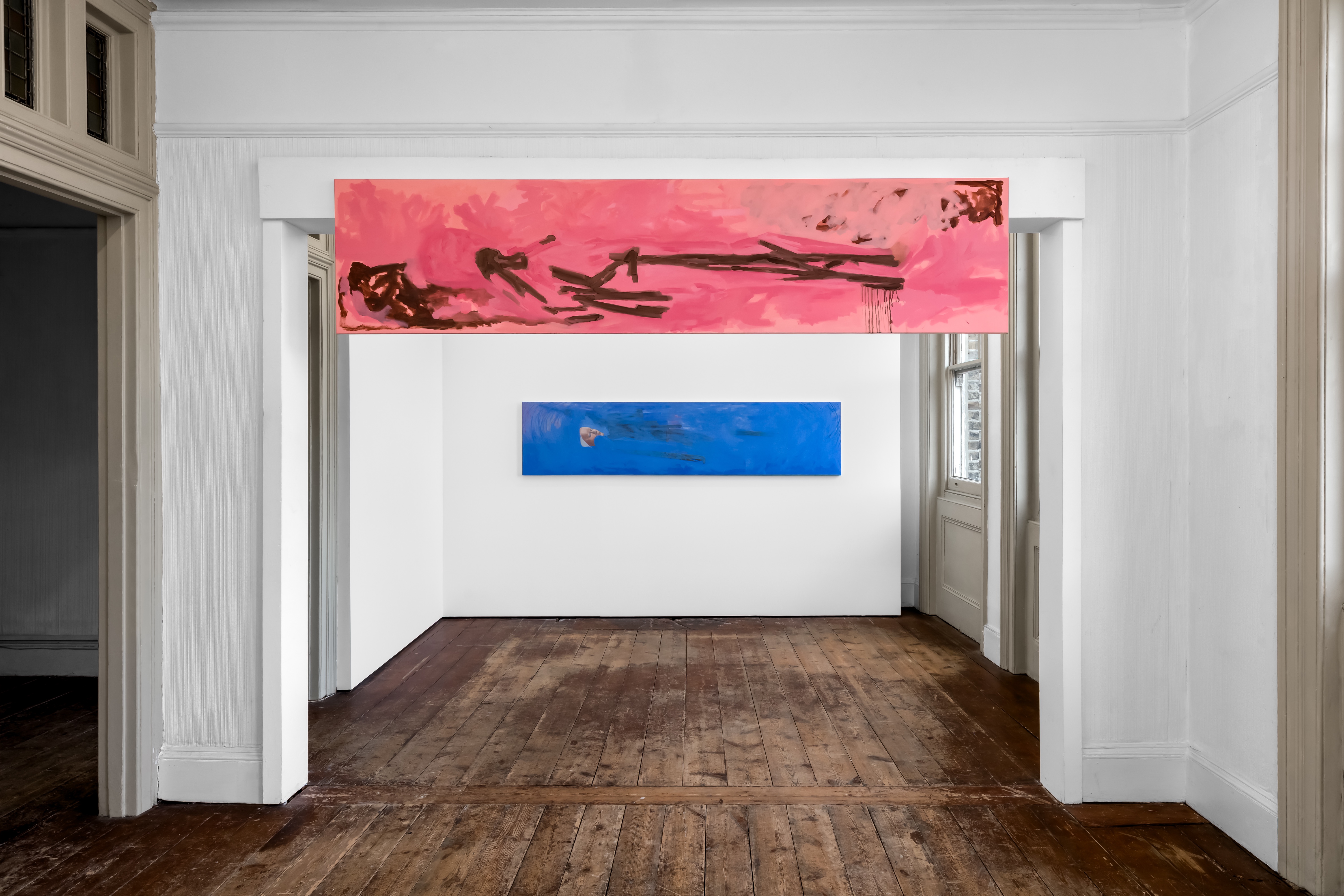
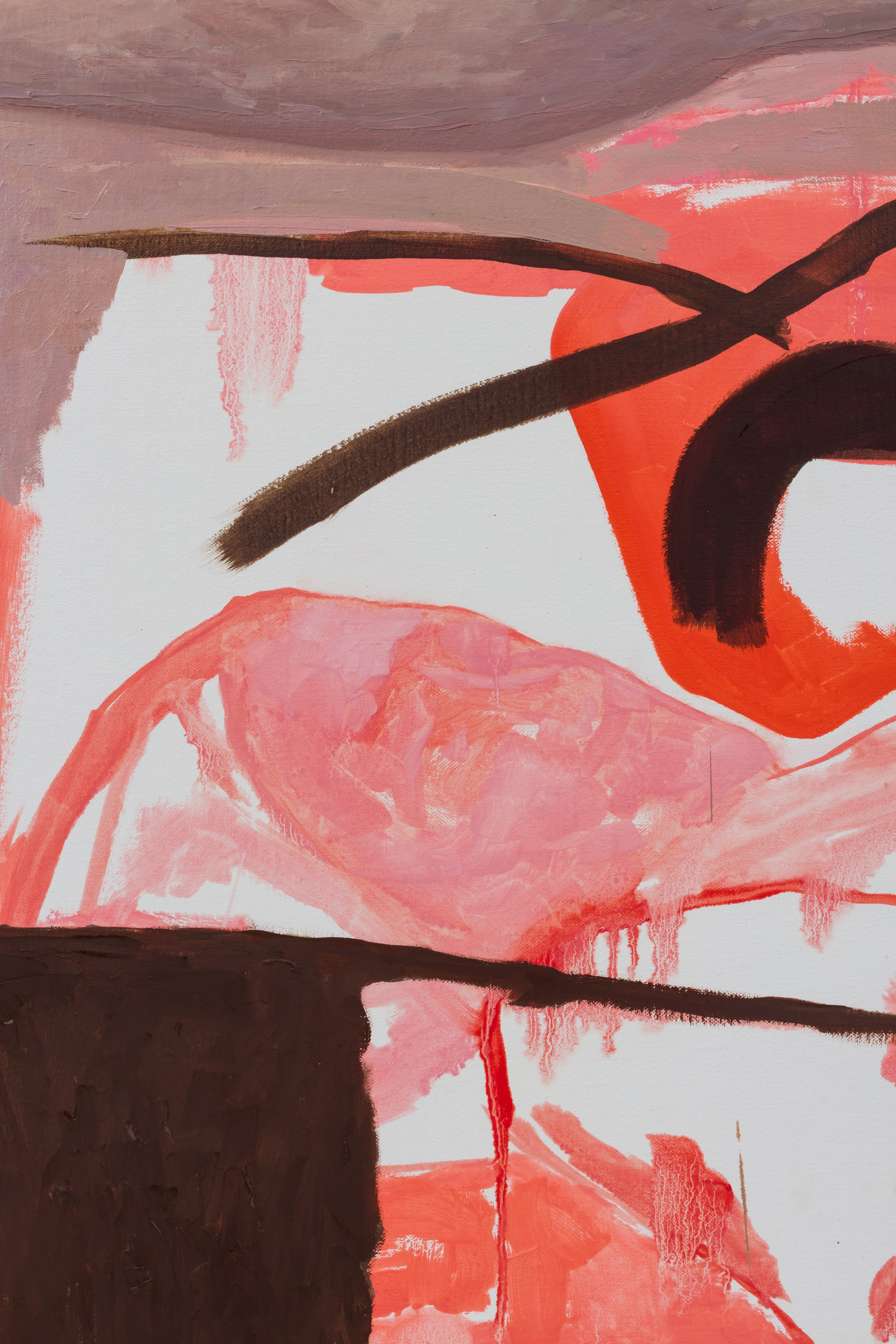
The pair that eventually became Blue Function and the Pink Brown Analogue started as an inner image, which is often how my work starts. It’s a kind of psychic desire, an image that comes from inside, something I want to conjure and experience while making it. It may sound abstract or even psychoanalytic, but that’s essentially it: an urge to bring something from the unconscious into being. I think that I, like many other painters, are slightly fetishistic: it's about wanting to create this object in a space, in a room for you to spend time with and enjoy, and wanting to see it coming into being.
Holbein’s painting comes up a lot as a reference in my work, and it’s interesting to reflect on why. The first time I saw that painting, it unlocked a solution to a formal problem I’d been having. At that time, I was working with more conventional height-to-width ratios, and I’d been struggling with what to do with the leftover space surrounding the body.
I had been painting singular figures – reclining, sometimes on all fours, moving through the canvas – and that focus on the solitary figure was important to me. The narrow format that allowed me to eliminate all the unnecessary space, which gave me a sense of freedom. There was freedom in that constraint.
Repetition allows me to formally engage with the idea that a single painting can contain many ‘paintings’ within it. That includes trials and errors, where I paint over something that doesn’t work, but also iterations – it’s not “this or that”, it’s “both”. Repetition lets me explore that “yes, and” approach.
For example, in Blue Function and Pink Brown Analogue, both exist simultaneously. It’s not one or the other. One aspect is figurative – the reclining body – and the other is more abstract. Without the figurative reference, the works might be read as primarily abstract. So the repetition allows me to consider multiple possibilities in parallel, rather than choosing a single outcome.
I don’t see myself as a narrative painter. There isn’t a story unfolding across these paintings or between the figures. It’s about exploring the body as a repeated form, a matter of presence. The repetition reflects how the body is our first and final matter, a kind of constant in life. It also creates a stable container or framework, which lends itself to experimentation and ongoing construction. So for me, the repetition is formal, but also conceptual. By keeping certain elements the same, the variations and negotiations in the work become more pronounced. It’s not definite; by repeating the same motif over and over again next to one another in a show, there’s no point of arrival. It’s a continuous renegotiation.
Yes. First, I want to say it was really great because it felt very free. Anna and Ted placed a lot of trust in me, but I felt very free to put whatever I wanted in the show. That was really important to me.
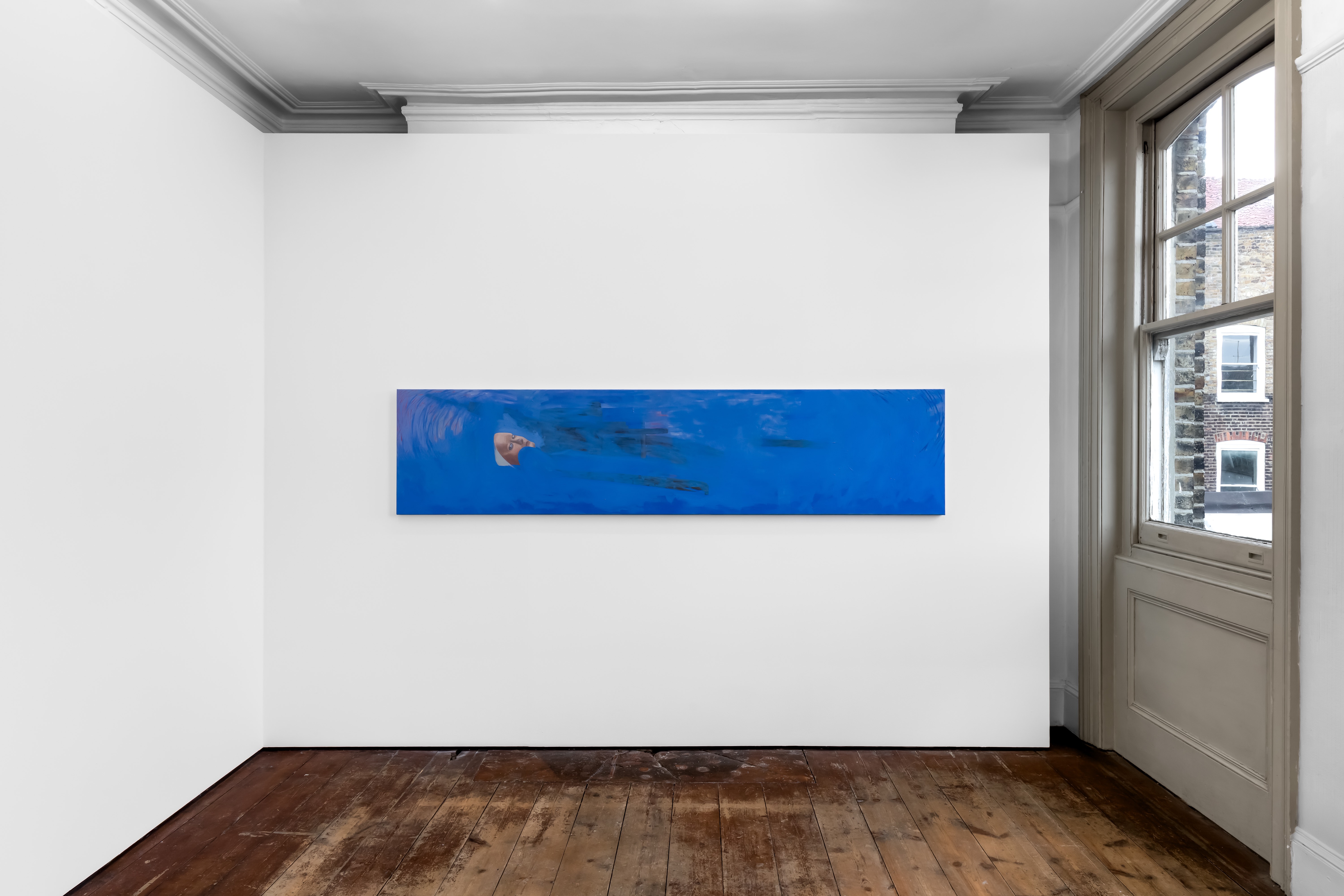
In terms of scale, I like placing large works next to small ones. It exaggerates the works in both ways – the large emphasises the small, and the small emphasises the large. It’s remarkable how it changes the perception of the figure. Small works feel delicate and intimate, while the larger ones can be imposing – people often describe them as coffin-sized. The same image in two different scales has very different effects: one becomes a petite figure you can almost hold in your hand, while the other is life-sized and commanding.
There are different ways of painting. With the large works, you paint actively with your whole arm; with the small ones, it’s painting with your wrist. These are different modes of making the painting as an object. I also think of the small ones not as sketches, but often as models – like a model of a model – a kind of prototype within the work.
It’s a difficult question. I wanted to make a painting in which the format itself – the height, proportions, and all the elements that define it as an object – took precedence over the content, the body, or the figure. I’ve done something similar before, but with a different result. Instead of starting with the figure and sizing the canvas accordingly, I first considered the wall or space the painting would occupy. This one is about 180 cm in height, human-sized. By starting with the format, the figure becomes subordinated, and it allows me to explore the dynamic between form and subject. It’s another iteration of the same idea.
The starting point for the title comes from the succession of my previous shows. The show I did in Stockholm at Issues was called Core, and an earlier one at Meredith Rosen Gallery in New York was called Centre. For me, I like the continuity – from Centre to Core, and then to Cocoon. It’s a subtle shift, but I like to think of them as linked, as a succession.
Whether the figures in the paintings are emerging or dissolving really resonates with me. Cocoon felt right because it continues the succession – and because it evokes a space where something is being created, a space before language, where something is coming together. It can be protected, and personally, I also liked the connection between the studio and the cocoon. A studio is very much like a cocoon: it contains the paintings and me as the reclining model. There’s this doubling – the works contain me, and I exist inside the studio-cocoon making them.
Yes, exactly. I like the idea of a container in relation to my work because it operates on multiple levels. It works for the painting itself and for the body depicted in it. When I start a painting, I choose a format and make a drawing of the figure. I spend a lot of time considering the ratio between the figure and the canvas the size of the painting as an object. From there, how much of the figure remains visible in the final painting is unknown to me. For example, in Blue Function, there’s a figurative figure beneath the surface, partially hidden under swaths of blue. There’s always a balance to negotiate: what to preserve and what to paint over.
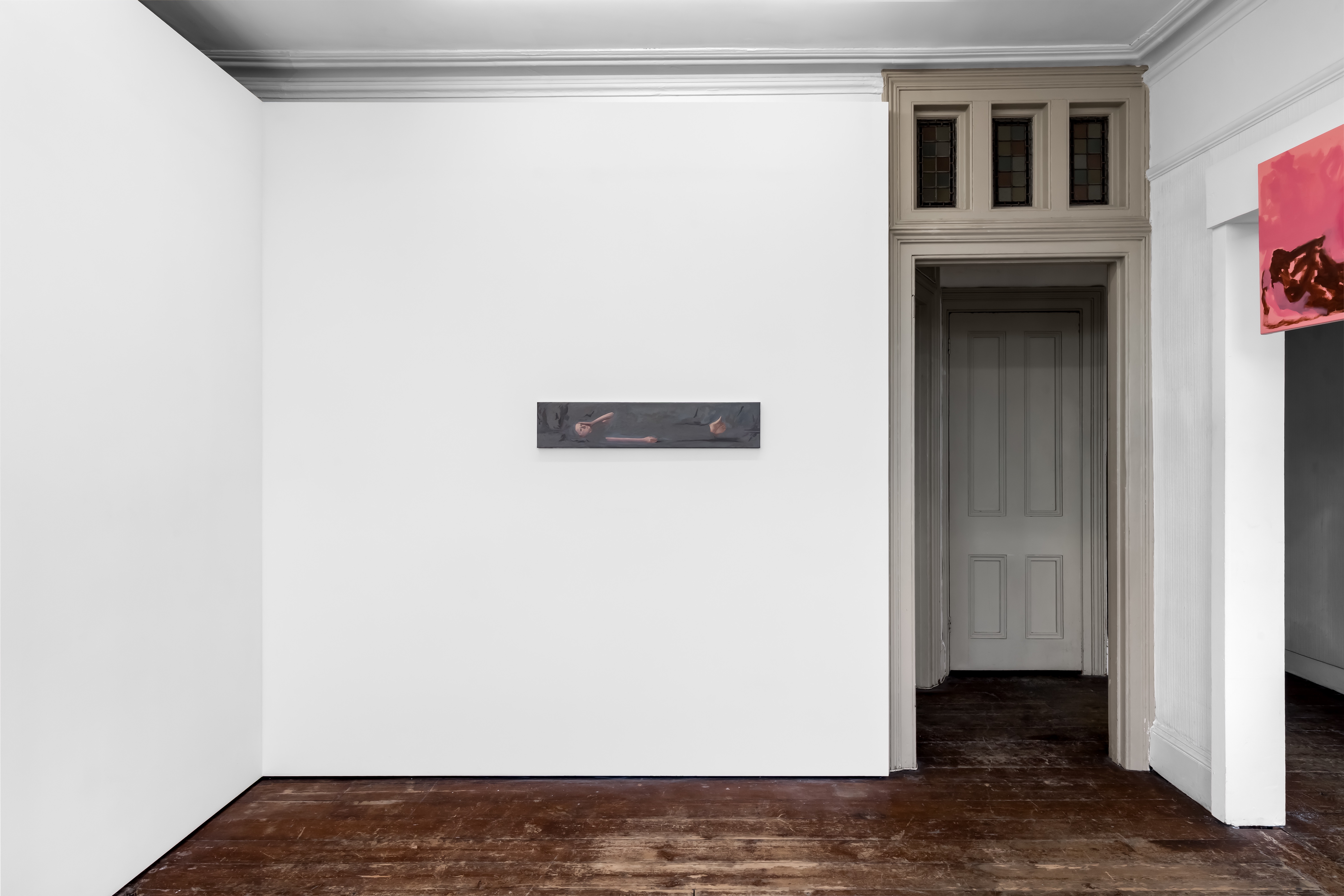
It’s a good thing when they do. The longer I work, the more I realise that the experience I have while making the work is what’s most important, because that’s what is left. Paintings come and go – some work out, some don’t, and some stay in the studio unseen. When a figure surprises me, I get really excited, and that’s usually what I aim for each time. Sometimes I succeed, sometimes I don’t.
It’s perhaps not just about the figure – it depends on how precisely you define the word – but I no longer really separate the figure from the painting itself. The figure is, of course, in the painting, but I think of it as a painting first. What I paint is this figure, folded into itself. For me, the default is that I’m making yet another iteration of the figure. And within that, there are surprises – moments when it feels right.
Yes. The painting and the figure become one, interchangeable, inextricable. I wouldn’t, however, call it a reckoning with the self – at least not directly. The works aren’t portraits of me; they’re rooted in the experience of inhabiting a body, which is universal – our first and final material. Yes, they happen to have my form, but it’s more about a state of being. Using myself is just the default – it’s what’s at hand.
In the beginning, sometimes I would use other people as models. That brings a host of decisions: who to use, what body type, shape, size, age – all of that carries meaning. When you depict someone else, it becomes relational – the viewer naturally asks, “What is the relationship between the artist and this person?” Using my own body removes that. It lets the work be about the experience on the page, about the state of being, rather than the dynamic between artist and model.
There’s also a space here for another conversation about the relationship between the artist and the artwork. How the artist and the work become, in some ways, one and the same, and what that means.

It was such a good thing to have studied with both of them. They went back to back, alternating every other semester. Both of them really have their own strong perspectives in terms of their work, their teaching, and just their general approach to things. I got to learn very different things from each of them as a result of that.
Amy really taught me to not fear the canvas. She encouraged me to go at it fully with no regrets, to embrace the process, and to not fear destruction. Destruction, or near destruction, plays a big role in how I try to finish a painting, and that’s something I learned from her. When you’ve worked on something for a long time, you’re so invested – emotionally, time-wise, economically, materially – and you can feel it’s not working: it’s not what you wanted it to be, it's not doing whatever you thought you could do. The only thing you can do then is go at it, be brave, and paint things over. You often come close to ruining it, and that’s part of the stakes. But it also taught me that removing something is just as important as adding something.
Monika, on the other hand, taught me the value of precision and decision-making. She would ask, "Why does it look like this?" If you couldn’t give an answer, she wanted you to have agency and understand your decisions – your call and response.
Because they were so different, I also learned that there’s no single “right way” to do this work. Everyone finds what works for them, and you have to figure that out yourself. On an interpersonal level, it was also very positive for me that they were both women. It has meant a great deal. I don’t think I’d be the painter I am today without those six years – they were almost all of my twenties. It was very formative.
My husband and I often watch films together, he curates a selection for me. Recently, we watched a French movie called A Prophet – early 2000s, amazing cinematography. We’ve also watched all of Michael Haneke’s filmography, but one that I hadn’t seen until recently was Amour. It’s definitely a bit of a heavy watch, but very moving.