In Conversation with Jenna Sutela
Words by
Nicolas Vamvouklis

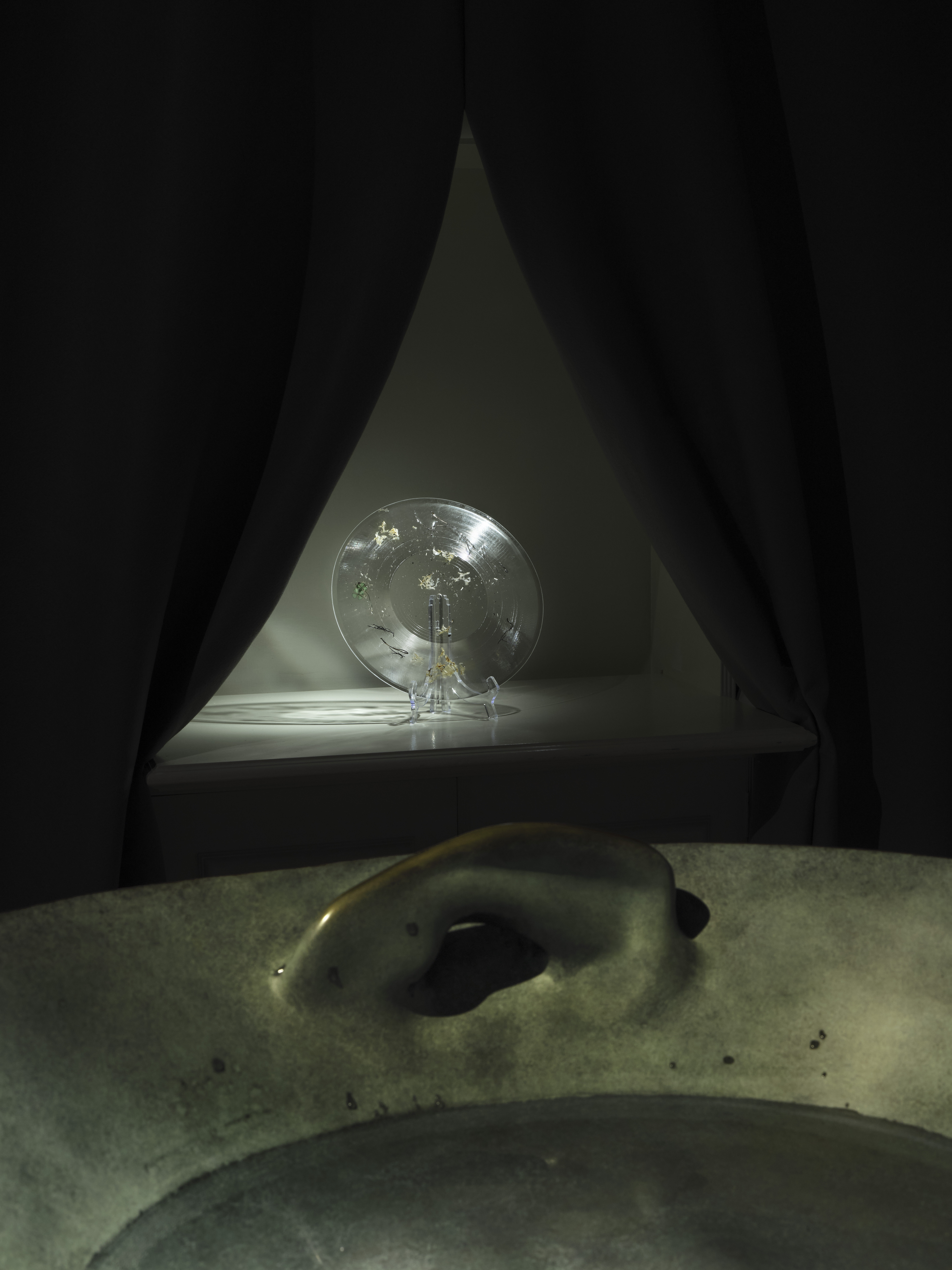
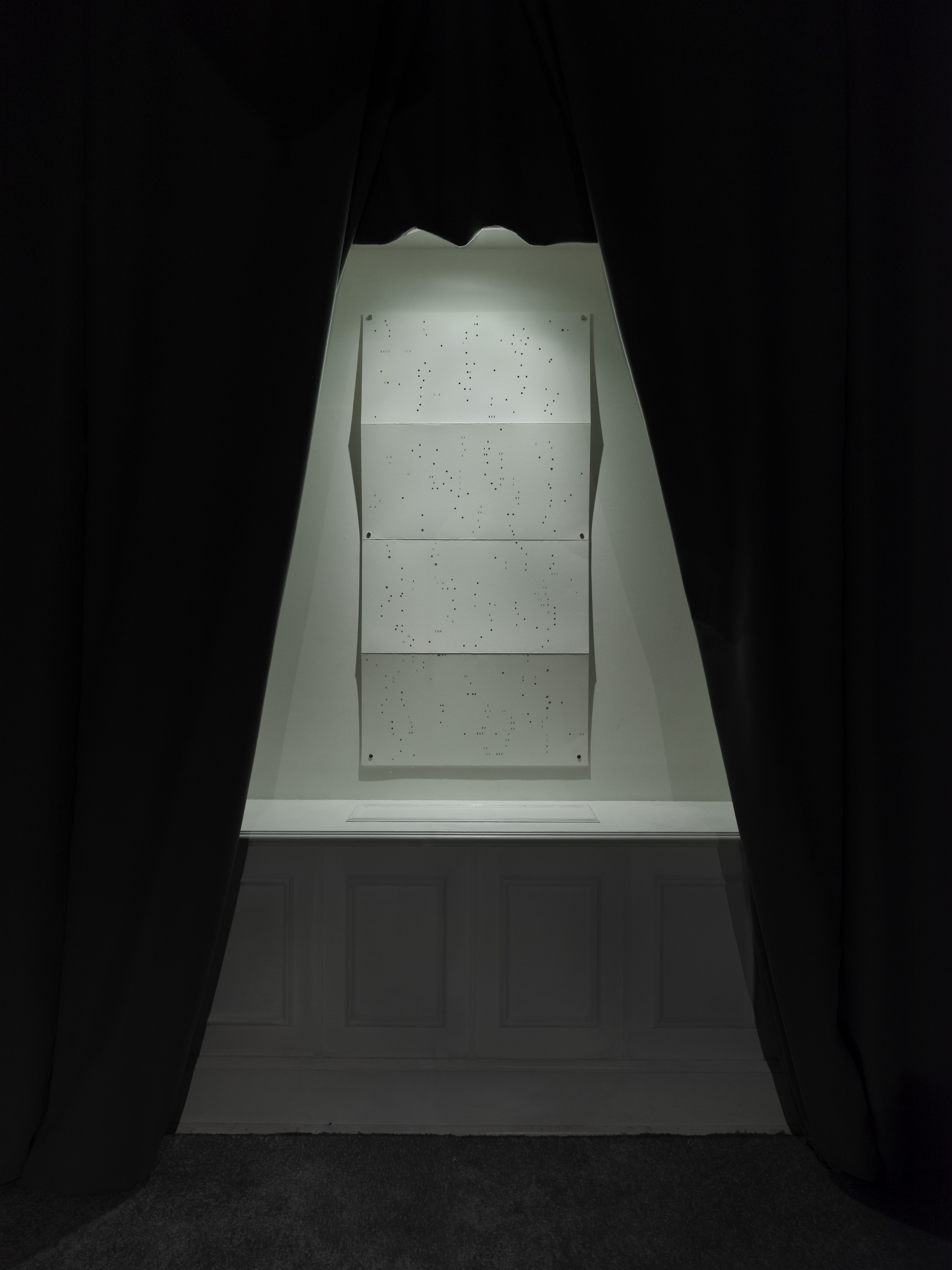
Pond Brain is an instrument-fountain, and it’s installed in the foundation’s library alongside new work I made this year: Pond Ephemeris, a score in the form of a lunar chart, perforated in paper like punch cards, and an eponymous limited-edition resin record with organic pond debris cast inside, featuring sounds from the installation.
Vittoria de Franchis, the curator, and I felt this combination would fit the library particularly well. The project draws on oceanic and interplanetary audio libraries – star pulses, dolphin vocalizations, et cetera – and the constellation of ephemera in the exhibition has an archival quality. The room becomes a kind of resonance chamber and observatory, a physical expression of the project’s cosmology.
The work draws on ‘alt’ cybernetic ideas of ponds as self-regulating, living systems (this idea of a world made of brains), and on the notion that the human brain, like a musical instrument, produces oscillatory, resonant patterns. So Pond Brain is a kind of neuroplastic portrait. In the installation, the head-shaped bowl’s frequencies interact with the otherworldly resonances from those audio libraries, and they shape each other in this ongoing exchange. With each incoming cycle, a new brain is born and reflected back into its mirror image. The title also nods to moon cycles, the way they influence tides, aquatic life, and ultimately us.
Pond Brain, for example, is a water-filled bronze bowl that can be played, or activated by touch and friction. It resembles a spouting bowl, orchestrating these feedback loops of sonic vibrations and dancing droplets. I originally planned it for a square in public space, where it would gather rainwater, existing in relation to the weather, the water inside, and whoever plays it. A lot of my work opens up to the wider environment and to chance in that way, which just feels true to life. It’s also about drawing attention to the continuity between physical and informational processes. I think of it as tech povera, treating technological materials as meaning and inverting what we consider simple versus complex.
I’ve also been thinking about ‘living sculpture’ more explicitly through teaching. I’ve been running a class on it in Berlin for a few years now, and in that context the idea expanded into something more holistic: a view of art practice as part of an expanded ecosystem, life and sculpture. It’s not just about rethinking what we make, but how and why we do it at all.
It’s a small edition of lathe-cut resin records with pond flora, such as algae and duckweed, cast inside. It’s released as part of PAN’s Entopia series, supported by the foundation, and made in collaboration with Disc Archive in Berlin. It was a long, experimental process, and it turns out this might actually be the first record ever made out of resin. Because the grooves are malleable, each play sounds different, and the record itself slowly disintegrates. This becomes central in forthcoming installations, where it’s performed all the way to its end.
I’m interested in parallel communication systems, both human and non-human, and symbiotic intelligences, like microbiomes. We’re living through a moment when traditional ways of making sense may no longer apply, and language ecologies are extending beyond human meaning.
As an artist, I see my role as a medium at this threshold, practicing porous perception. But I’m also thinking about something that artist and writer Gary Zhexi Zhang talks about in his essay for the Venice catalogue: the bleak scenario of a post-literate planet in which language is outsourced to machines, swallowed into the atmosphere. In that sense, we find ourselves as keepers of reading and writing, along with other modes of sensing available to us as organisms.
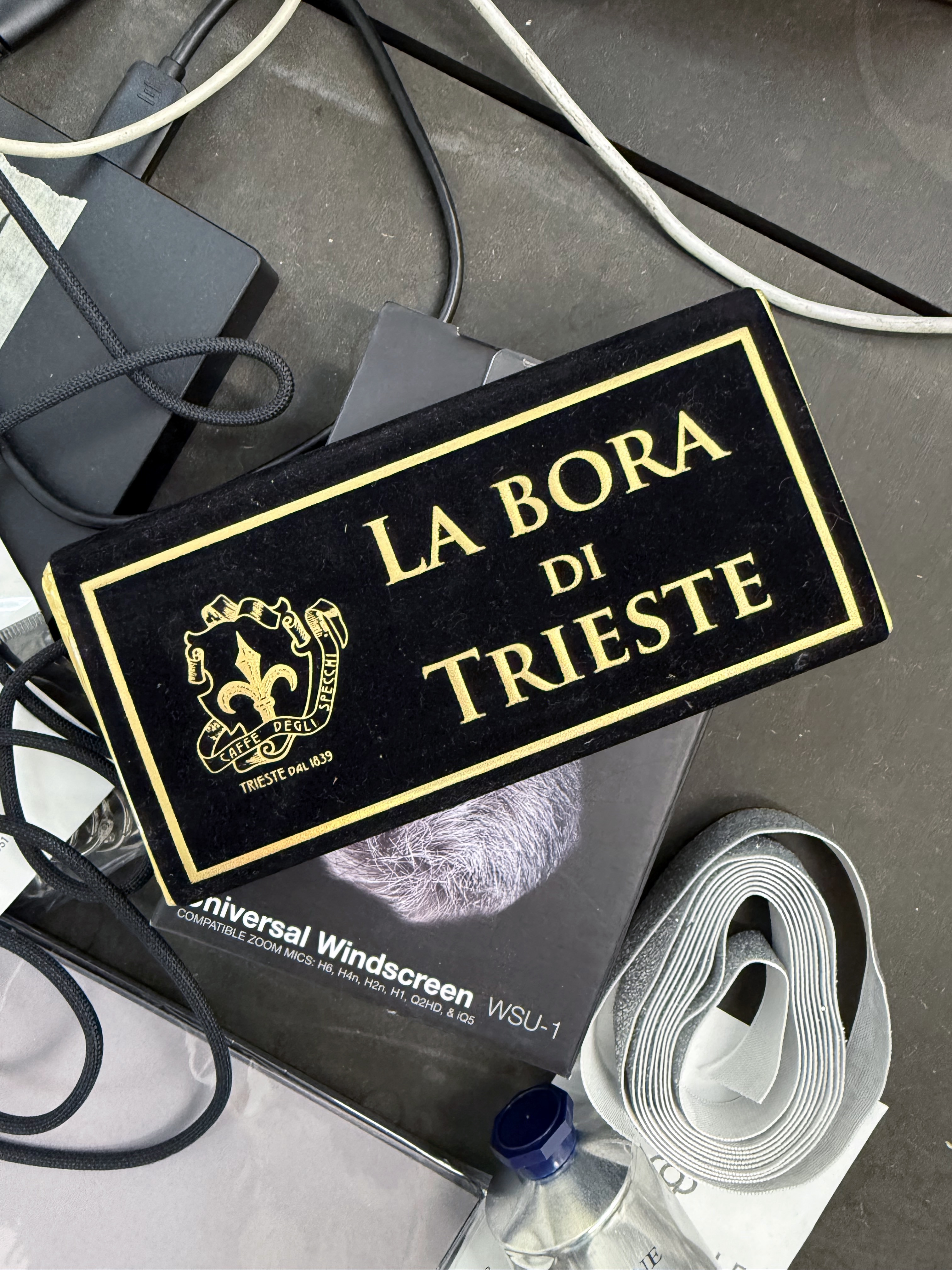
I’ll be experimenting with noise in Venice. Beyond the obvious reference to unwanted sound, noise is interesting because of how it sits between contingency and control, sense and senselessness. Wind on the microphone creates noise, interference. But the same wind that interferes with our recording is also what makes sound possible at all – in a vacuum, there’s no sound. And information becomes noise when it’s so abundant that it loses meaning. My work is trying to find meaning in that chaos. I keep coming back to philosopher and historian of science Michel Serres, who calls the wind the medium of every signal that reaches our senses, entering the nose, mouth, ears, throat, and lungs, surrounding the skin. The baseline of the senses. Carrier to all of them.
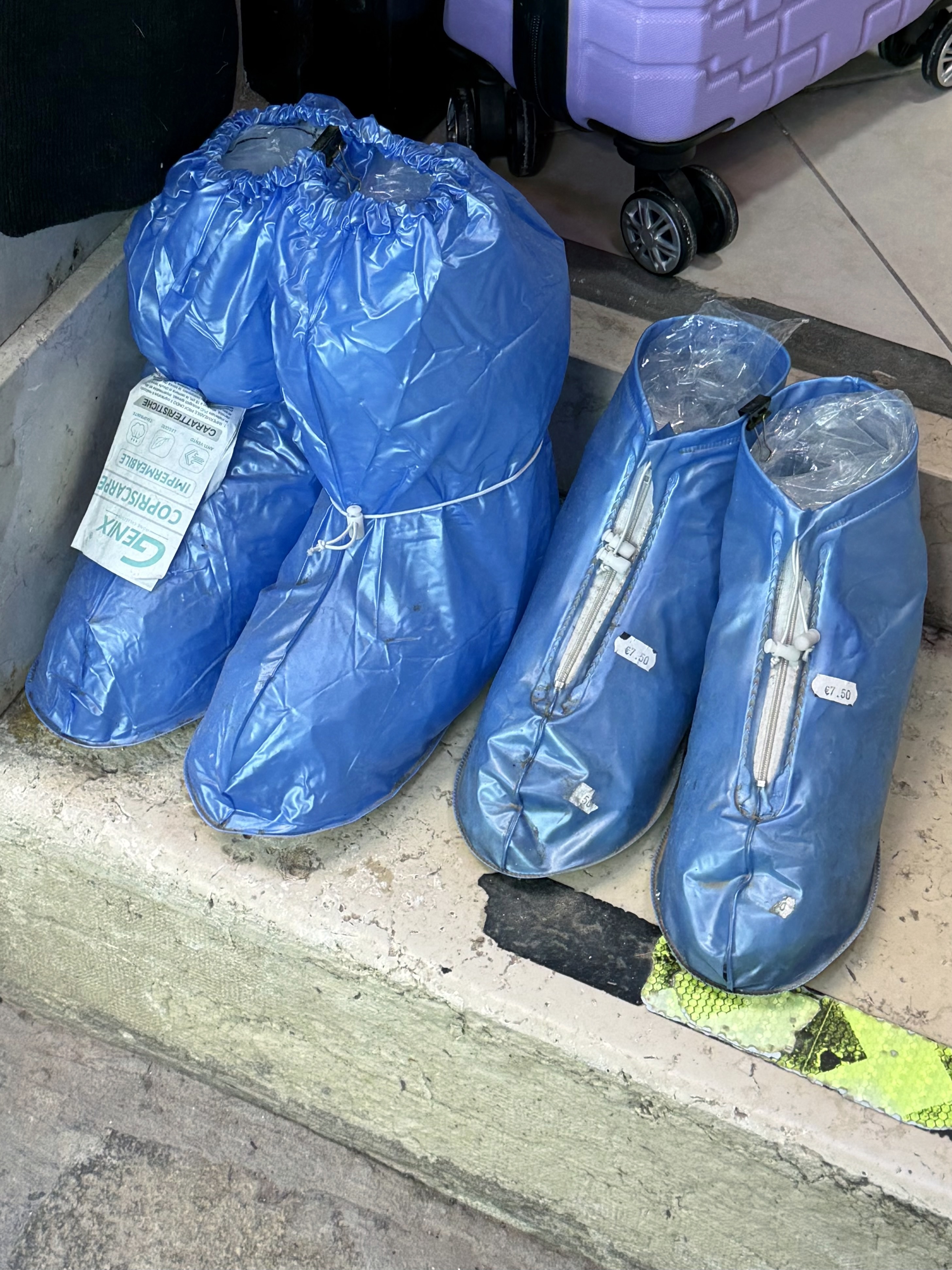
It's a series of sound sculptures in a kind of strange theatre. A windscape. I came to the topic through my original instrument, the flute, and through more recent sculptural work on wind-driven, aeolian instruments. And Venice felt like exactly the right place for this: it’s already a stage for the drama of winds, which are closely observed and meteorologically tracked in preparation for the acqua alta.
Winds are also emotionally present in local stories: the melancholic Scirocco, the limerent, maddening Bora. Venice has always had this artificial nature. It’s a city that shouldn’t exist in that location, kept alive through constant engineering. So weather becomes infrastructure, becomes politics, and that feels like a sign of the times in an age of climate crisis. The work lives inside all of that.
At the core of the work is a composition using meteorological data and musical instruments – wind machines, alto, basset and contrabass recorders, and a children’s woodwind orchestra – alongside recordings of winds from Venice, Helsinki, and beyond. The architect and musician Tuomas Toivonen captured the singing Merihaansilta bridge in Helsinki for the piece. And then there are clotheslines, sailboat masts, and poplar trees from Venice. These different site-specific sounds are placed in conversation with each other.
It means we can continue developing ideas together, building on years of shared discussions and exhibition experience. That familiarity feels important here, especially in a context that is, by contrast, quite unlike anything I’ve worked in before in terms of the scale and structure of the Biennale. We also get to work with a trusted team, both at my studio and on behalf of Frame Contemporary Art Finland, the commissioner, alongside collaborators like the scenographer Celeste Burlina and hair artist Sara Mathiasson.
Honestly, I’d love to just continue doing what I’m doing, which sounds simple, but isn’t, at this particular moment for artists and for everyone. A lot of structures that used to feel stable no longer quite do. We need to come up with new ones, collectively. I suppose some people might now consider me a professional at something, which I’ll take with a grain of salt. And maybe put to use.


