In Conversation with Flora Klein
Words by
Pieter-Jan De Paepe

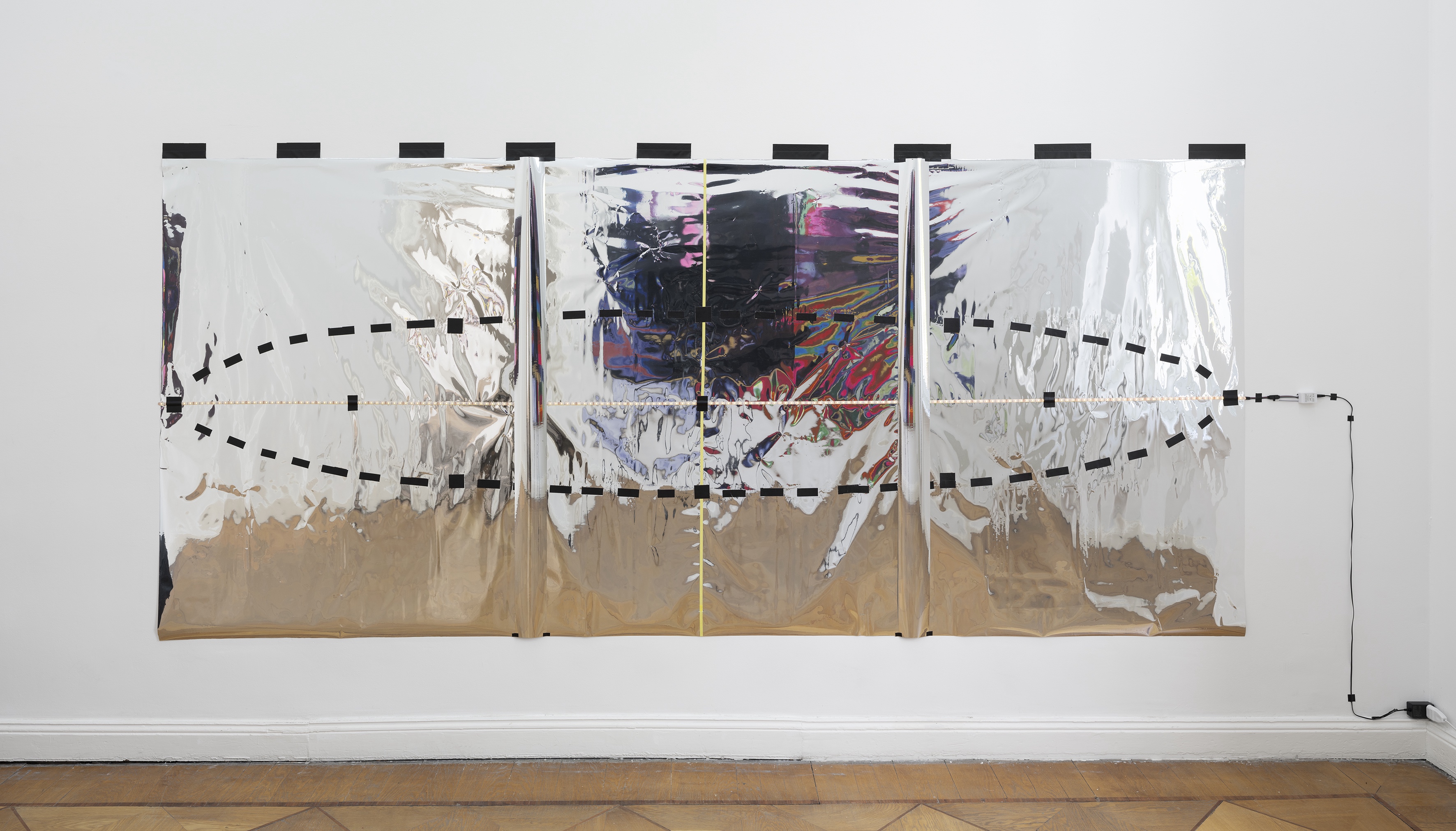
The gallery consists of two rooms; in one room, four works are being presented, two of which are hung over windows, creating a surround view. To me, the windows in this gallery tend to offer moments of relief, breaks within the exhibition, a bit like how punctuation works. I wanted to interfere with that by partially blocking access to the outside and removing some of the “pauses.” Moreover, my intention was to stage an over-full show, to match the high-saturation of the paintings themselves.
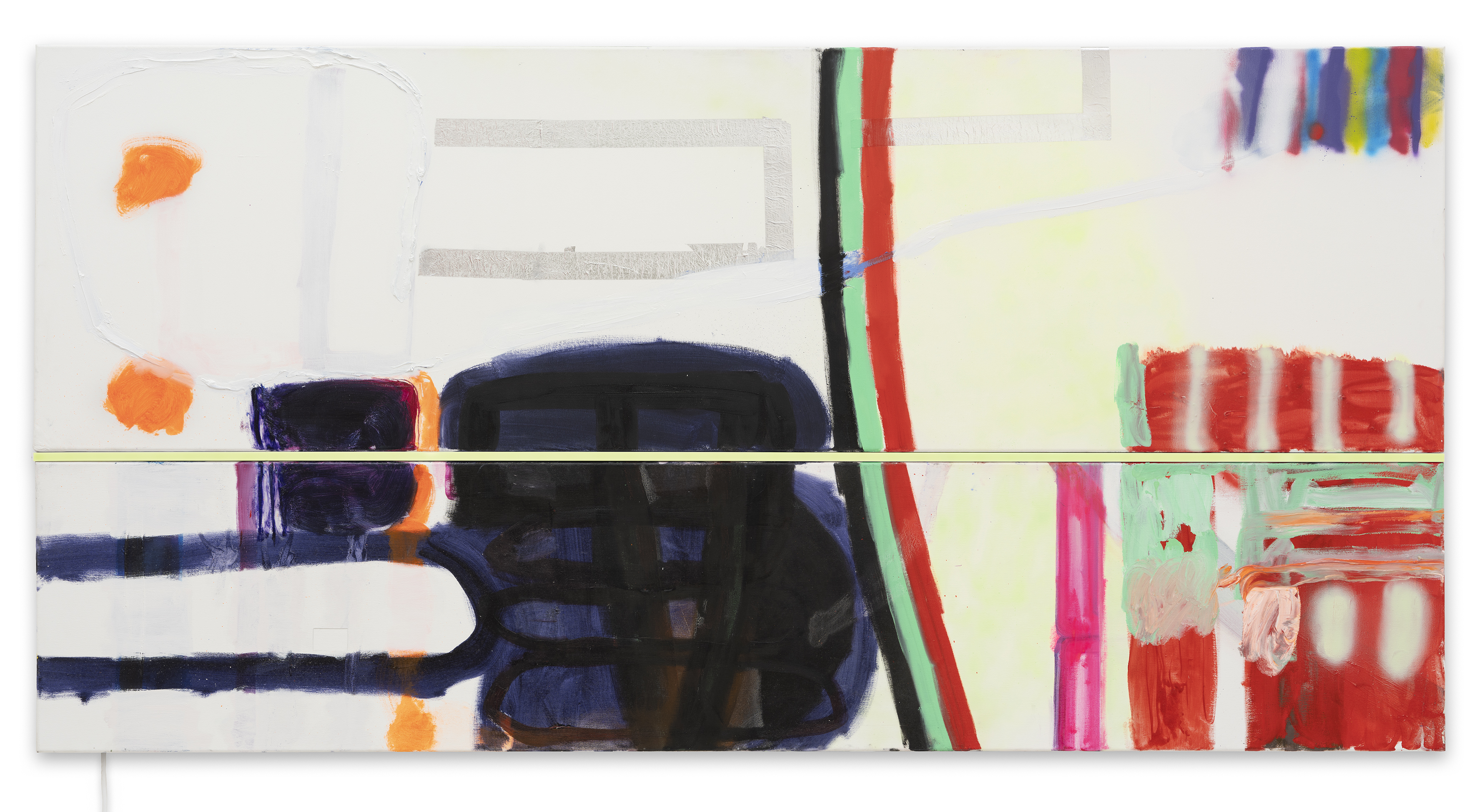
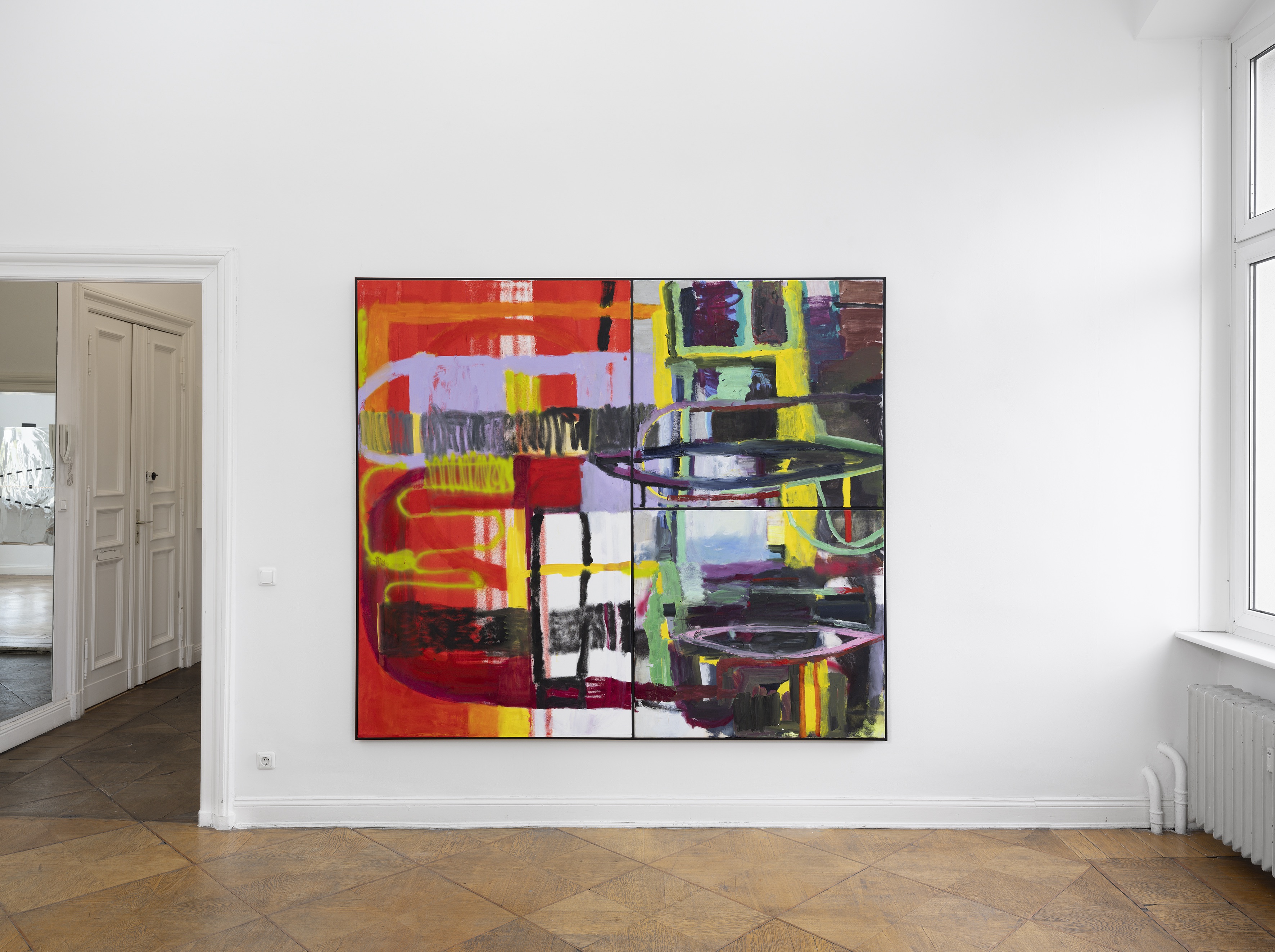
Untitled (LED), 2025, which is hung over a window, blocks daylight whilst emanating artificial light from an encased LED that is sandwiched between the work’s two parts. Similarly, in the other room, 0O54OX, 2024, is split horizontally with a pale, naked LED strip—its mirror foil offering the world back to us, reflecting and distorting its surroundings, the other paintings and us. The notion of the painting that ‘looks back’ nods to portraiture, a mutual gaze between image and viewer. I also allude to this dynamic in the title We Saw You at Kaufland, the largest painting in the show. The “We” here may refer to a plural, specifically the three panels of the painting itself, which seem to look back at us.
The sentences you cite from Samuel’s text made me laugh when I first read it, especially “this is likely an appeal to further reconfigurations, but we’re not sure.” “We” evokes multitudes: author(s), readers, viewers or, again, the groups of panels, and of course the paintings themselves. In any case, the text underscores the openness of the project, its refusal to settle. I think “an attempt to unify seems to halter wholeness” apprehends our (flawed, conservative) desire for something “whole” and “stable,” something that a classical painting is associated with. More specifically he speaks of how this kind of framing exposes a certain instability in the work, as if the paintings could be rearranged or reconfigured.
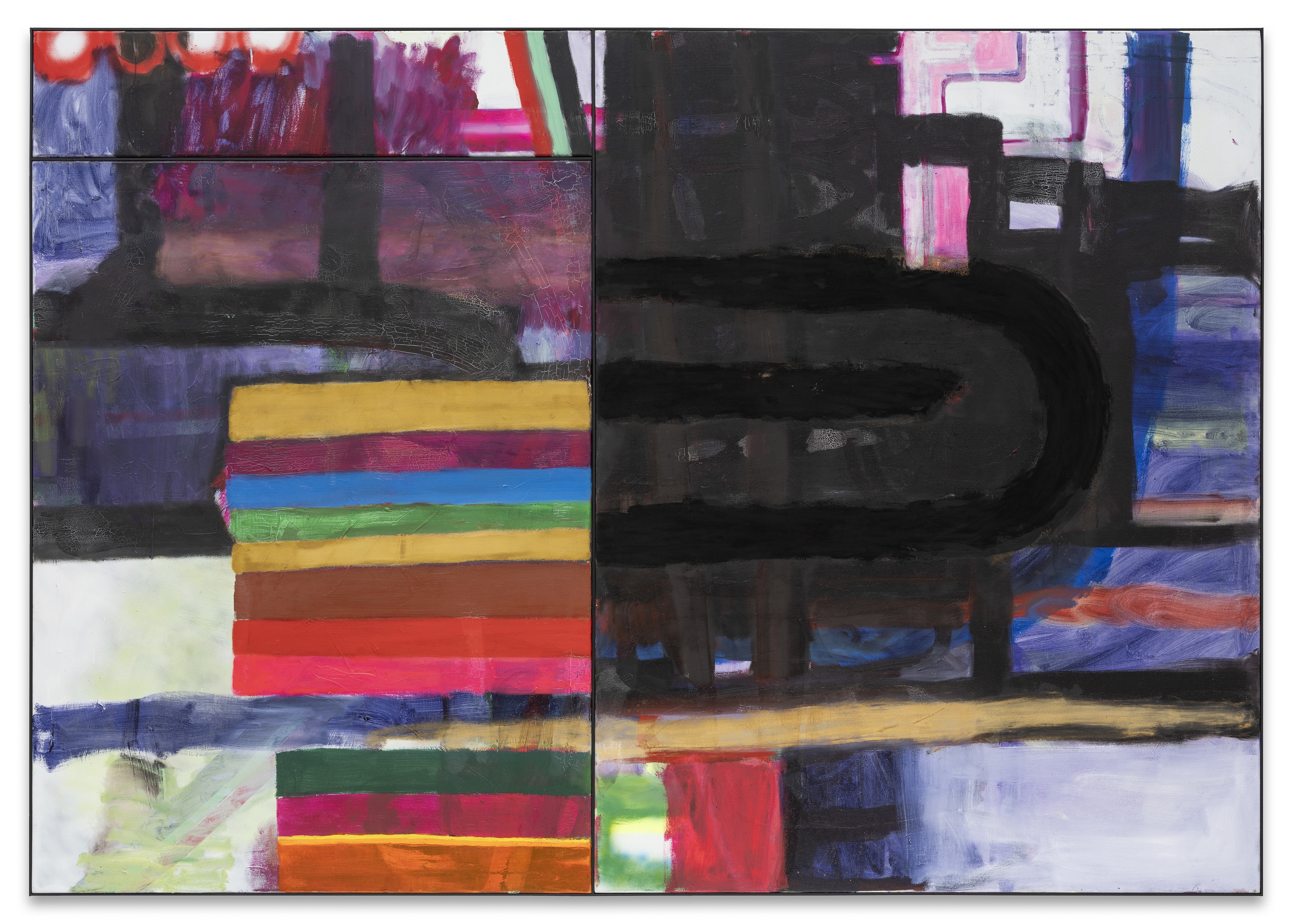
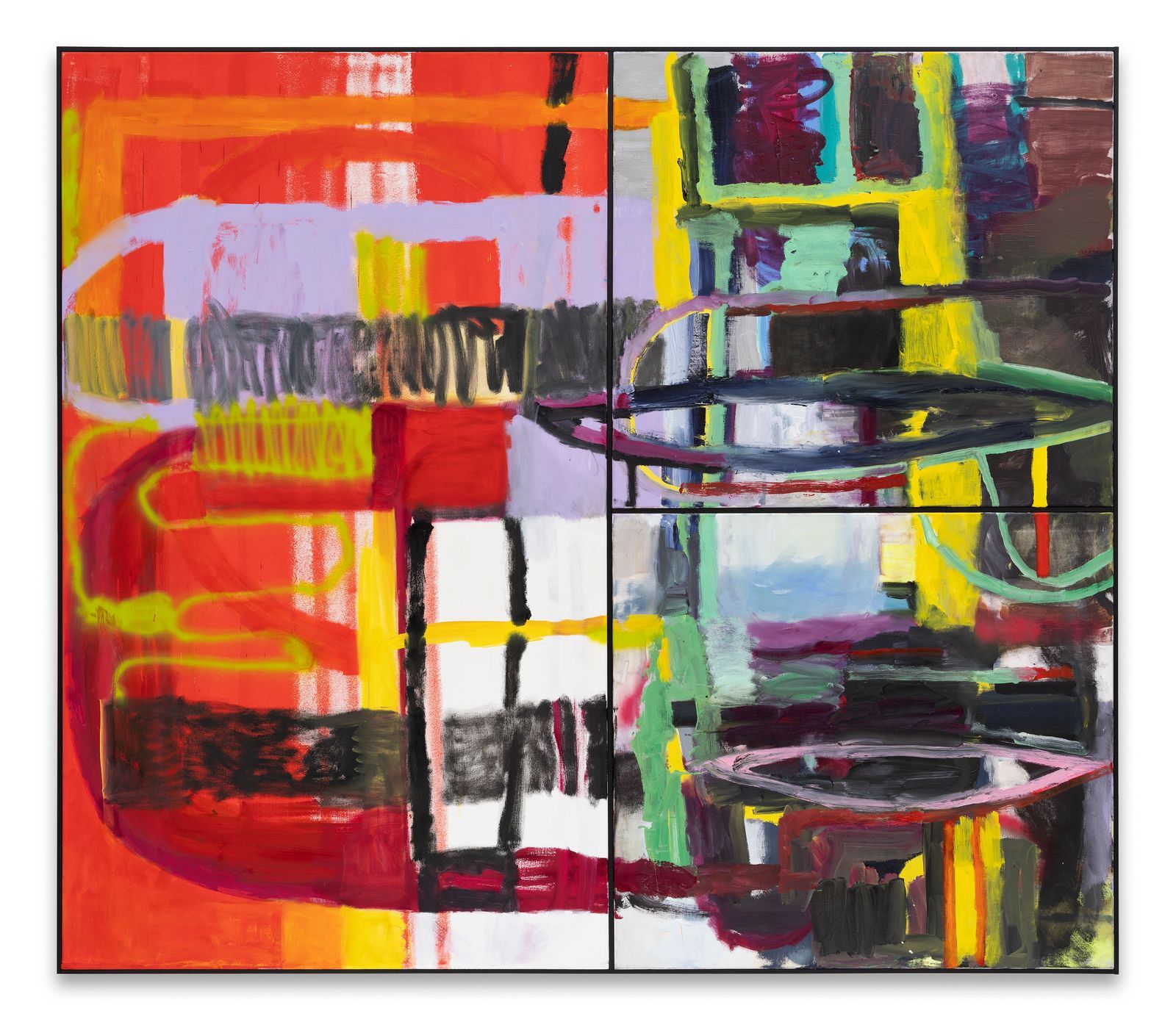
The larger panel works—what you refer to as “over-sized frames”—came from my desire to stretch the formats of old, discarded paintings that I since reworked: Sick-leave, 2015/2025, and Scheinschwanger, 2019/2025, needed more volume to the sides. I was thinking of panel painting, tabernacles, and coffering, but also of flatscreen TVs, as in objects that are image containers and were, for a short moment, something chic, desirable. The paintings rely on the crutch of their chunky frames, their pompous little stage. Whilst working on the wooden panels my attention turned to what happens around the “important” parts, the centers, or the actual painted parts, toward the edges and the margins, the borders of things.
Firstly, the material conditions were given, and I imitated my surroundings: my father painted, my mother was interested in art, and both of my older siblings went to art school. I guess I’ve always been drawing and painting since childhood and I stuck to it through my teenage years. Being around artists, that’s what I wanted, and so I tried to become one, and since theater school didn’t work out, I applied to art school instead.
For many years, I only used acrylics, mainly because they are affordable and dry quickly. Their immediacy forces a certain decisiveness; you can’t go back and soften a gesture as you might with oil. The medium demands a more assertive approach. Acrylic has a colder, plastic quality, which I liked. Around 2019, I began using water-dilutable oil paints for technical reasons. Oil dries more slowly, it allows the line to be dragged further, which was useful at that point.
When the exhibition at Kunsthaus Glarus took place, bringing together works from 2013 to 2023, it felt like a natural turning point. After that, I began working almost exclusively with classical oil paints, a medium that was new to my process, it was messy and fun. It’s important for me not to become too comfortable with a material and certain gestures. Sometimes I can achieve that with small changes such as different formats, brush sizes, and sometimes, a more radical shift in technique needs to happen.
Another reason why I started using oil paint was that I’ve wanted to paint larger, dark, and black areas. With acrylics, dark tones tend to appear graphic and flat. But with oils, one can achieve polydimensional spectrums of darkness. That’s what I was looking for.

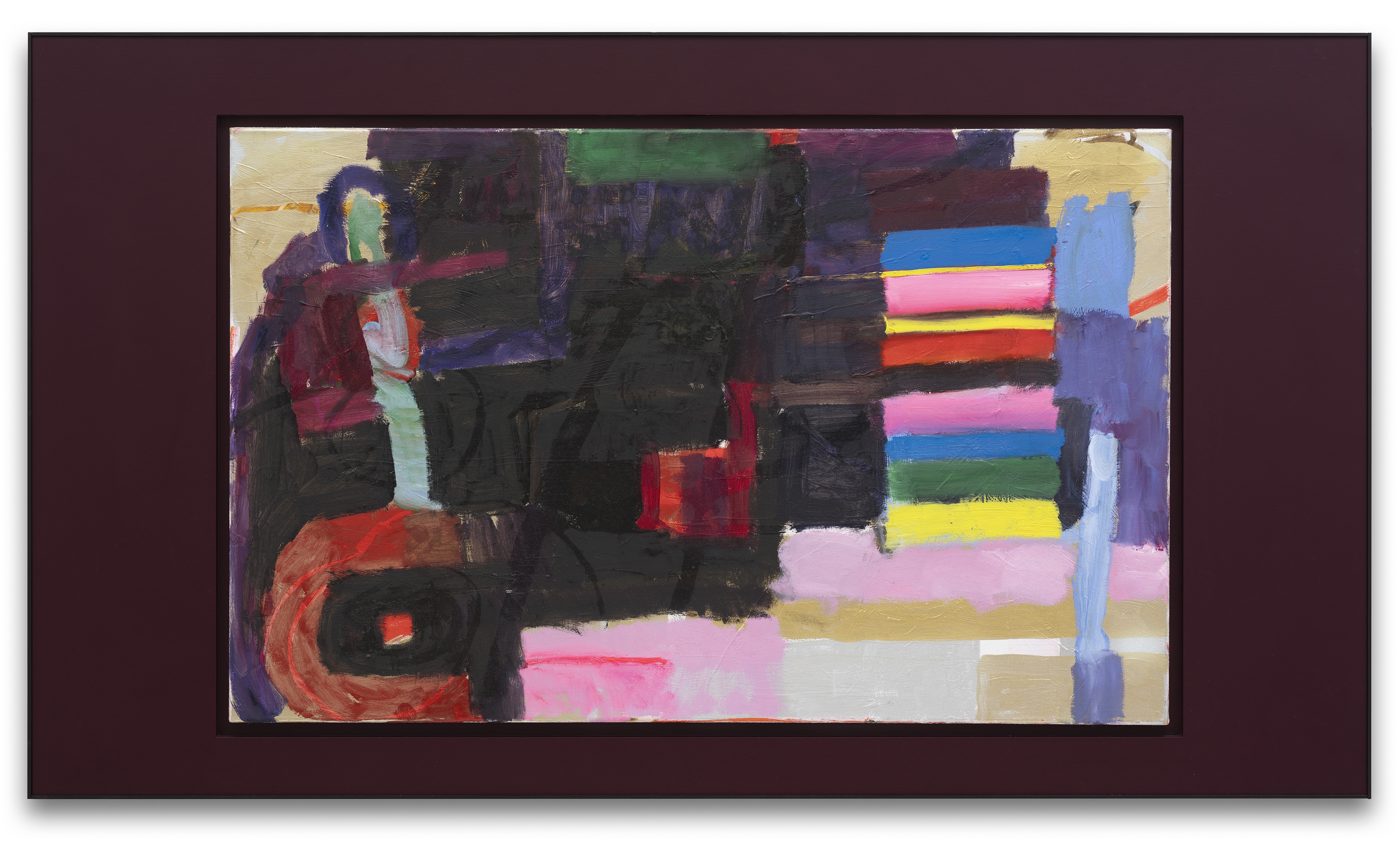
Expansive is a good way of describing my practice, but I wouldn’t really know how I experience that. It feels natural to me, I guess, to follow these subtle shifts you describe. I don’t really plan my works; I’m not interested in executing ideas. Chance, impatience, and boredom play a role, combined with concrete elements such as colour, gesture, form, and various recurring motifs like the ellipse or openings, or the reflective surfaces. In this show at Lars Friedrich, for example, things started appearing that are not abstract, things that attach themselves, that insist on their presence. These impulses manifest in real-world materials: tape, LED strips, wooden panels, mirror foil, power cables. Let’s see what happens with this inclusion of the mundane and the symbolic, toward the point in which painting begins to combine itself with the material conditions that surround it.
—
Flora Klein (b. 1988) lives and works in Berlin. Her work has been exhibited at Kunsthaus Glarus, Kunsthaus Hamburg, Galerie Max Mayer, Düsseldorf/Berlin, Tara Downs, New York, The Green Gallery, Milwaukee, Treize, Paris and Piper Keys, London, amongst others. Alongside her painting practice, Klein has instigated various projects for social exchange – such as multiple exhibition spaces, a music festival and screening programs. Klein teaches at the Zurich University of the Arts.
Pieter-Jan De Paepe is a curator and art historian based in Ghent.