In Conversation with Courtesy
Words by
Niina Ulfsak

It's just that one single, which leads to the start of this series called Dance Review, which you could almost call a sub-label for Against Interpretation Club, a way to allow me to revisit works. All of the music I've released myself has primarily been ambient and pop music, but without any drums.
In music, normally, there is this tendency to focus on new original music, as in new compositions made from nothing, and obviously nothing is made from nothing. But I really like what I see within a lot of contemporary art. The way that you work in a series, you revisit earlier works, and reappropriate yourself or other people’s work. That’s much more the kind of approach I’m going for with this. The original track is from an album I released in 2023, which featured covers of popular hits or songs that were familiar to many people when I was growing up. I just felt like that work wasn’t done yet, and I’m also not done with making covers.
The music I’m interested in has very strong melodic components, I guess you could say I am also mainly interested in producing visual art that has some kind of strong emotional component. For me, the most important thing about music is always the melody, the synth, the pads. Everything that I would kind of prescribe an emotion to. I think the different elements of music have different functions – the drum and the bass particularly encourage movement in specific ways. But the aspects of melody are kind of what goes in a very cheesy way in your heart, or kind of gives you some other emotional stuff. And obviously, the music I like is also very camp. And the music I make, you know. It is the kinds of sounds that I like to listen to repetitively, which is what you have to do if you're producing music. What can I stand to be in a room with for a very long time? And for me, that’s been ambient. It’s been playing the piano. It’s been playing analogue synthesisers. And particularly working with stuff that's not on the computer because that is one thing I don't want to be in a room with for very long at a time. I think if you are a drum producer or more of a traditional music producer, you have to love your computer. You know, you become much more of a programmer or something. A lot of very good music producers were into gaming or programming. I am not that at all.
%20.jpg)
I think a mix of my interest in reading and literature, together with wanting to do something that leans even more towards an art production field. Because with Kulør, my label before, we did a lot of artist collaborations, commissioning artworks for the vinyls we released, working with a lot of different artists that I still like today, like Young Boy Dancing Group. I wanted to make a... I hate the word platform. I think the connotations are not really correct. But I wanted to make...
A club. I wanted to make a club. I wanted to make a club that was much more personally collaborative. So much of it was about me stepping into a slightly different role, a much more blurry role as a curator. Where earlier I had really been the label head and the curator of the projects. And I had this role. As more and more projects developed, the boundaries of that changed a lot and I became more technically hands-on. It’s like, I learned whatever different skills. So it was less about outsourcing and more about working very closely with artists that I like, and also just using it for my own projects, basically. So it’s more of an art club in itself, than a label.
It really just depends on the space. What I’ve really learned is that it’s all about who works at the space. Who’s the curator? What kind of energy do they come with? And ideas and openness. And then it doesn’t really matter if it’s a music space or an art space. It can be equally bad or good. But I will say that what I’ve really learned is that I really have to trust my gut in terms of the energy that has to come from the place, the institution or venue. If I don’t immediately feel this willingness to collaborate, from the very beginning, it just can’t happen. You can’t do it. Because it’s too stressful and it’s something that I put an enormous amount of work into. For me, the most important thing is that it's good for the artist performing. That's the top priority. In addition to, obviously, that it's a good audience experience and that something interesting happens. My own experience is then the amalgamation of that and how it felt to work with the venue. But then, if it's not a fun thing to do, it doesn't make any sense. It's definitely not a business. I have zero work discipline if I'm not... if I don't find it exciting. I have no self-discipline at all.
%20Courtesy%20with%20Laura%20Schaeffer%20%20CCA%20Berlin%2017.jpg)
Yes.
I thought it was a catchy name for a project. I like reading about what was contemporary for her at the moment and then understanding a bit of the zeitgeist around certain topics. As I understand it she was also the first to write about camp, even if the way she spoke about camp was critiqued later and so on.
I think often with camp, because there's this underlying homophobia in it, it's something people are not aware of or self-aware of when they're critiquing work that's camp. I’ve spoken a lot about this Juliane Rebentisch essay “Camp Materialism,” which is a critique of Sontag's camp. With Sontag, she was kind of talking about that camp which considers the ugly or artificial or unnatural as being beautiful but Juliane Rebentisch is like, okay, no, camp is not about the ugly or the unnatural being beautiful. It's about refiguring what beauty is and the decisions which have been made historically to consider one thing being so-called natural and one which is not. I am very drawn to this way of thinking, and I think it relates a lot more to my work than any Sontag comment on gay culture or transness or whatever.
I guess my own relationship to art is a bit intricate because I was always producing a lot of art, as a child and a younger person, without having knowledge about contemporary art. I grew up in a small city in Denmark, close to the German border, with parents who are teachers and dentists. So I had no exposure to any form of what art meant or something, except for all the cliches. But I was drawing a lot and making sculptures.
As an adult, I obviously focused mostly on DJing and making music, which was kind of my creative voice in all of this. I started being more and more interested in video and photography simultaneously. For me, it wasn't necessarily an exhibition because the work has been shown in a few different shows, but in making my video work, intimate yell chapter II (2024), which was a collaboration with a photographer, Laura Schaeffer, and a few other artists, I really realised what I wanted to do in the context of art. What gave me a rush in terms of the work process and the conceptual development, resulting in the kind of life of the work. Which is combining, I guess everything into these formats of music video as art. Sort of art pieces. They were shown in a few different exhibitions at Schinkel Pavillon and the Julia Stoschek Foundation, and are being shown again on Friday.
And... as I said, with this kind of... my extreme... lack of discipline, there are just very few things where I get a visceral feeling of, this is what I want to do and I want to spend a lot of time on it. I have gotten the same feeling when working with the choirs that I've put together. I've done this a couple of times as well where I am asking people who I'm interested in and want to work with, if they want to participate. In the videos as actors and in the choir as singers. And then what's really interesting about the process is that I come with a concept and maybe with some text and it becomes a collaboration. Everyone is chosen also because of what they would contribute with in terms of composition and writing, so it's really unpredictable what the finished thing will be when we start. Obviously my job is just to make sure it's good. But this is the end of it, you know? And directing it enough that it's fair for everyone because obviously if it's not... if I'm not directing it properly, then it's not good and everyone suffers. It's not just me, you're really doing a disservice to the people that you're exposing this way. I have an enormous feeling of responsibility within those projects.
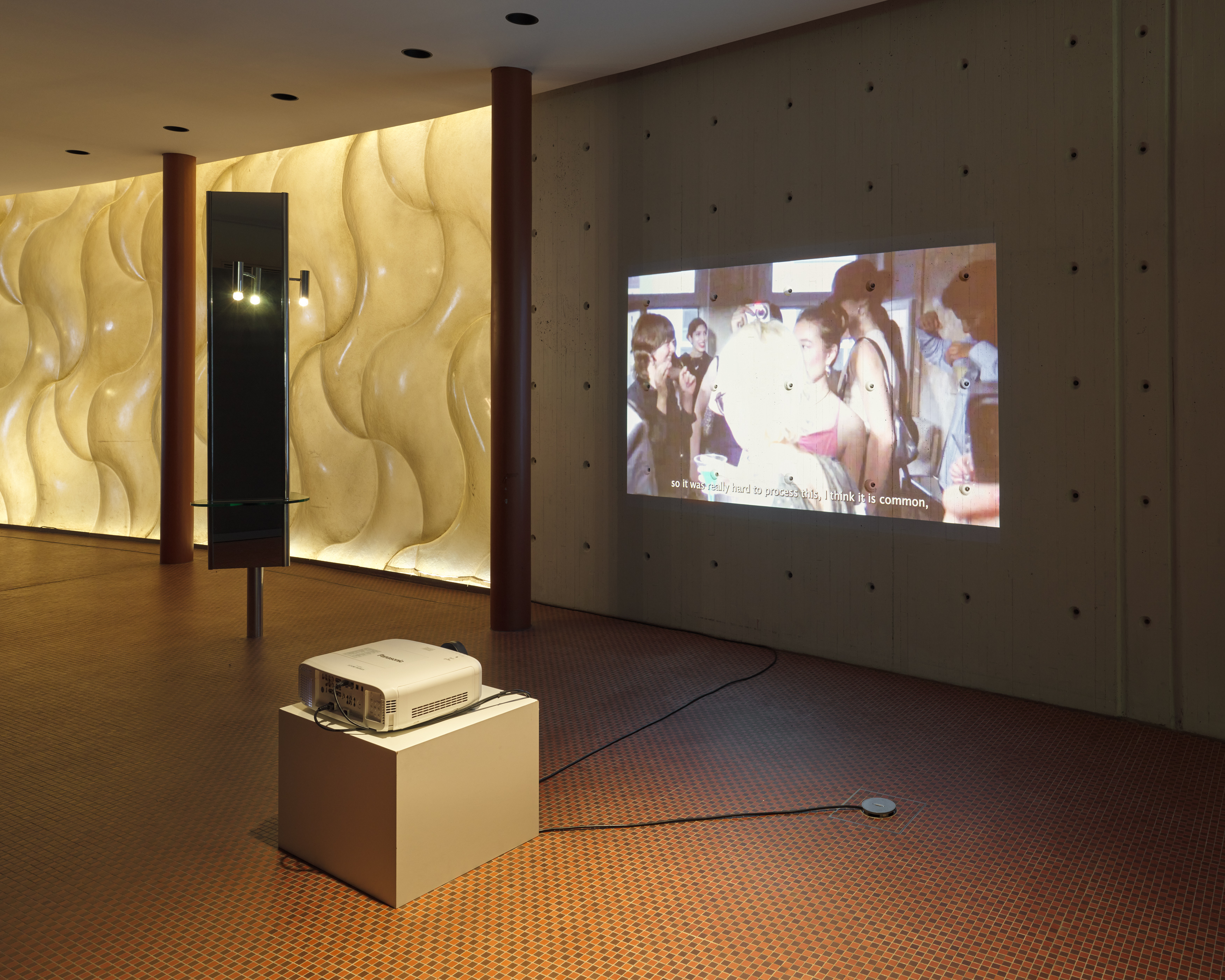
I think it is a product of who I worked with. The text in intimate yell is edited from a conversation with Transmisia who also stars in my new desire series. She has become very important in these videos. We hadn't planned that there was gonna be as much focus on her, the narrative was quite different in the initial idea for the video. But when we started filming, she just... her presence is so strong. And obviously with these smaller productions there's an enormous flexibility. I love working this way. She contributes in a specific way. She's a Slovakian academic and her thesis subtitles the video. I played there once and she was my driver. I just fell in love with her and it was very clear that I wanted to work with her. So last weekend I went to Slovakia again. Transmisia’s aunt let us stay in her house in the suburbs of Bratislava. We spent two days filming in the snow and in her aunt's house, just me and her for these quite intense 48 hours. It was really amazing. And definitely very difficult as well to be operating everything in terms of camera and light on my own, but a very giving process creatively. These are the videos that I'm working on now. Transmisia's still in school and now she's writing her final master's thesis on language and discourse in queer culture and how this is appropriated into pop culture. Talking about these like coded languages in different minority groups.
I think it's very much the colours, and then a lot of the work that I really like has an element of photography or appropriating photography. With painting, it's obviously a little bit more complicated, but I really like this Roland Barthes definition in Camera Lucida (1980). He writes about a photograph having these different elements to be an important or really interesting photograph, the Studium and the Punctum. There's the scene, the Studium, which is the historical – what's in the image, what's going on, what kind of clothes are they wearing? And then there's the punctum, which kind of is the context for the image. An obvious example would be Gerhard Richter who uses this a lot in his photography paintings, or whatever you want to call them. You have the Birkenau paintings, which come off as an abstract painting, where the Punktum is that the work is based on photographs from the holocaust. It sets this enormous historical context for it. This is also why I like Merlin Carpenter's paintings, his paintings are technically really well executed, but then he would have Kate Moss as his subject. I love his work, I think he does this in a camp or cheeky way, with at least some kind of humour. The paintings are based on ideas, but not the way someone like Richter would do it. In this very serious, conservative way of working with history as a painter. For me, with the kind of artists whose work I really enjoy, are the things that make me feel a sensation.
Angharad Williams did a nice Lady Diana painting recently, and we had a conversation about the tragicness of it, you know, which for me is potentially similar to Warhol's disaster series. It has this character, which is maybe a seductive way of creating emotion in visual art, when you're kind of using imagery that has a lot of historical connotations. And it can be like, more or less known. But I think this is definitely what I'm more interested in over things that are extremely subtle or purely conceptual and about identity and stuff, which maybe is not so much what I'm thinking about.

I think it's also important that I don't consider any of the work finished. This obviously is very different for people, but I try to finish as much work as possible, but I have no need to close it completely. I thought a lot about R. H. Quaytman and her chapters, and how she also works a lot in this serial way. Many artists I like a lot do this. And I think it's not common in music, but I think you see it a lot in contemporary art, which I like.
But I also think this is the really positive thing if you're an artist who exhibits pretty often and used to working smaller exhibitions rather than doing these big spectacular museum shows. I'm sure you are used to working a couple of months on a body of work and finishing it, exhibiting it, and then a lot of people would go back and use leftover material from former exhibitions, Mike Kelley for example. I don't know if it's a good "strategy" commercially for an artist or a musician, but I think as an artist, as musician, as an art practice, it's really helpful to have a continuous stream of finishing work, not sitting on things for too many years.
I released this one body of work, some of it I don't like as much, or I think it didn't hold up time-wise, but just in the process of finishing it and hanging it, I learned a lot. There are a lot of things you learn in what would be considered the install part of making an album. If you never allow yourself to get there and put the work on the walls, the work is not going to develop further, you know? I think reading a lot of art history, you can just see how these in-between exhibitions where the work or the ideas were not really finished, are always art historically enormously important. When you read about the full endeavour of someone, you will always see these slightly weird interruptions. Krebber, I think, talked about how the exhibitions he hung, and was most doubtful about, became important in the bigger body of work. But you know, the reality is that I don't come from a commercial art world. I come from music, and my relationship to the art world is primarily through reading. And then obviously most of it is terrible, so I don't read about it.
The kind of bitterness that I experience from a lot of people I know who are in art comes from being forced into the commercial aspect of it. If you're looking at it on those terms and what sells, it is pretty awful, but I kind of look at it from a more pure, and maybe more of an art historical kind of aspect. I can drag out a lot of very useful things from it, that inspire me a lot. Also, since I'm spending so much time on video art, it's obviously very clear that it's not a financial gain that I'm going for in my current work in the art world. I used to joke with Reece, my ex, that there are hundreds of euros to be made at art readings, and there are thousands of euros to be lost in making video art. That's true. It's a tough medium.

.jpg)
.jpg)
.jpg)
.jpg)