In Conversation with Boz Deseo Garden
Words by
Kandis Williams

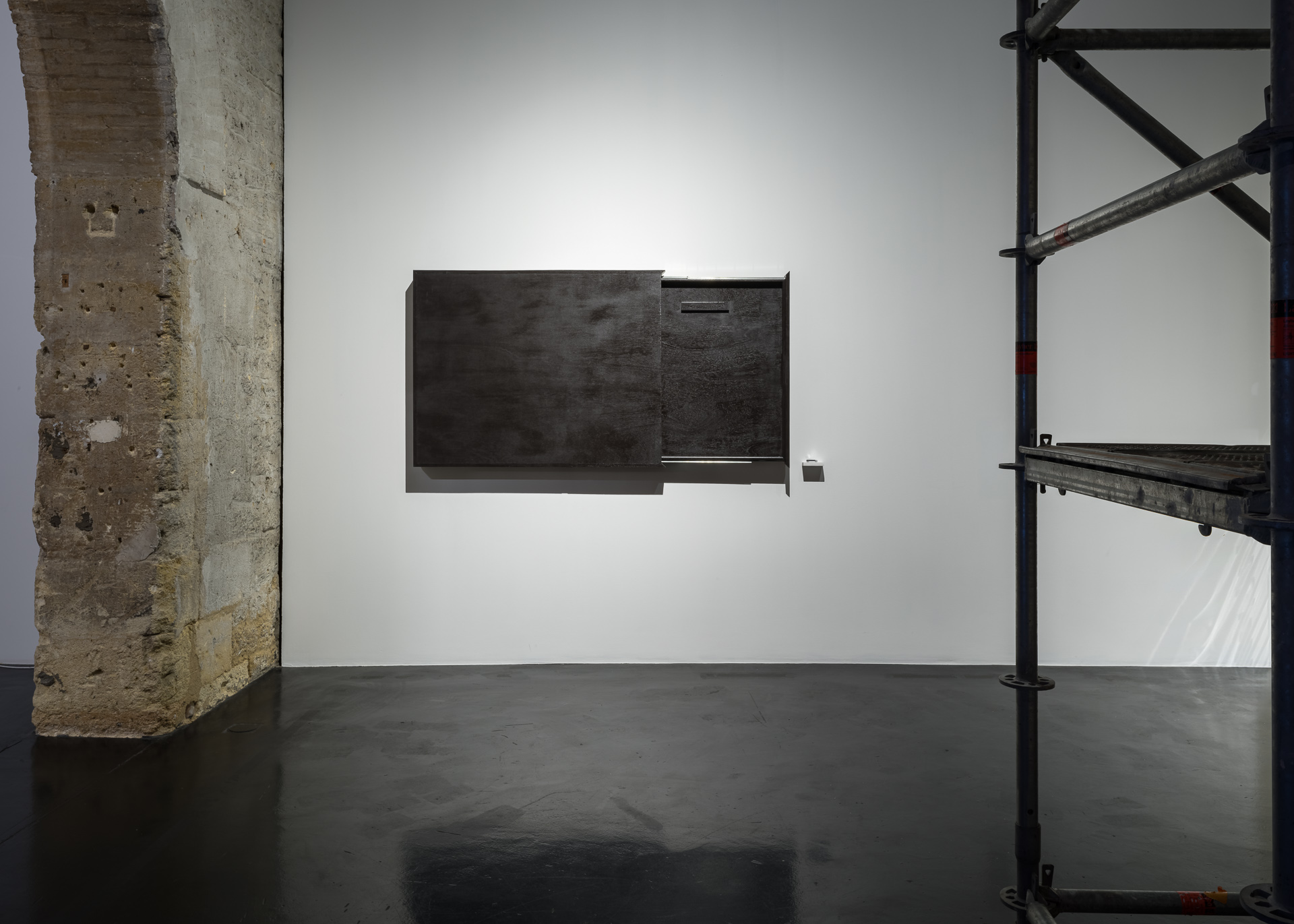
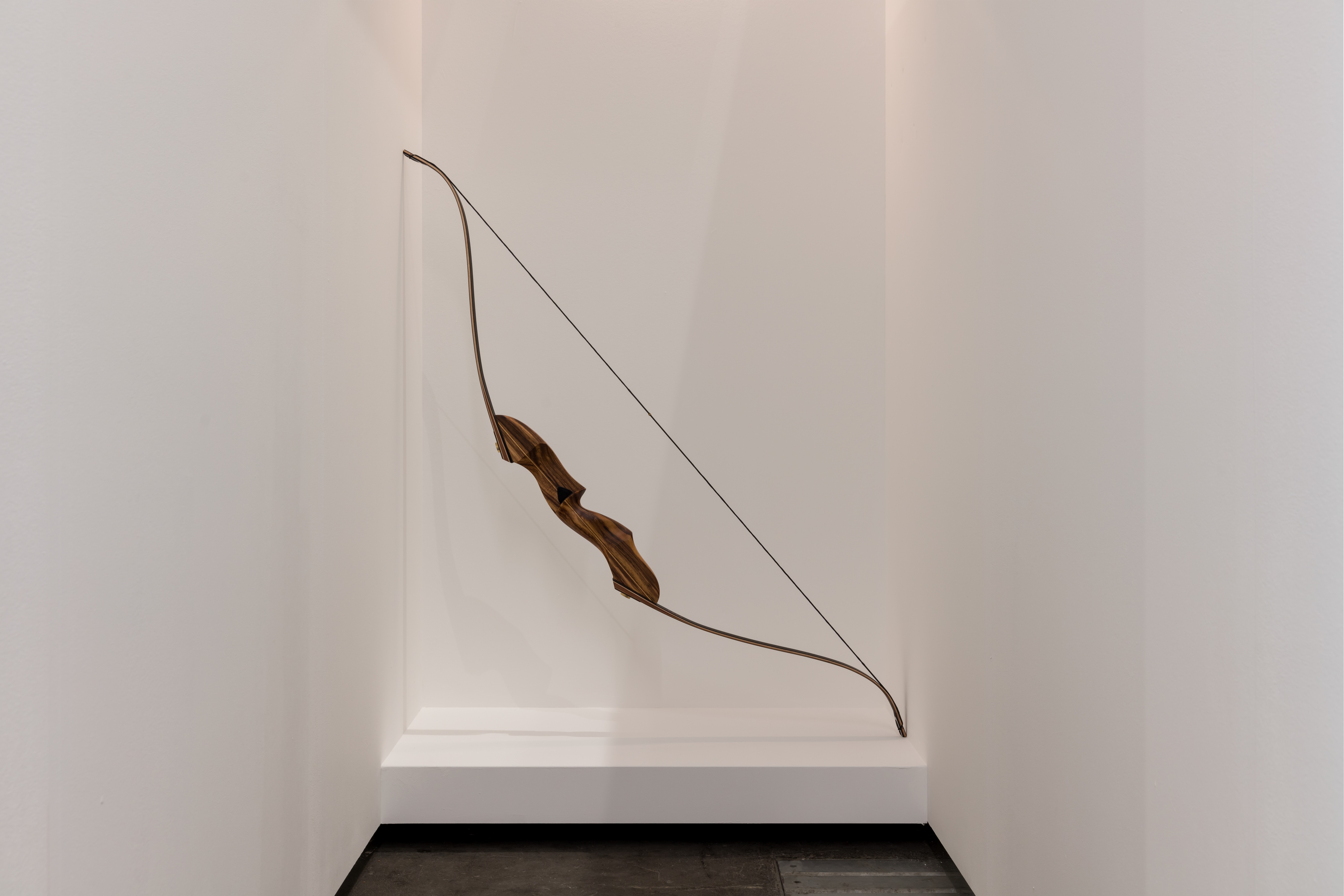
First, thank you for speaking with me and for starting here; I think it’s the part about the work that deserves the most attention. The work (Celia, or the Misfortunes of Virtue), at first, invites you to make a prediction about which of the two identical rods is the more conductive one, the one that would most likely attract a strike of lightning. But because each rod is patinated—its surface materiality alchemized or suppressed, to borrow your term—one is seemingly invited to wait and see. But my hope is that, since this is an art object, we are discouraged from dwelling in a functionalism for too long and, implicitly, any kind of anticipation, however suggested. And that what we are left with, I hope, is this bare desire for a prediction, for a determination to be made. Such that the happening it depends on is also caught up in an economy of assumptions about what objects do when they are ‘at their best’ or their ‘worst’. Objects can supply a ‘strike of clarity’ or make something soluble in the sea of metaphysics—but which of these qualities is an object at its best or worst will depend on who you ask.
So, I think you are right to keep the operation of ‘material suppression’ underlined as the thing rehearsed over time in cases of Black women’s sexual violability. If I’m interpreting you right, material suppression—the historico-legal assumption that rape does not happen to Black women (as Saidiya Hartman and Patrice D. Douglass have elaborated)—is what I think persists in this desire for a prediction, which I think is symmetrical to the demand for something to be “available evidentiarily”. Prediction dreams of determinations based on the availability of previous determinations (like legal precedents), which reminds me of Oliver Wendell Holmes Jr., who defines the law as “prophecies of what the courts will do”. If the law is composed of prophecies, it tends toward determinism, or comports with a general eagerness to arrive at the determination.
But there is then this dilemma of prophecies without subjects: what the court will do when there are “no humans involved”? It must be able to arrive at a determination without recourse to a “happening,” or an agential subject that something can happen to. Perversion, in a psychoanalytic sense, resolves this dilemma. It can invent evidence, like Celia’s complicity or Little’s premeditation, that enters discourse without needing to confirm if anything happened—their blackness (slaveness) already answers this. And this perversion includes the capacity to evacuate evidence of its truth-claims if one understands Celia as rendered incapable of testimony and Little radically reduced to testimony, since her case helped pioneer the science of jury selection. Just a final point, I do read this refinement of the infrastructure of law as actually what the acquittal demonstrated over and against something like a ‘recognition’ of anti-black violence. The very logic of determination gains incredible sophistication here.
So yeah, the question I really try to work immanently from is: if anti-black violence can be discredited in general, projected as a thing that does not happen, what, then, is there to corroborate its indisputable effects? Art, for me, becomes some strange divination work that, as you’re getting at, allows material suppression as such to be materialized.
Yeah, exactly. I think this bundling of rights or possessions reminds me of K-Sue Park’s essay on Walter De Maria’s The Lightning Field (1977), which I see as a latent influence on me and this work. For Park, that work rediscovers an American logic of dividing property from first principles. She opens her essay by characterizing the work as a “hypothetical experience,” but for her, what is hypothetical, which is to say prophesied, is the use and exchange value of land within the complex of the US real estate system. I think she and I go in different directions here, but in a kind of as-above, so-below way. Because I am really inspired by what her question allows us to think: how does that artwork naturalize the way land is divided, indexed, and valued? Like Park, I think I’m trying to understand how potential naturalizes property logic but of another kind in the racial slave.
But, as you’re getting at, ‘knowledge as property’ is never far, nor are the grandiose literatures of ‘the idea’ that you’re pointing to. Regarding erotic fantasies, it makes me think of Jacques Lacan, who talks about jouissance (painful enjoyment) as “beginning with a tickle and end[ing] with blaze of petrol.” Jean-François Lyotard, going perhaps the other way, talks about the ‘incandescence’ of a ‘spinning bar’ that shines with undifferentiated affects. The realm of the social may want to keep the bar still and from glowing, such that political differences can be delimited by a stable bar. But Lyotard argues that the more this bar is forced into stasis, the more likely it is to begin spinning into its ‘white-hot’ state. So yeah, I’ve always been drawn to this way of thinking about the erotic life of concepts that depend so much on a resistance to becoming objects via an aesthetics of ‘white-hot’ indeterminacy. But, following your framing through Harris, the indeterminacy isn’t necessarily diffuse. You’re right that it can look like coherence, singularity, or possession. That it looks like anything at all means it crossed the threshold of legibility at some point. Or, in the case of Little, so many reductions or consolidations had to happen for her case to be legible. So maybe there’s something there about the way slavery (qua the ghost of Celia) has to be reduced so that blackness can come into view in the scientific modernity of Little’s acquittal.

Totally, we are. To the extent that, for blackness, it’s difficult to adopt this discourse without it really being a way of talking about all the things slavery can be and do.
Precisely. Yeah. And I wanna say two things before I forget. One, I mean, just Joan Little’s ice pick as an object could be considered this historical sublimation of the lightning rod. And I was talking to my friend about Celia, or the Misfortunes of Virtue, and he reminded me that when lightning strikes, the image might suggest its energy hits an object and then dissipates into nothingness. But in fact, what’s happening is that, of course, it’s just being focused, and then it spreads. And so there is no real sense of the rod capturing anything and then releasing it. The force does not really disappear, I think, in the way that maybe we think it does. It continues and finds itself involved with other objects. So I’m thinking of what you're saying in terms of this alchemy of forms and this idea of the spread that decenters difference if only by making difference all.
Oh my God. Okay. I did try to dive into this book recently, but was so disappointed because at first I said, “Oh, this is a really interesting kind of position. Why is sexuality always on the side of freedom?” And then I watched more recent interviews, and I guess he’s just totally cooked.

Right. Yeah. I’ve been trying to think more and more in the past few years about what de Sade licenses conceptually. I think outside of Aline et Valcour (circa 1788), de Sade doesn’t make much use of Africa or the slave trade. Even within Aline, Africa doesn’t do anything singular compared to the figures and geographies that he explores in the manuscripts that follow Aline. But because de Sade seems to take a position opposite Rousseau, I think he is worth taking seriously on matters of slavery, property, and rights. Not because his eagerness to expose the libertinage of relation makes him easier to use as ‘evidence’ but because slavery is a given in his discourse. According to him, it would be redundant to push on its singularity when everything else is so essentially vile, and we are all always already to blame for the horrors of relation. But I think Rei Terada has been helpful for me on this point. In the imagination of 17th and 18th century philosophy, embracing complicity in the violence downstream of relationality is read as some radical or antidotal mode to a disavowed involvement. Sade, I think, if read as a free indirect discourse, will of course say that complicity in violence is not only natural but good for you because it is natural. So there becomes, on his reading, nothing special about slavery. Which I think is the call to engage him critically if his antidotal mode—or his way out of hierarchy or the ills of political relation—is actually to heighten all other crimes of the flesh to make slavery ordinary (if freedom and infinite use become equal in the law), slavery begins to split into infinite parcels until we lose track of it entirely. I think we are certainly living in Sade’s world, but it has the guise of Rousseau’s (to white people).
Yeah. And it helps contextualize this recrudescence of To Catch a Predator; with Primetime coming out, everybody wants to revisit this idea. I mean, it feels very post-Epstein, since now everyone’s like, “Wait, how does sexual perversion work? Is that actually what the world is predicated on?” And it’s like, yes.

Yes, precisely. Yeah. This passage in Patrice Douglass’ Engendering Blackness has really been sitting with me. She says that “Reproduction extends beyond the function of organs into the terms of multiplication and conservation, where violation under slavery and in desires that meet the archive are sutured by an auto-erotic pleasure of engaging the obscene, demonstrating that the slave never dies but is a moving surface upon which objectification and violation persist. In short, reproduction here is not about the biological.” Which connects back to your point about the reproductive value of Celia becoming the potential of Little. That is what we mean by reproduction in the context of Black women’s sexual violability exceeds any enumerative event, of 1 becoming 2, etc. And to your language about maps and mapping, Douglass’ idea of the moving surface, I think, yeah, gets to this idea of a geography that is highly plastic, infinitely extendable.
They are endlessly reproduced or reproducible.