In Conversation with B. Ingrid Olson
Words by
Olesia Shuvarikova

I was thinking about reproduction—as a technical process, but also metaphorically. The works in this show are made using techniques such as print-making, analog photography, digital printing, and casting. What interested me most was the idea of approaching this through an analogy of biological reproduction, where there is an element of evolution—or possibly de-evolution—depending on which traits are carried forward. This became a way of thinking about repetition: how one idea can take on a new form in a different room, or be repeated in the same form but become degraded or enhanced. I wanted to see how something might be lost in translation, or conversely, gained through it.
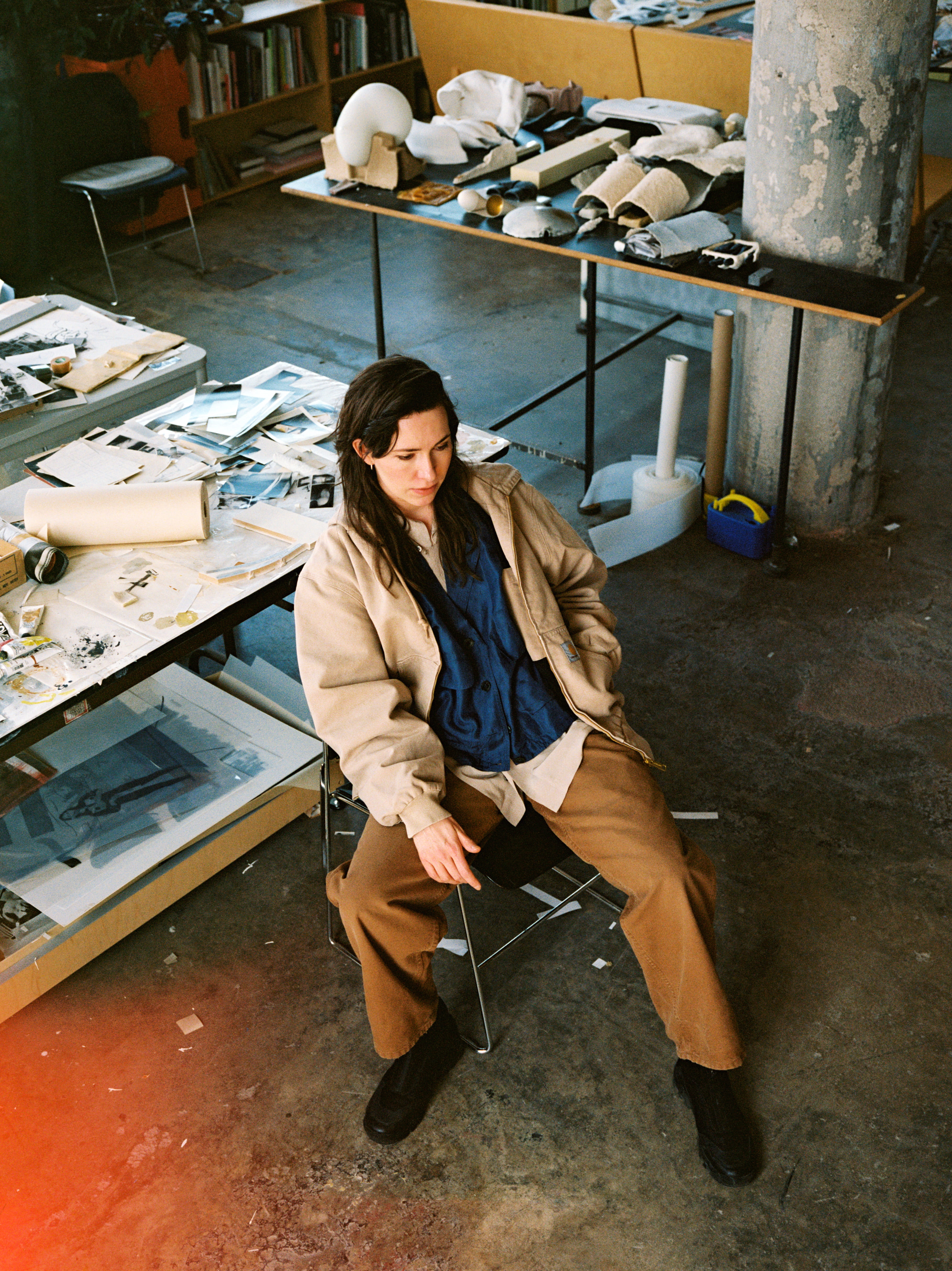
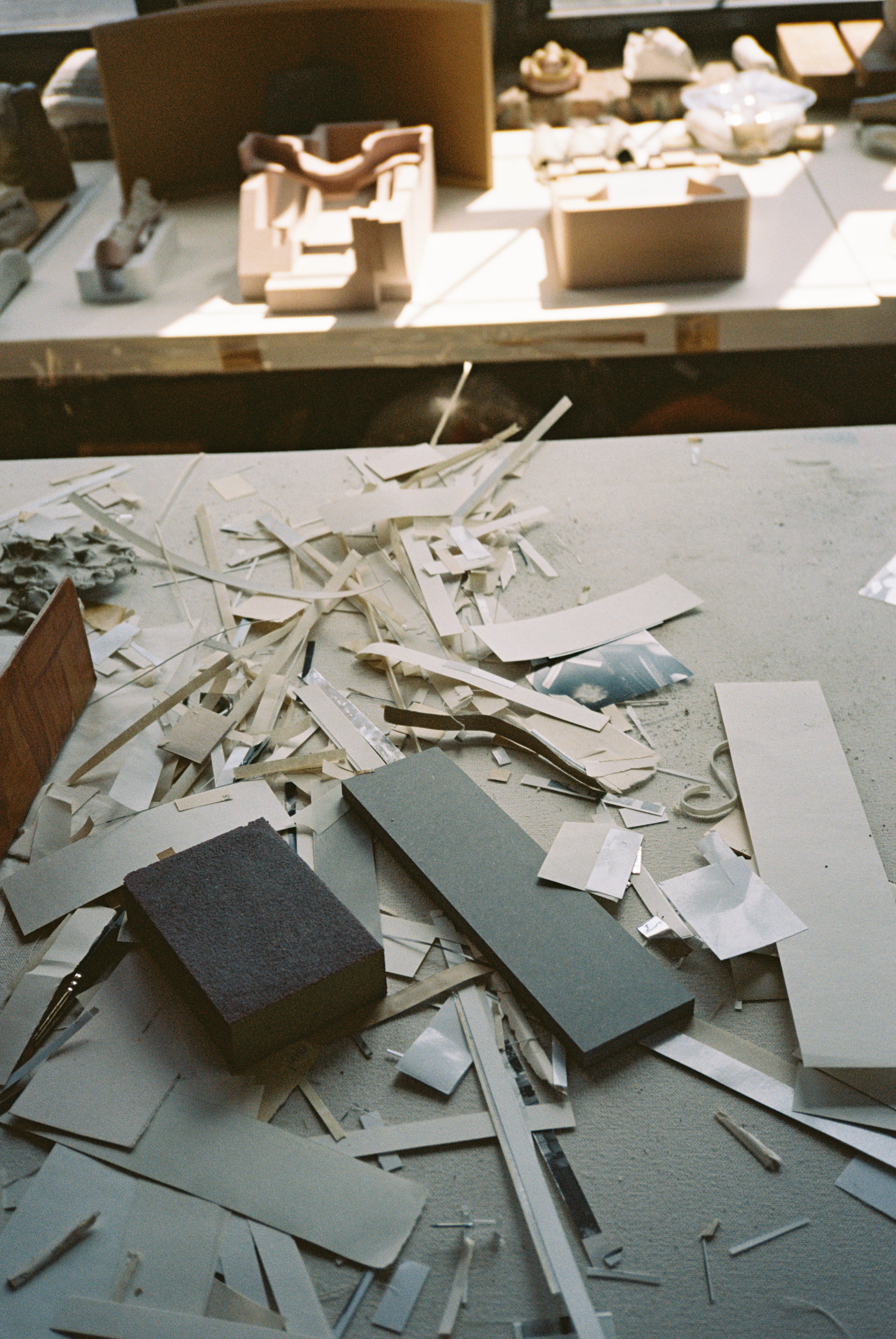
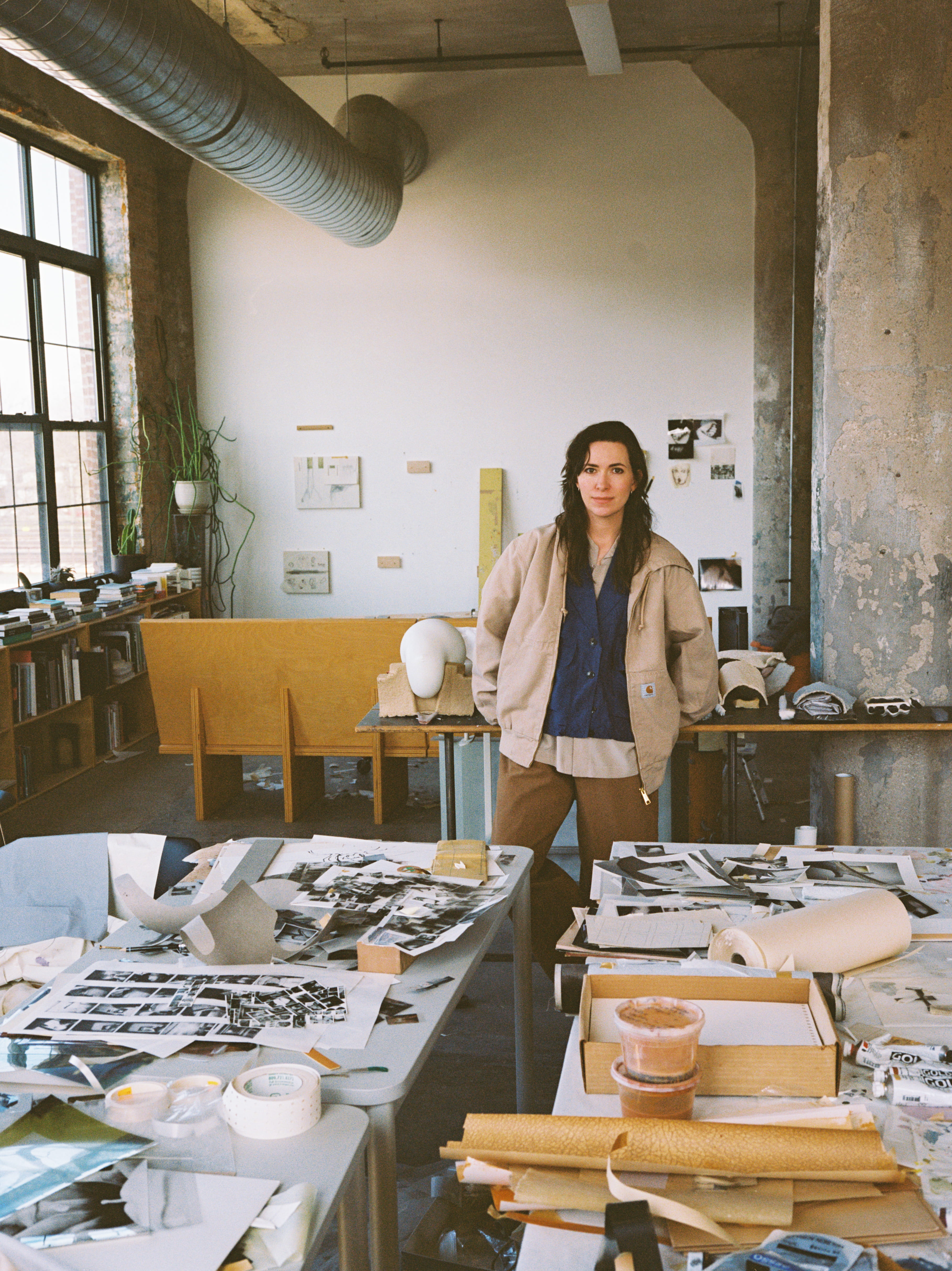
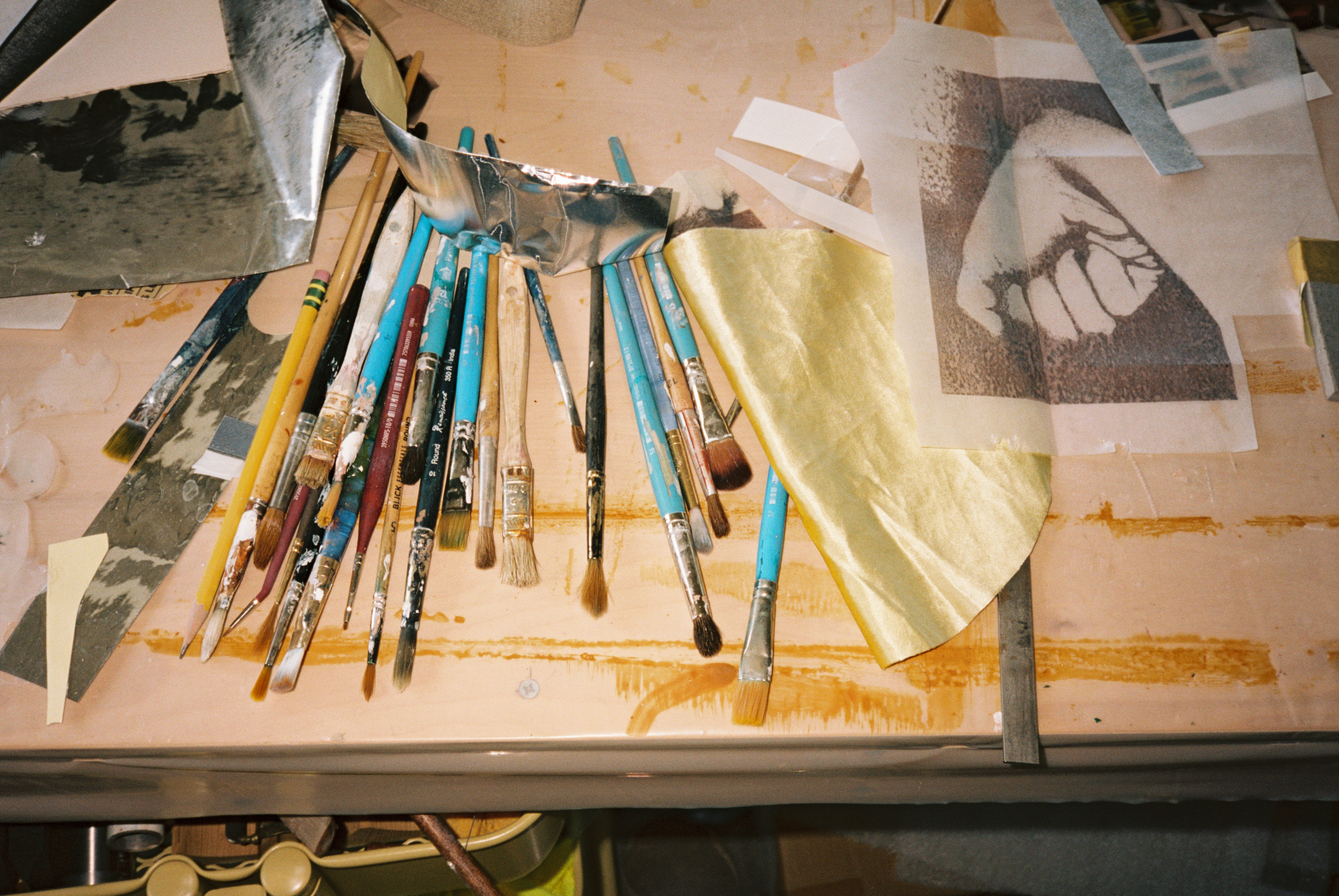
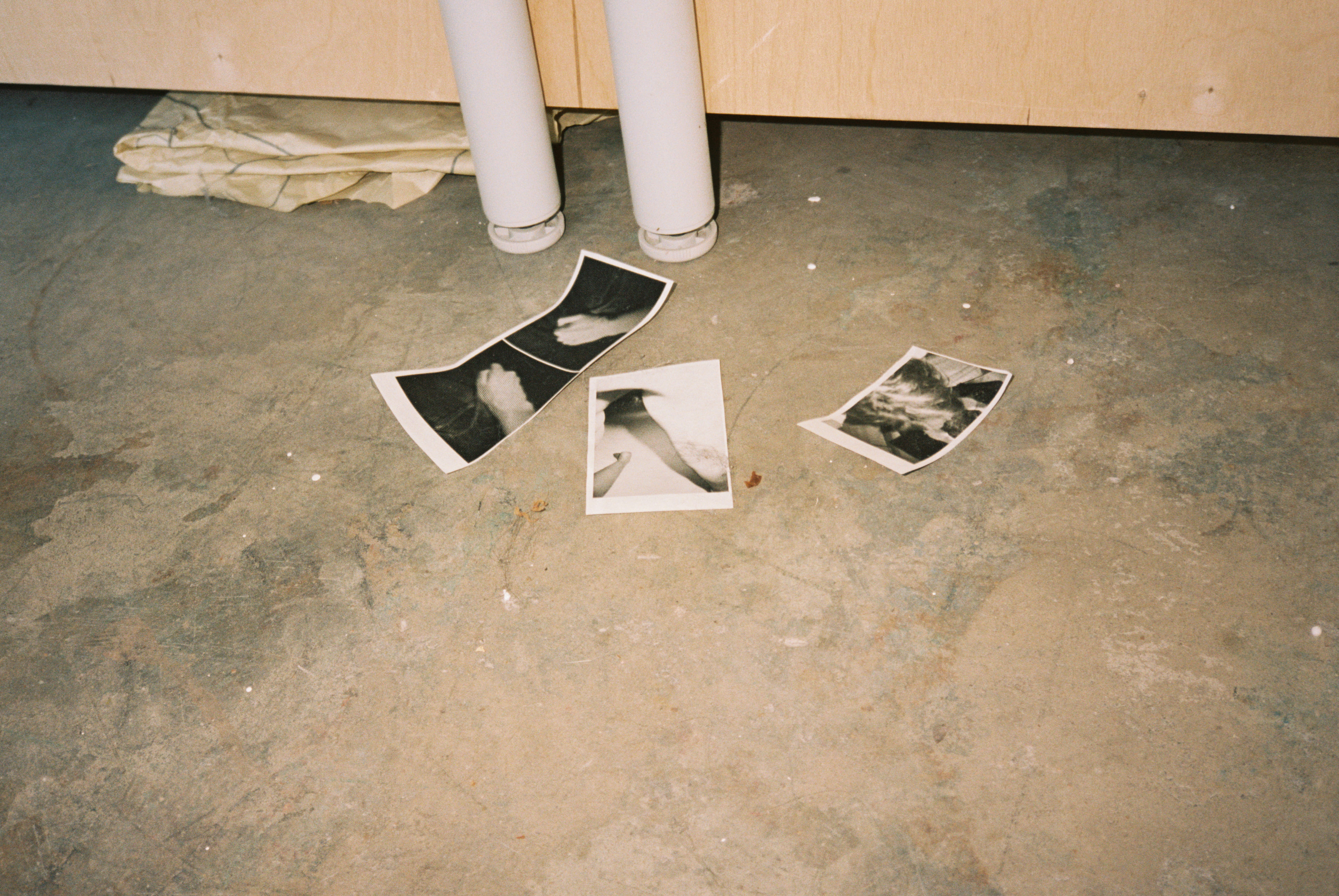
I’ve always been interested in reusing images, or in understanding a photograph as a material rather than in the traditional sense, as a finished image. Some images I’ve printed only once and never again, while others I’ve printed twenty times or more, taking on different shapes or materials as I rethink them in new contexts. When I prepare a show, I might take new photographs, but then I think about them in relation to things made many years ago, whether it be photographs, drawings or other materials I’ve collected that all still sit in piles in my studio.
I think that’s why many of the titles in the show reference ideas like reservoirs or dams. As I accumulate more images and forms, the process becomes more overwhelming, but photography is related to liquidity and accumulation. There’s something really satisfying about letting a lot out in one release and making use of it.
That’s something that’s always been of interest to me. For a long time, I didn’t like photography at all, until I saw an exhibition that featured very sculptural, conceptual photographs from the 1970s. It made me realize that photography doesn’t have to be an illusionistic image that you enter into. Simple images plopped in a frame never spoke to me in the same way. I saw this possibility of thinking about photographs materially. It became more about letting the image do what it does, but then disrupting the process: the image invites you in, but by treating it sculpturally, emphasizing its materiality, physically blocking it, abstracting it, or degrading it, the illusion is hindered or stopped. Then you think more about yourself as an onlooker rather than as someone who can enter the space.
I’m interested in the speed at which we look at things. Photographic, illusionistic, or representational images are usually perceived more quickly, whereas something minimal, abstract, or even blank requires slowness. That slowness pulls you out of quick recognition and into a feeling that can be meditative or even awkward, as you stand in front of it. This push and pull, in and out of mental or bodily registration when encountering a work, is a mainstay in everything I do.

I usually think about how it feels when you walk into a space. When I did the site visit at Kunstverein Braunschweig, the windows were extra-present. The exhibition space is made of a circuit of rooms, with a window in every room, so wherever you are, you can see clearly out of and into the spaces. That’s when I started thinking about using privacy film. It sounds like making something private would feel protective, but in actuality, there’s something very uncomfortable about it. When I started experimenting with this material in the studio, it was unnerving not being able to see out.
There’s a kind of social contract with windows: you get to see out, so you know what’s coming, but at the same time, people can see you doing what you’re doing. It becomes a philosophical conundrum: do you want to be seen? And if you aren’t seen, you can’t see who can’t see you.
My initial engagement with the architecture of an exhibition space usually has more to do with floor plans than actually being in the space. Often, especially when working remotely, I am looking at images, which are never accurate, and floor plans, which don’t convey how it really feels to be in a space. I think a lot about the structure of experiences and imagine how someone might encounter something. For example, the idea of splitting the show at Croy Nielsen into three repetitions came from looking at the gallery’s floor plan, and its three distinct sections, which you don’t always feel consciously. But even when I’ve physically been to a space, my perception or memory of it changes and is exaggerated. What I do is an amplification of this experience: I imagine different ways to highlight this gut instinct or the first thing I feel when I am in a space.
While I often make relatively small objects, like the components of [M]others, the gallery becomes an extended frame and the experience balloons outward. I think about how to condition the space with light, paint, or creating impediments to affect the flow. For example, closing a door can make someone walk back through a space to see everything from a different angle and in a different order. These amendments shift the tone and meaning in an encounter.
The video room was originally an actual vault. Vaults have the double-edged meaning of being places where you put something valuable as a protective measure, or where you keep something secret hidden away. The idea came to me as soon as I started working on the exhibition: I wanted to focus on the weight of the vault’s capacity to hold things, more than to recreate an enterable facsimile of the space.
I took the dimensions of the shelves where you would normally put money, or other valuable materials and made the interiors into closed boxes that can’t be opened. You don’t know what’s inside of them. They’re neatly stacked, and instead of being set within another space, they hint at an enclosure without actually building a room.
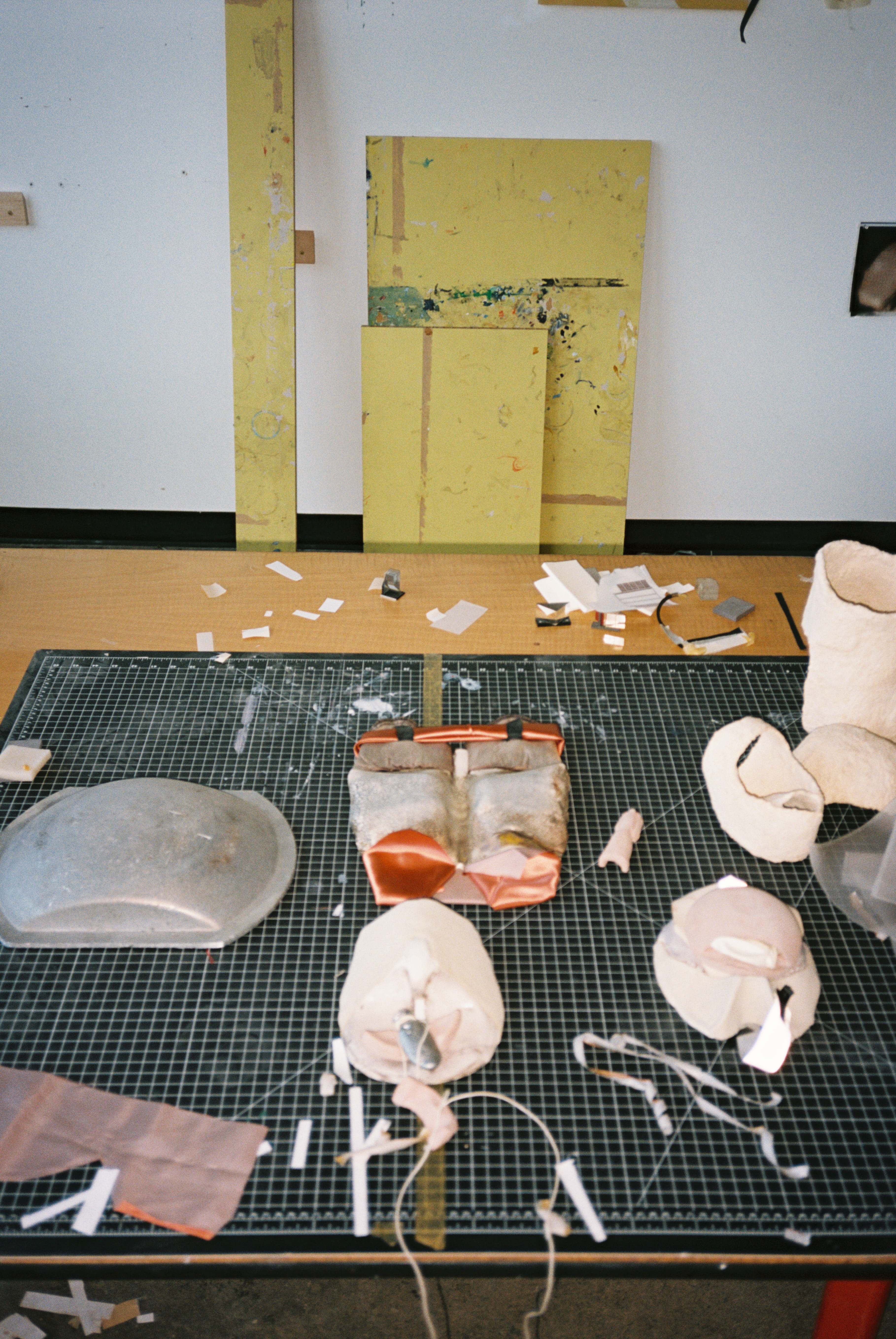
In the space between the two rows of stacked containers, a parabolic reflector sits on the floor. The sink-shaped cavity of the reflector holds a ceramic form, a strip of sheer cloth, and a smooth plaster cast with small photographic images pasted to its surface. The concave shape of this mirrored bowl captures reflections of the images and materials, without much of the surroundings. The shape also magnifies and stretches the reflected images, making them unstable, and erratic. The experience is almost cinematic, even though the object does not move.
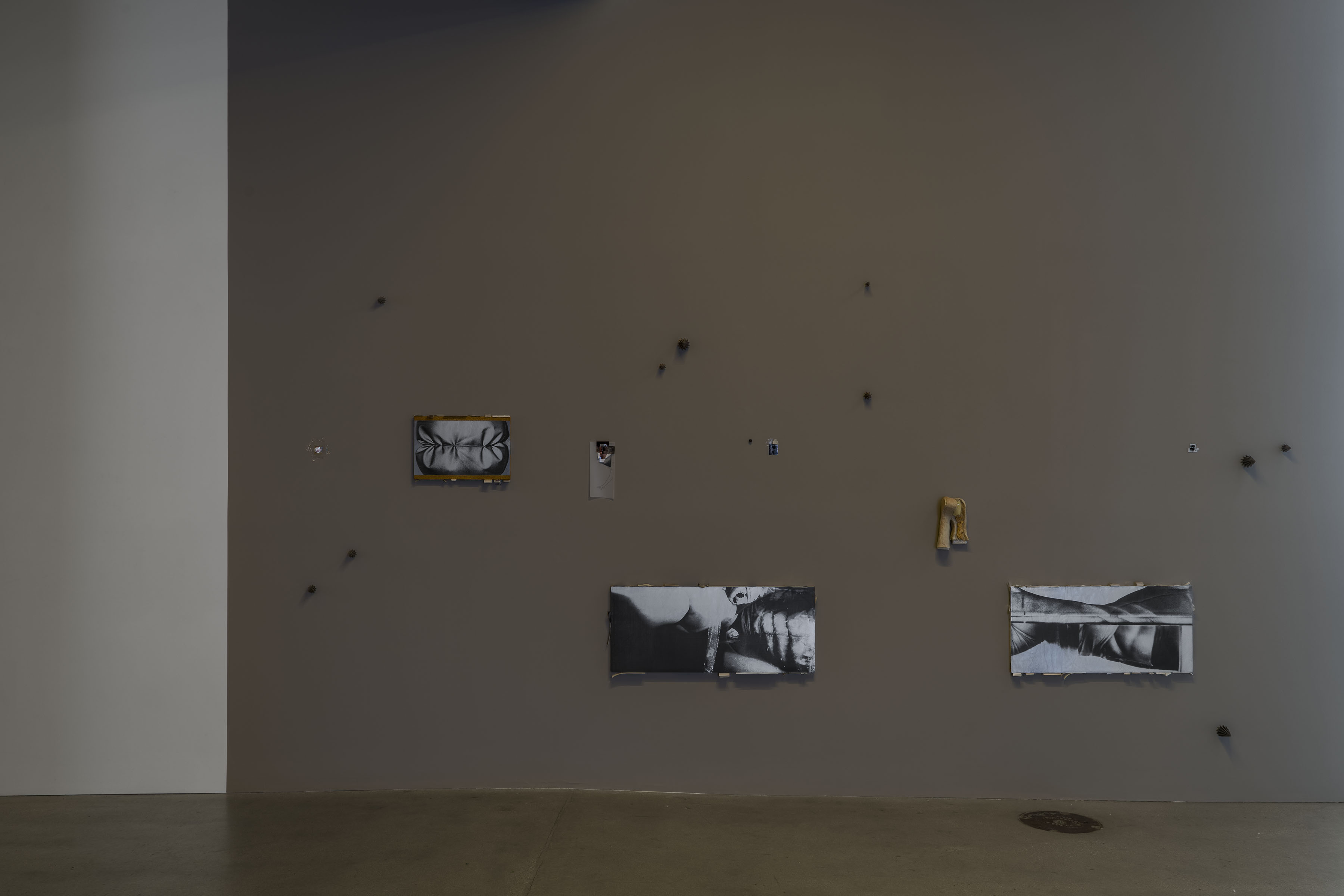
The exhibition at Corbett vs. Dempsey re-stages an aspect of an installation that was conceived for XYZcollective in Tokyo. XYZ is in a basement and is usually very brightly lit, but I wanted it to feel like a dark cavern with a tiny, clustered corner. At Corbett vs. Dempsey, I wondered how the space would feel if the lights were just dimmed, rather than removed. The dimming film we used created this really warm glow and created a completely different energy. The low light level also offered a contrast to another element of the space I wanted to accentuate: a corner within the gallery has a large gap where two walls would otherwise meet. Natural light from the office windows leaks into the exhibition space from this opening.
I had started thinking a long time ago about this idea of what is going on outside of the work. One of my favorite books is Remainder by Tom McCarthy, where the character builds a sort of theater set to recreate a memory, and it keeps expanding outward from the room, further and further.
It’s very important to me. Many of my titles are culled from notes I take while I read, sometimes changed a little, or multiple sources cobbled together, sometimes verbatim. There was a show at the Poetry Foundation in Chicago recently, one of my favorite places. Alex Katz had a show there featuring portraits of poets and cover art for poetry books he’d done. There was an anecdote that he didn’t like artists; he only made friends with poets. I do have friends who are visual artists, but I also have a lot of friends who are writers and poets, and I really identify with them. Maybe it’s also a kind of jealous admiration. I love what they do, creating something not visual at all, and yet it feels so visual. The removal of tactile or physical imagery makes it full-on imagination.
And the work you’re referencing, the paragraph-length title came from a dream. I woke up and transcribed it. It was almost filmic. At first, I thought it could have been a video piece, but it worked so well as a text, just as it is. There’s a similar logic in another series, called Enlargers. They are found objects, steel reamers that have been used in construction work. I like the incidental marks of their previous use; some are worn down, some still very sharp, still functional or potentially violent. However, the titles are more of the point of these works. They become simple markers, or placeholders for more complex language.
I’ve written a few published texts, and I write many of my press releases. More frequently, I write in my sketchbook. I think artists’ writings are always good for posterity, for an artist’s archive, but not always necessary to make public. Not everyone can be Anne Truitt. When I read her journals, I can hardly get through a page because there’s something so beautiful and transcendent that derails me.
The closest thing I have to a journal is my sketchbooks, where there is a really clear view into a thought, written in the moment. They are like notes for my future self. Otherwise, I don’t remember all the things I’m thinking, or the strange analogies that help to make decisions in my work. It’s amazing to have that portal, that time-chute into my own mind in the past.
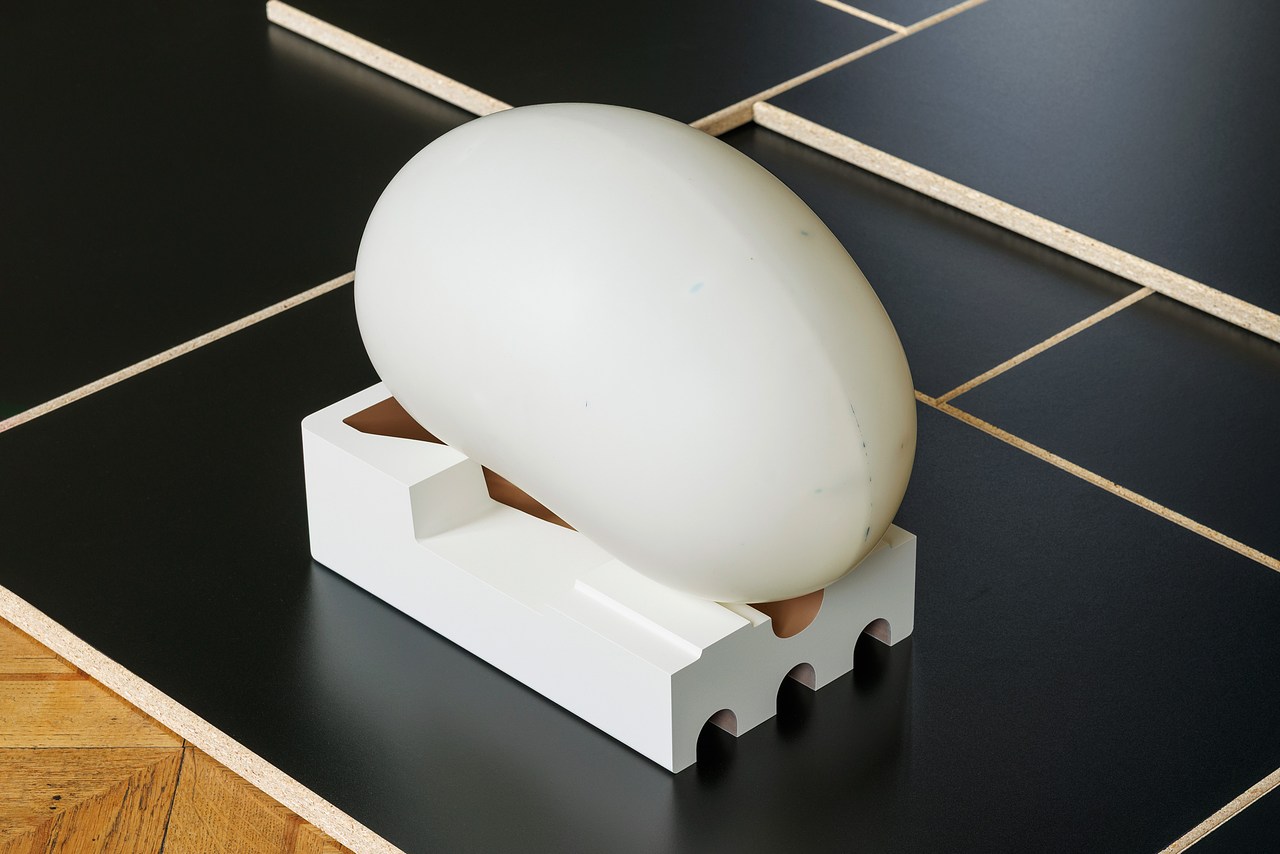
I’m actually really interested in the Cartesian split between body and mind, which I think most people don’t believe in. But somehow this lack of integration is often the way I perceive the world. I feel a real separation. What began mostly as an interest in phenomenological exploration of bodies within spaces at the beginning of my career has transitioned into thinking also about more psychological aspects. I’m very interested in how such interior things— mood or psychology, or even mental illness—can affect your perception of exterior things.
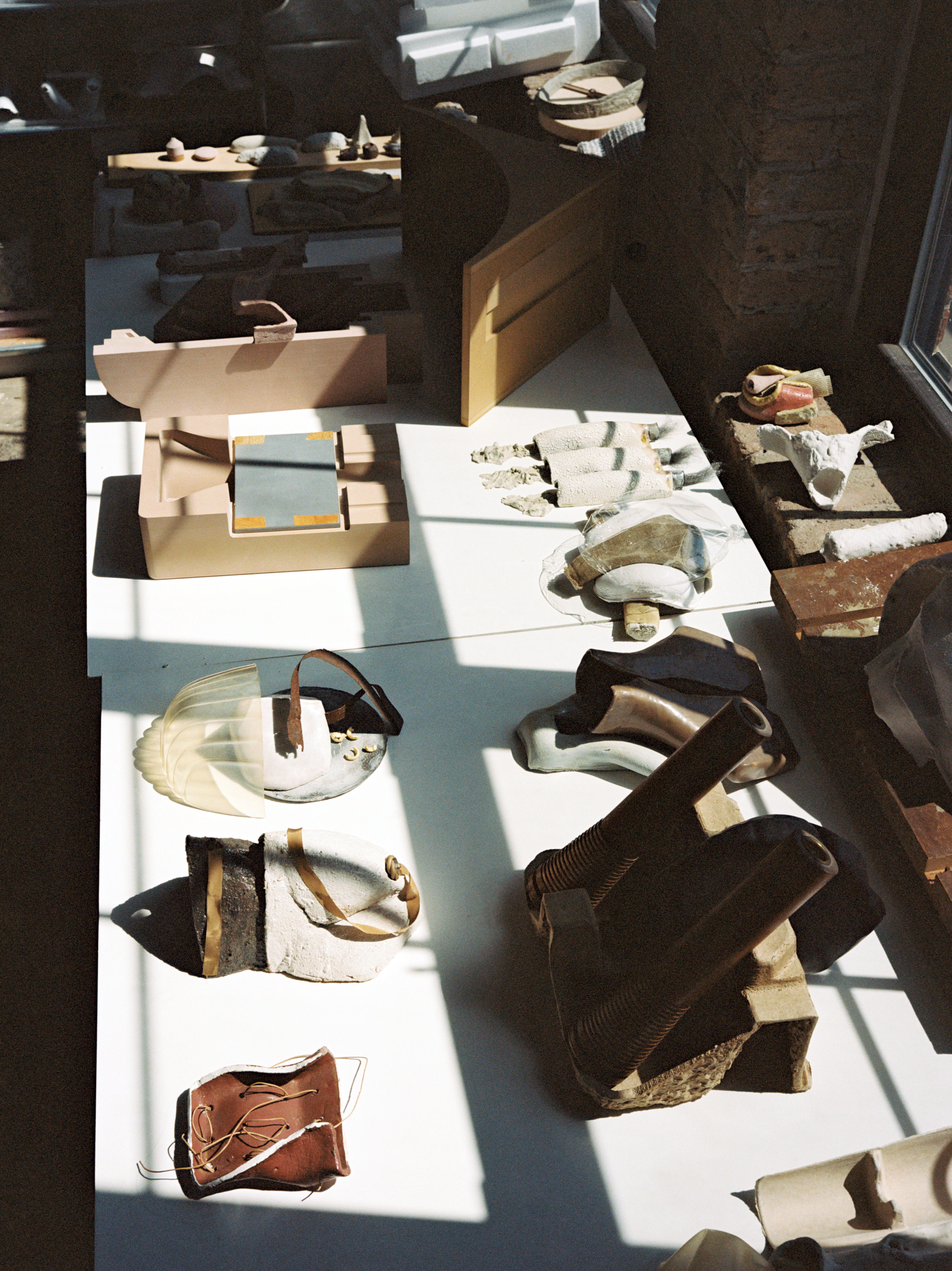
I don’t often think of my work through a personal lens, but it’s such a strange time, and the world feels like it’s falling apart in an exaggerated way. As I was writing about the work, A Feminine Thought, I realized there is a neatness to all of the stacks of these things, but actually, they are all little dismembered body parts all over the place. And it started feeling to me like the aftermath of an explosion, of someone laying out all the parts, trying to figure out what, who, and where they belong to.
Also, I had a surgery a few years ago, and I started to think about how you can completely pull all your organs out of your body to fix a problem and then they can all go back in place. Maybe the surgical actually goes back to this archival sensibility. Surgery is a kind of excavation that, even though violent at the time, makes sense of the mess and tries to find order in disorder. I think it’s very hard to make artwork in this historical and personal moment. And I think the important thing for me right now is actually being honest about that feeling and the circumstances, which is reflected in the work I am able to make.