Tolia Astakhishvili at mumok

with Vito Acconci, Zurab Astakhishvili, Aurel, Ştefan Bertalan, Karl Blossfeldt, Kaucyila Brooke, Veronica Brovall, Günter Brus, Elene Chantladze, James Ensor, Nan Goldin, Yaryna Fedoriv, Irma Gubeladze, Ull Hohn, Joe Jones, Paul Joostens, Louise Lawler, Charlotte Moorman & Nam June Paik, Dylan Peirce, Pablo Picasso, Charlotte Posenenske, Alexandra Ranner, James Richards, Irena Rosc, Medardo Rosso, Dieter Roth, Maka Sanadze, Stefan Wewerka, Heimo Zobernig.
–
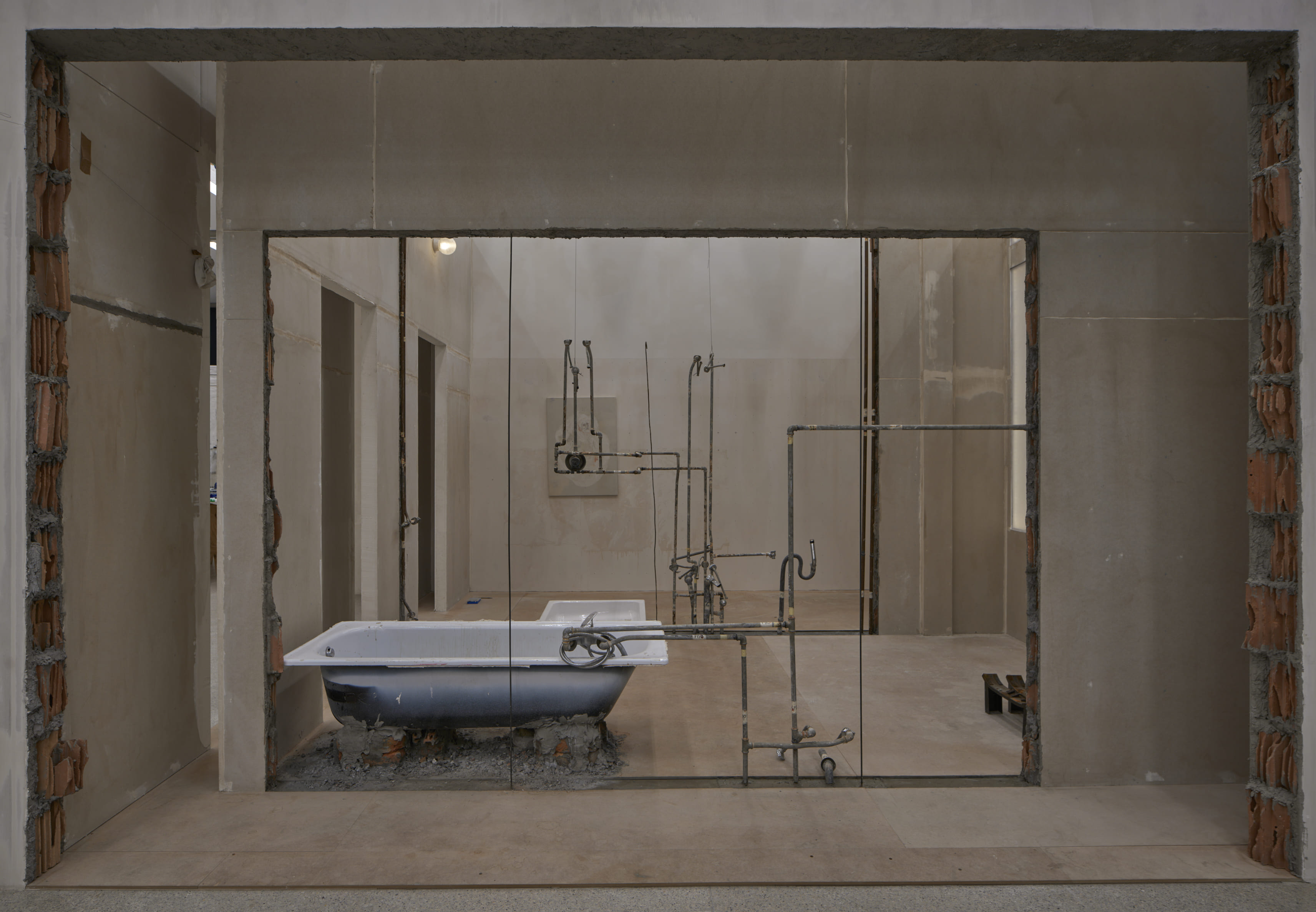
Figure of the Child is the first solo museum exhibition of the Tbilisi- and Berlin-based artist Tolia Astakhishvili. For mumok, she developed a large-scale installation that fundamentally transforms the two lower exhibition levels—starting in the foyer of the deepest level with a video installation, which includes footage from the publicly inaccessible cellar and boiler room. Where rigid lines and cool lighting usually emphasize the boundary between art, architecture, and viewer, Tolia Astakhishvili has created a space that subverts this order. Instead of using the floor and walls as presentation surfaces for artworks, she constructs and designs her own environment. Moments of instability—of rawness and unfinishedness—shape the exhibition. Ramps and mirrors shift lines of sight, while pipes and shafts point to larger circuits—to something behind and beneath that evades the gaze. Astakhishvili is interested in such transitional states: thresholds at which perception is recalibrated and expectations begin to form.
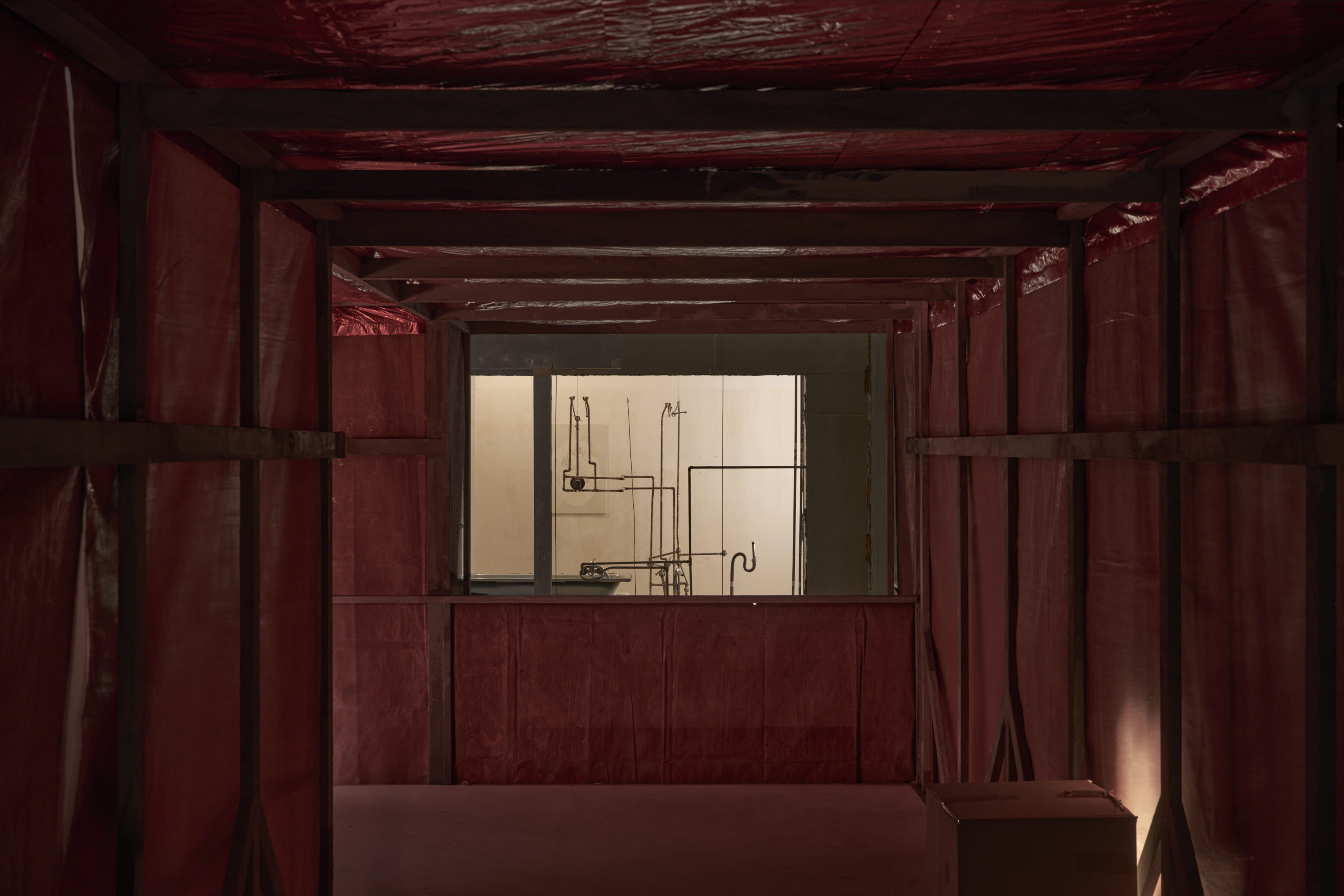
Visitors enter the exhibition on Level -4 through a red tunnel. The tunnel first leads toward an opening that reveals the fragment of a room, with pipes extending into the space without connection. With this image of interrupted circulation, the tunnel then redirects the entry into the exhibition level from an outer corner, generating a new perspective, where the eye must first adjust to the dim light. Visitors are still inside the museum and, at the same time, in new, uncharted territory—with the ceiling seemingly supported by makeshift pillars and its layers and interweavings only grasped piece by piece.
This passage from one environment into another recalls a motif that is in focus for Tolia Astakhishvili’s exhibition at mumok: the “figure of the child,” after which the exhibition is named. The child embodies both a high degree of intellectual and creative autonomy and a profound vulnerability and dependence on others. Figure of the Child unfolds from this tension a reflection on the existential condition of being thrown into the world—on ideas of home, shelter, and belonging; on feelings of uncertainty and loss as well as the need for protection; and on navigating social systems and structures that demand adaptation while pro- voking resistance.
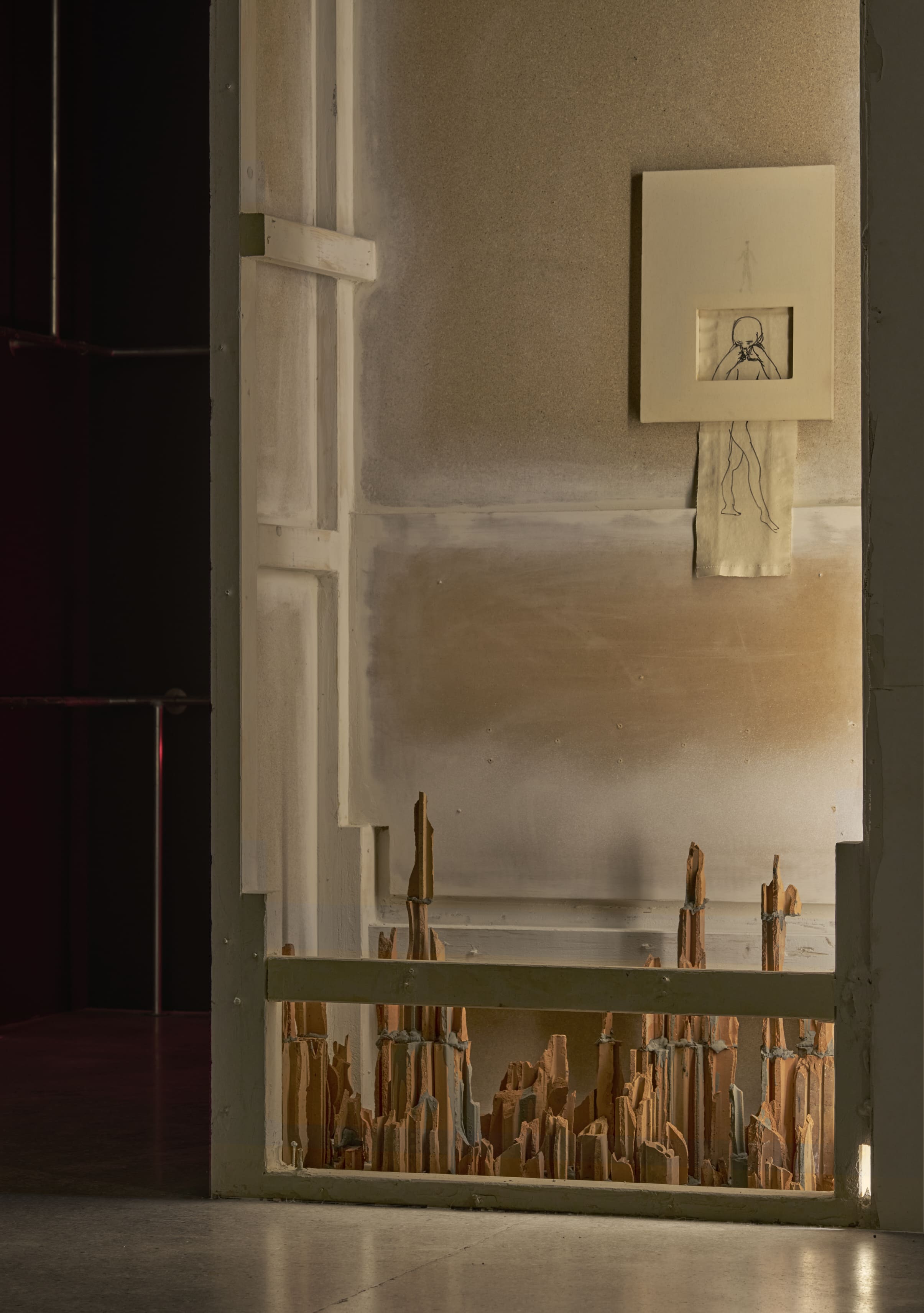
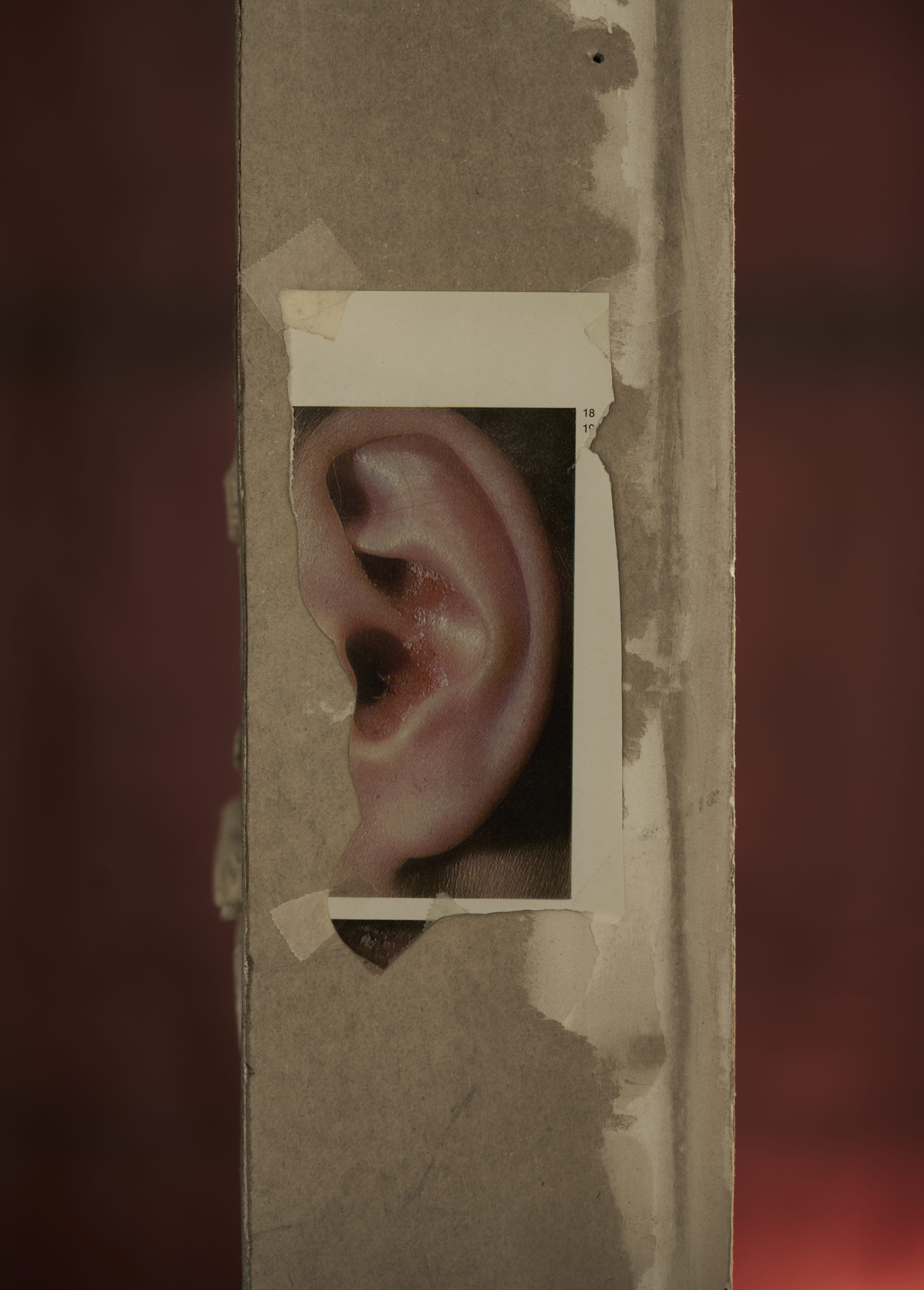
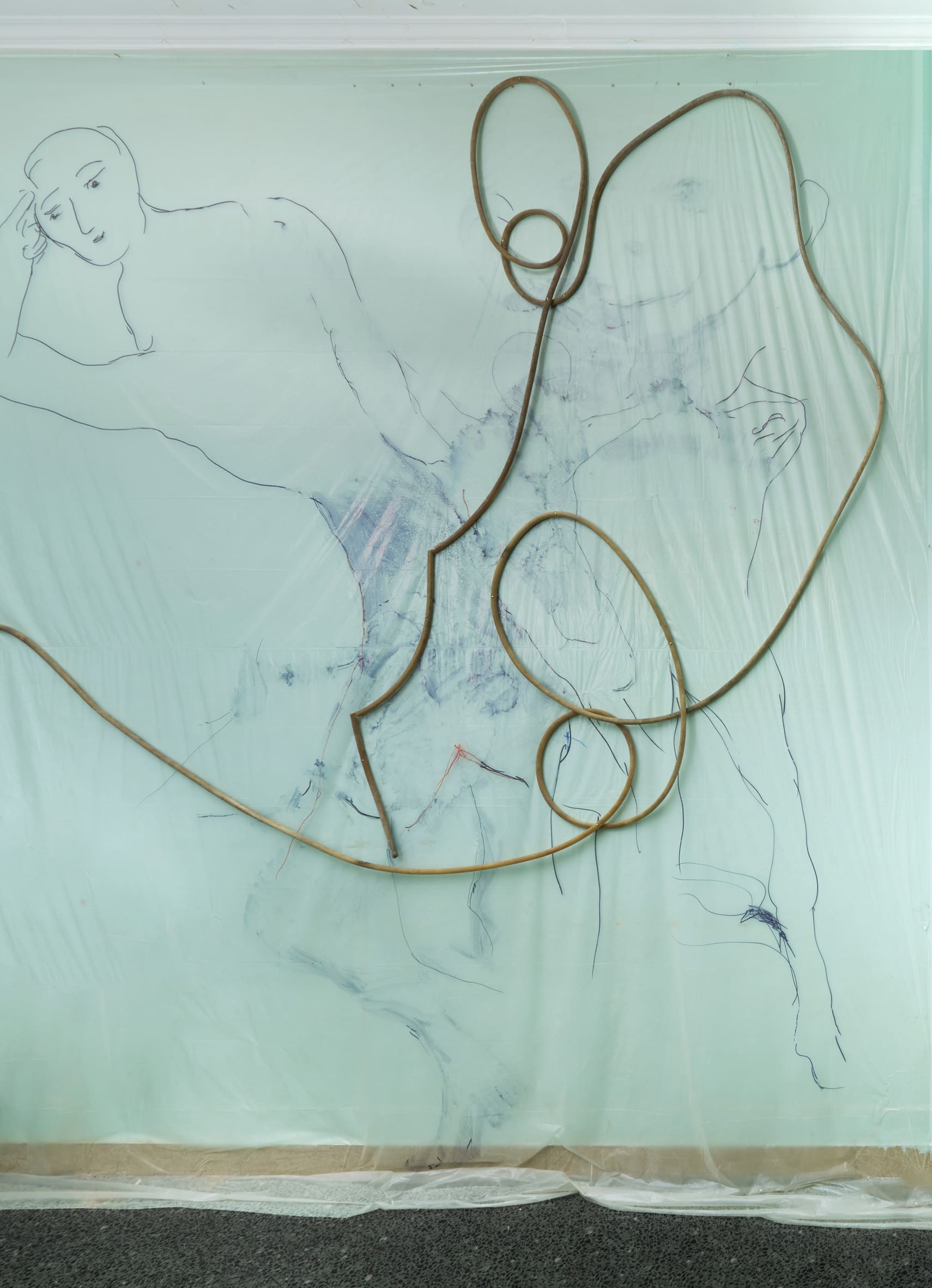
Against this backdrop, Tolia Astakhishvili’s exhibition can also be understood as a response to the blank slate character of museum spaces. Her installations seem inhabited. They explore manifestations of decay, wear, and discard. Across layered surfaces, the artist presents drawings that often depict only partially articulated figures. These drawings enter into dialogue with their surroundings, rendering the traces and revisions of the architectural elements legible as further pictorial interventions. In this way, drawing shifts from the page into space. As fragile markers of corporeality, the drawn figures stand out while simul- taneously dissolving into the bricolage of their environment.
This constant refocusing corresponds to the experience ofthe exhibition itself, which does not follow a predetermined route. A cluster of objects prompts us to peer around a corner; a mirror guides us in a new direction; a red glow draws us into a side room. Movement becomes a detour, and the direct path increasingly seems wayward. The distinction between work and context erodes, while transitions and interstices open up new possibilities and connections.
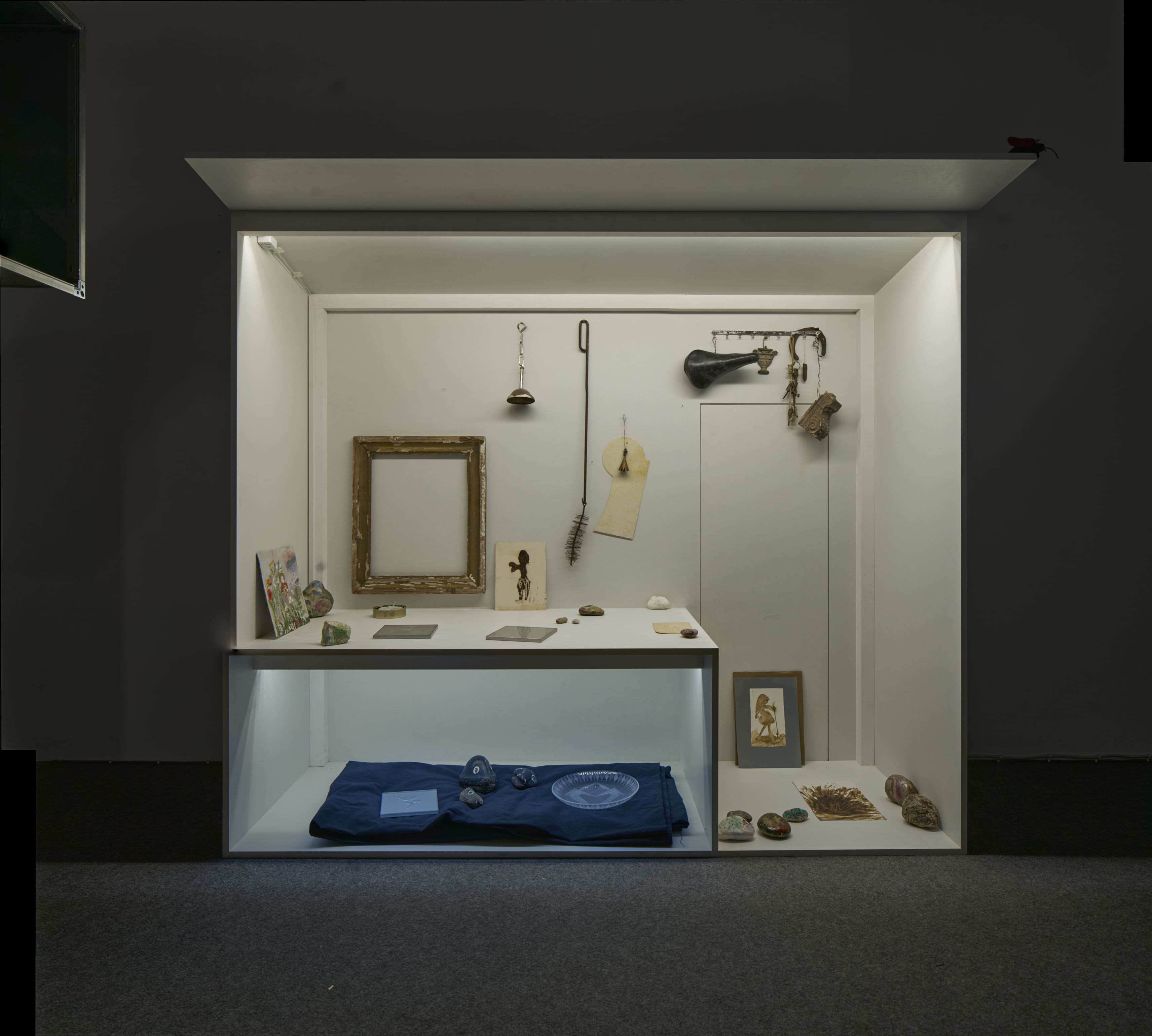
This openness informs Tolia Astakhishvili’s way of working, which is profoundly shaped by collaboration. The exhibition includes not only works by longtime companions and members of the artist’s family but also works from the mumok Collection, some of which are presented in cases built specifically for this occasion. Astakhishvili’s selection extends key motifs of the exhibition: the box as miniature dwelling and site of storage; plans and models of imagined buildings; everyday objects, including furniture and tableware; the newborn as a liminal being; and surfaces as carriers of marks and scribbles. Emerging from various contexts, the collection works become part of a reflection on history as layering and on what we preserve, discard, or leave to decay.
In preparation for her exhibition, Tolia Astakhishvili spent several months working in the spaces of mumok. During this process, she hosted Tolia Curriculum on Level -2—a format that made the otherwise concealed phases of production and installation accessible to the public. Within a continually evolving architectural environment, an almost daily program of workshops, film screenings, readings, and participatory formats for children and adults unfolded between May 22 and June 18, 2026.
With Tolia Curriculum, the usual temporal constraints of exhibition-making shifted. Visitors experienced moments of creation and transformation—and left their own traces within the space. The museum thus became a site in which artistic production could be experienced as an ongoing process.
Even after the exhibition opening, Level -2 remains a place of hospitality. The architectural elements conceived by Tolia Astakhishvili for this space, marked by traces of prior use, host additional event formats throughout the exhibition’s run, animating and activating it. Figure of the Child is therefore not only an exhibition but also a spatial-temporal experiment: a changing organism that challenges perception as much as it does the institutional structures that govern it—and in which the museum will itself can be experienced as a place of becoming and possibility.
The three publications produced in conjunction with the exhibition reflect this approach through processes of layering and accumulation. The first volume, published on the opening day, explores drawing and materiality at the heart of Tolia Astakhishvili’s practice. Using the same printed sheets, two further volumes will emerge, with exhibition views overprinted onto their pages.
Much as the child experiences everything for the first time at some point, this emphasis on process reflects a commitment to curiosity. In other words, the decision to allow life—and therefore change—to become part of the cycle through which an exhibition comes into being, is experienced, and is ultimately remembered.
–
Tolia Astakhishvili (born 1974 in Tbilisi, Georgia) lives and works in Berlin and Tbilisi. Her most recent solo exhibitions include to love and devour at the Nicoletta Fiorucci Foundation in Venice (2025); between father and mother at the SculptureCenter, New York (2024); The First Finger (chapter II) at Haus am Waldsee, Berlin (2023); and The First Finger at Bonner Kunstverein, Bonn (2023). Tolia Astakhishvili’s works have been featured in numerous group exhibitions, most recently at MoMA PS1, New York (2025); the Fondation Pernod Ricard, Paris (2025); and the Museo de Arte Contemporáneo de Roma, Rome (2024).