The Otolith Group at greengrassi

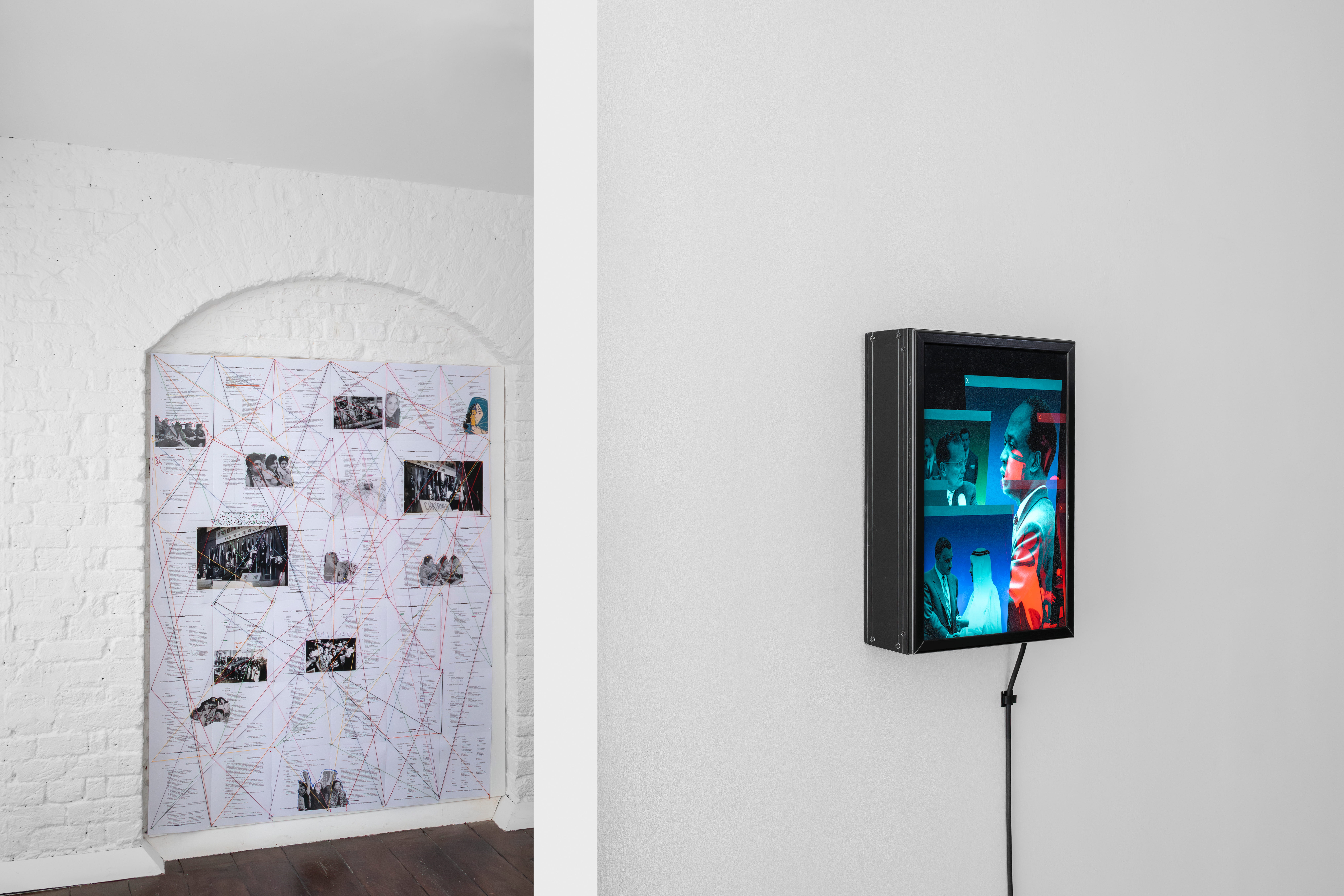
Hex Code Basement Logic (2026) draws selected CIA documents on the Womens International Democratic Federation (WIDF) from 1956 into a yarnwork that aims at ensnaring the travelling images of WIDF conferences into an anti-Communist pareidolic imagination.
The transparencies of the three lightboxes titled Made for Theodosia, Named after Tayeb and Intended for Ibrahim (2014) prefigure the compounded simultaneity of MASCON: A Massive Concentration of Black Experiential Energy premiered at Neubauer Collegium in 2024. They emerge from ongoing research undertaken at the photographic archives of the First Summit Meeting of the Non-Aligned Movement held in Belgrade from 1 to 6 September 1961.
The digital photo collages from Speaking Motions of Gesture (2025-2026) reconfigure gestural, geographical, geometrical and expressive motifs drawn from the monumental visual study of the films of Ousmane Sembene and Djibril Diop Mambety conducted for the mural entitled MASCON: A Massive Concentration of Interscalar Energy commissioned by the Art Institute of Chicago in 2024. Each work undergoes a series of transpositions that invite and modulate sustained states of synthetic pareidolia.
From 2006 to 2010, Communists Like Us existed as an audiovisual performance of projected archival images, amplified music and real time interaction with photographic publications before its single channel version in 2010. The recto and verso of delegation photographs selected from the Otolith archive are counterpointed with translated subtitles from the train compartment sequence of La Chinoise (Jean-Luc Godard,1967) between revolutionary activist Francis Jeanson, acted by himself and Veronique, the Maoist student, acted by Anne Wiazemsky and juxtaposed with sequences extracted from Paragraph 2 of Cornelius Cardew and the Scratch Orchestra’s The Great Learning (1969) and Ennio Morricone’s soundtrack to Dario Argento’s film Il Gatto a nove code (1971).
The misdirections between captions and images, the inadvertent synchronisations between subtitles and images and the discrepancies between sounds and images engender an ongoing delamination of the relations between looking, reading and listening. The apparent linearity of Communists Like Us belies its aggravated arrangement of false promise, delayed anchorage and non-necessary belonging.
The Otolith Group aims to subject its objects to degrees of concentration, compoundedness and aggravation.