Isabella Benshimol Toro at Belmonte

A cross-section of the Earth would reveal vast fields of pure color. Time portrayed in agglomerations of matter. Layers and layers of grains of sand, dust, minerals, bones, rubble, sediment, lava. What accumulated from previous eras has turned into brushstrokes of color, strokes made of time. Beneath the Earth’s crust lie our most recent and our most ancient ancestors. All the detritus of the centuries.
As I write this, you persevere in your irrepressible attempt to contain time, almost as if you wanted to hug it. You pause to take a photo at the least expected moments—when it’s time to hang the laundry to dry or when you
undress to take a bath. Ordinary, automatic tasks; universal actions repeated across the planet in every possible direction of time and space. Things we have always done.
Your works are monuments to the everyday. One should not overlook the fact that, in Spanish, the translation of “everyday” is diario, a word that can mean at least three things: newspaper, one of the most widely accessibleinformational tools; journal, a notebook for the most private notes; and daily, something that recurs each day. You have always been interested in that blurry space between the intimate and the public, in the moments in which neither action nor rest takes place, in the instants when something is neither dry nor wet but still drying or un-wetting. We are united by a curiosity about what was said without being uttered, what only you and I understand. Although perhaps, really, only I understand it.
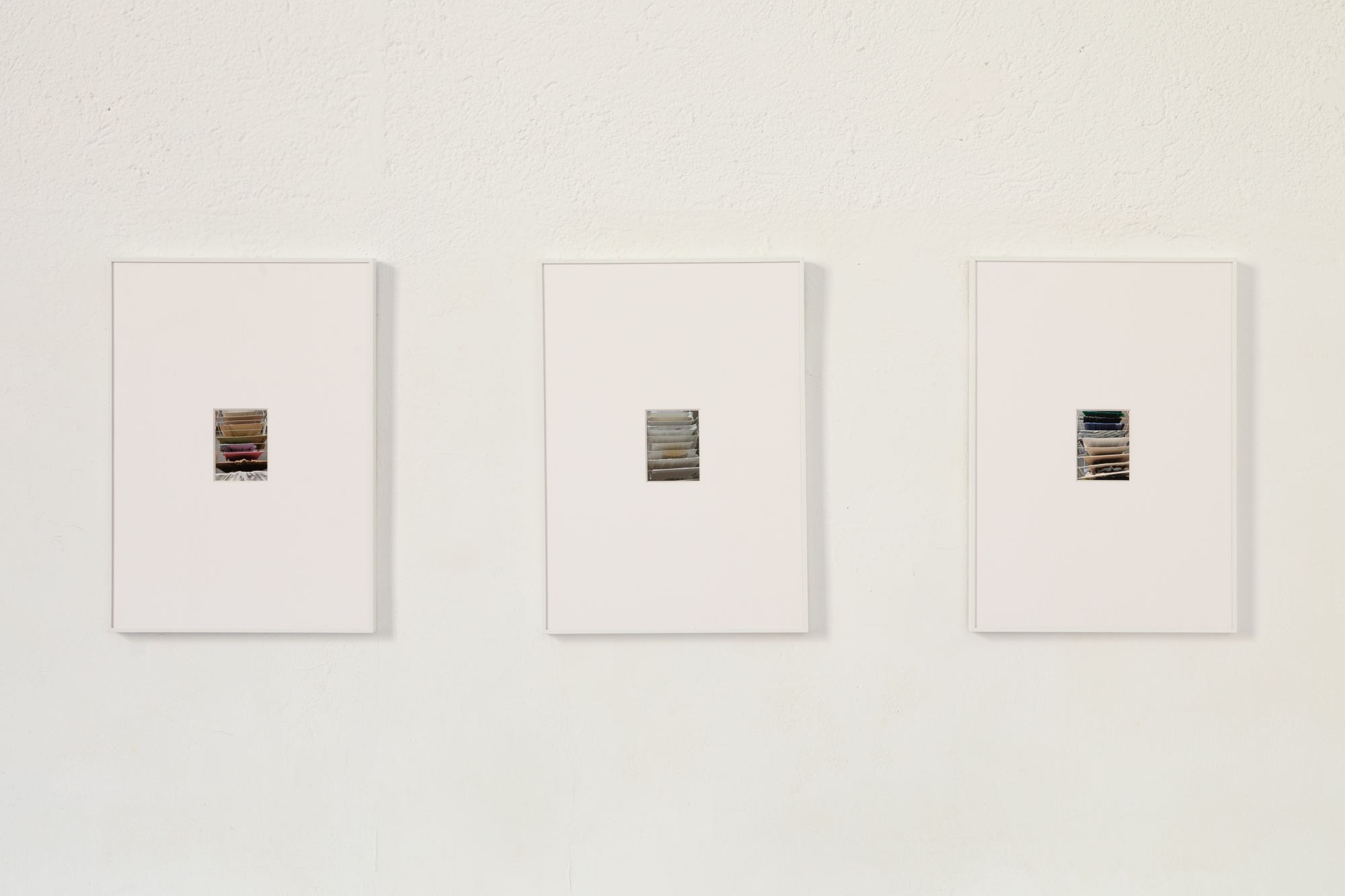
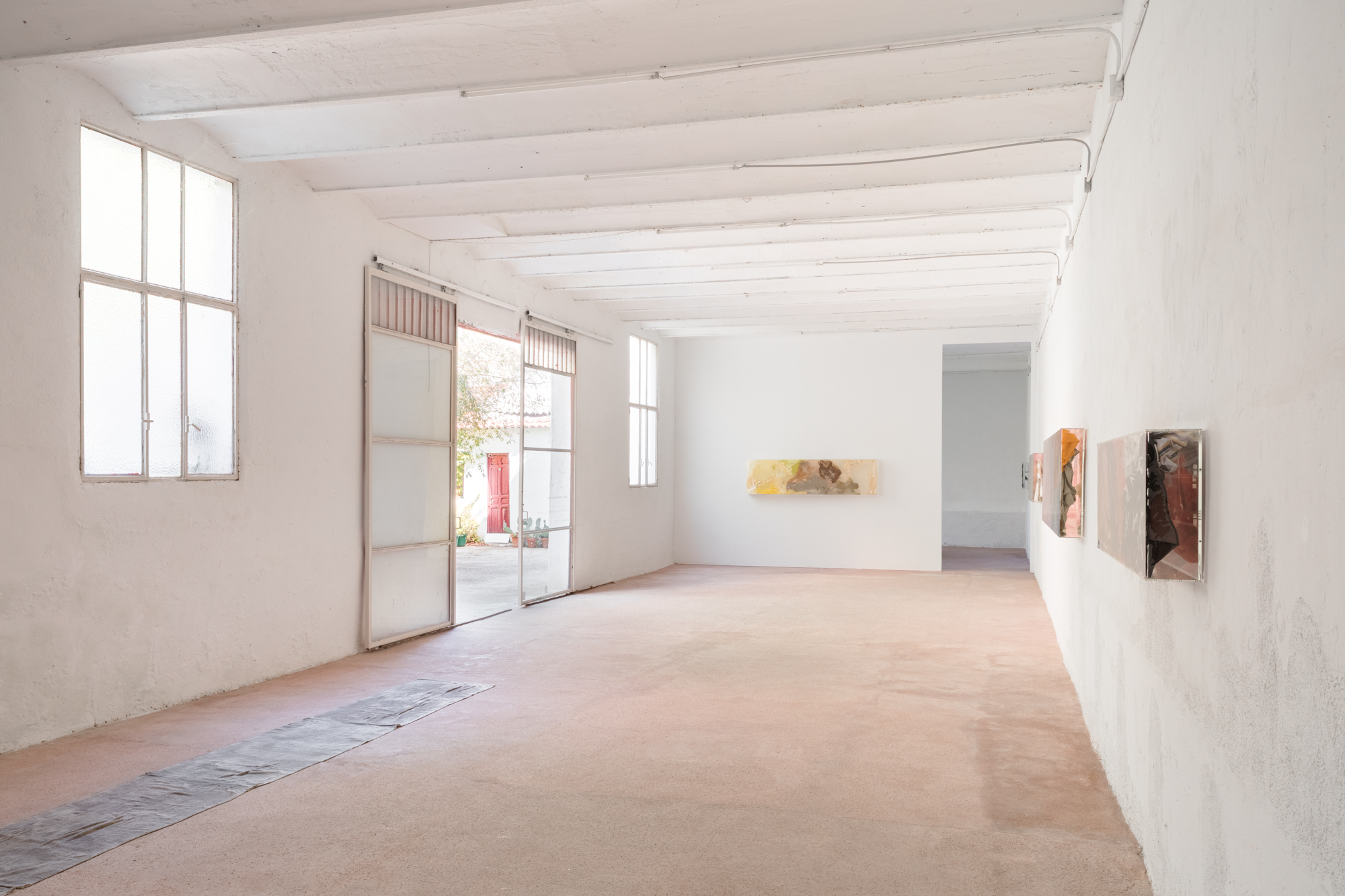
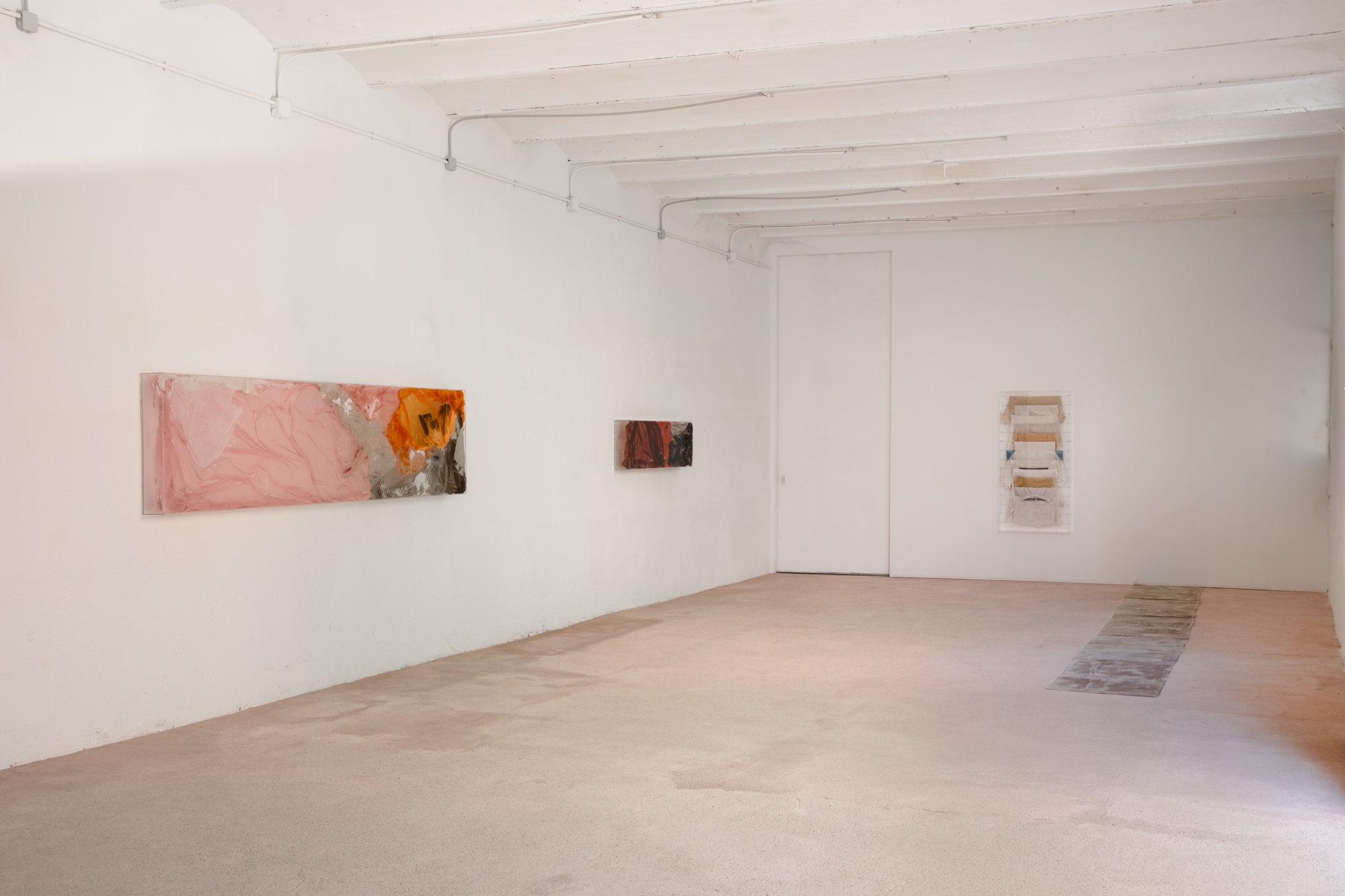
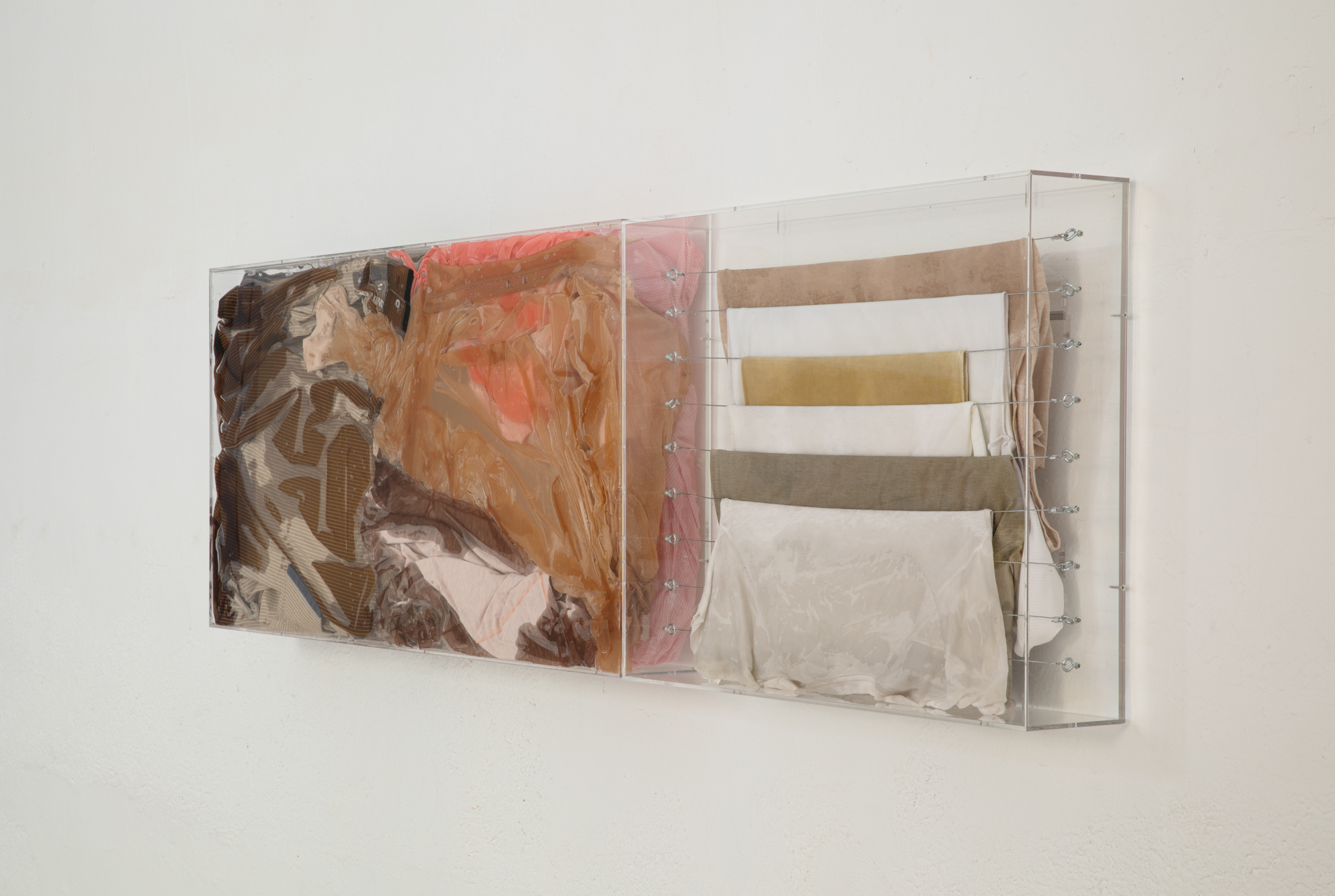
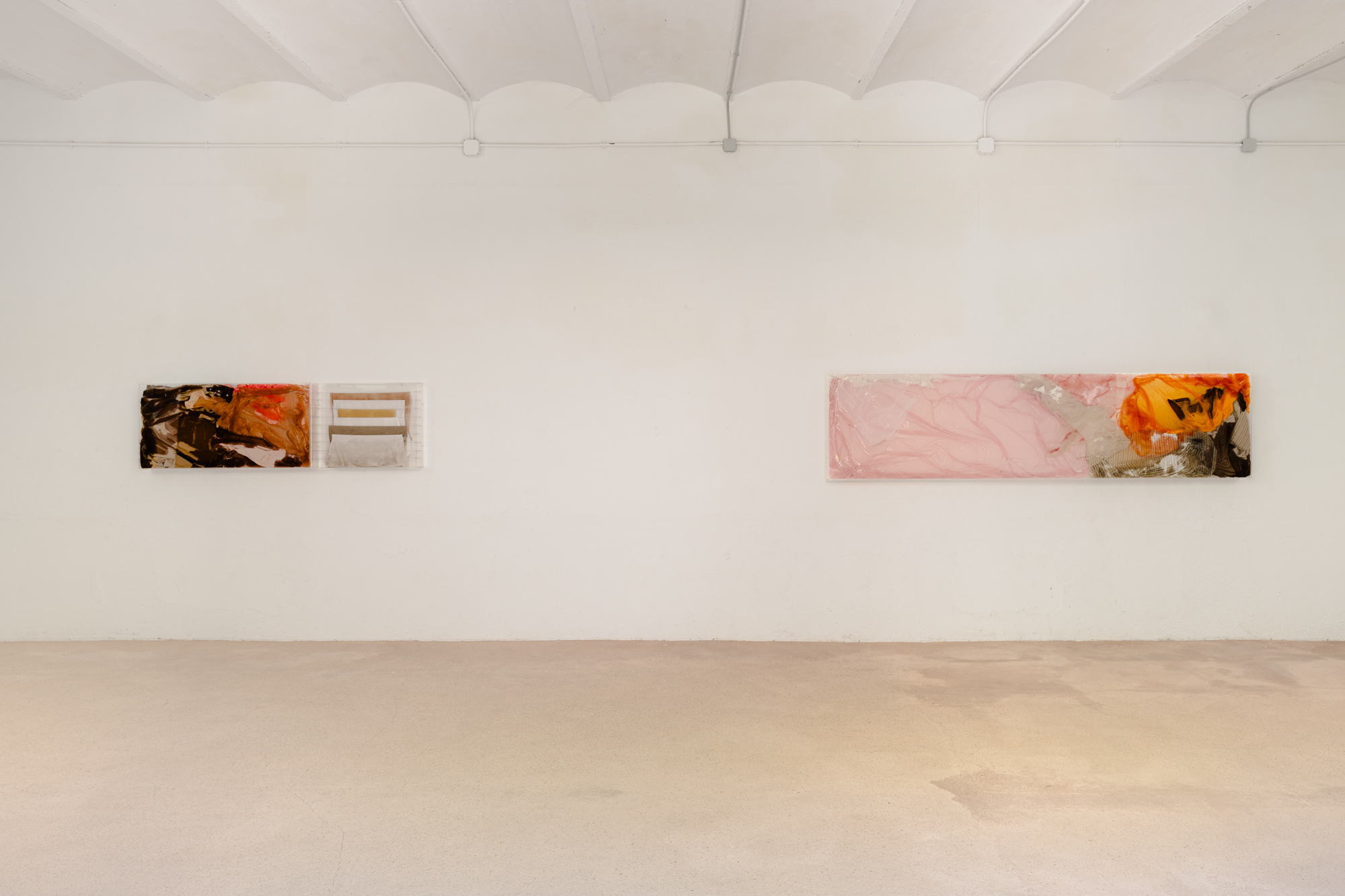
I imagine that all your conversations are almost like this exhibition. Timelines (or cross-cuts of time)—clean dissections, slicing through the body of time to study it archaeologically. You move in two languages and sometimes four different accents. Against the clotheslines so meticulously and vertically arranged, your Coladas [‘Washing cycles’] speak a language that is equally abstract but expressive, and shaped like the horizon. The Y-axis is like the left hemisphere of the brain: logical, mathematical, analytical, craving order. The X-axis is its counterpart: passionate, chaotic, prone to fantasy. Together, they form a grid. Resin helps you petrify in a practically liquid state. It mimics the gloss of water and soap, like an oil stain still fresh on the canvas even after the decades. Everything wrapped in Plexiglas, a material you use both to cover and to display content, like a vitrine holding a relic of the past in a museum. Working inside the box, you arrange, move, and sculpt the fabrics like brushstrokes.
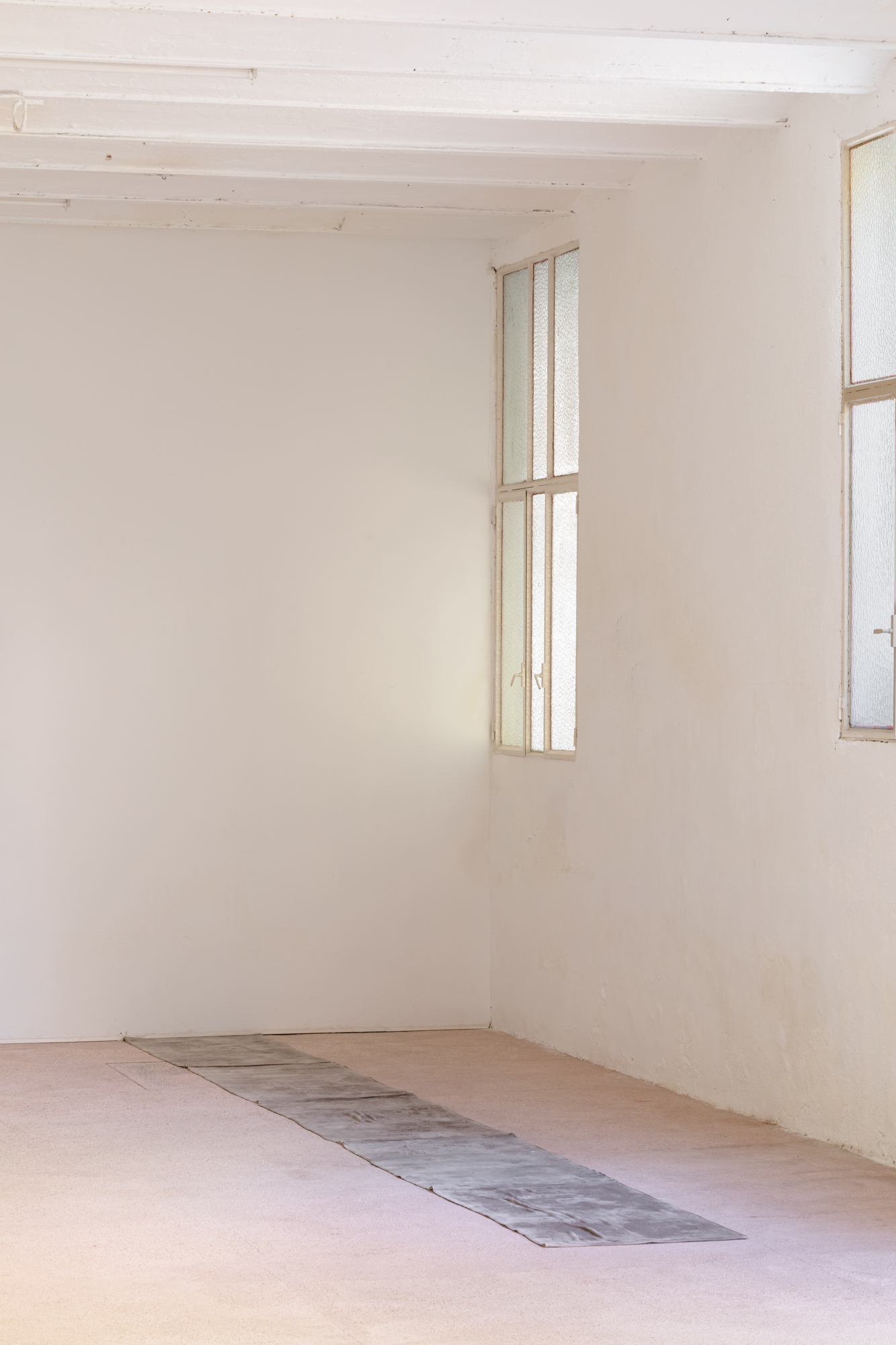
Echoes of Gego and of Agnes Martin resound in the perfect lines of the stainless steel wires, draping the freshly washed clothes, sketching a pale striped landscape. In portrait format, you paint the Earth’s crust or a cloudy sky, loosely, with broad strokes in the style of Helen Frankenthaler’s large color fields of the 1960s. Again, the midpoint: it is not painting, nor is it only sculpture—it is something in between. It is both. Línea Gris Perla [‘Pearl Gray Line’] is the most interstitial piece of all—it is a flat trace that wants to invade the three-dimensional. In your attempt to study the magnitude of time, you once again reveal how elusive and slippery it is: just when you almost feel you have managed to measure it (or, on a larger scale, to give it dimension), it becomes fossil, treasure, memory of a moment to which one can no longer return.
The last time we spoke, you told me about a text you have never been able to reread because you don’t know who the author is or what it said; only the essence of the memory of having read it remains. The text was about John McCracken’s monoliths. Tall and imposing mystical artifacts, reflecting their surroundings. Unlike McCracken’s, your monoliths are canvases that reflect us back from the wall. The last time I wrote to you, I told you about a book by Clarice Lispector, ‘Água viva’ (1973). And just this morning, I felt a hunch and saw ‘The Hour of the Star’ (1977), her last novel, sitting at the top of a pile of books beside my bed. Lispector dedicates the book to the scarlet color of blood; to all the artists who foretold her—who spoke to her about her before she herself knew who she was, and to two people dear to her “who today alas are bones.”
-Melanie Isabel García
––
Isabella Benshimol Toro (Caracas, 1994) is a Venezuelan artist based in London. Her practice arises from the need to freeze ephemeral gestures and actions of everyday life. Drawing on photography and in dialogue with its processes, she reuses domestic objects and garments, which, when incorporated into materials such as epoxy resin and silicone, are transformed into sculptures and installations. Her works evoke a body that is absent yet present in an indexical way. Through them, the artist invites the viewer to reflect on intimacy, the subtlety of the every-day, and the temporality of the ephemeral.
She has held solo exhibitions at Neven Gallery, London (2025); Les Vitrines, Institut Français, Berlin (2025), curated by Indira Béraud; ZÉRUÌ, London (2024); 11 Grosvenor Place, London (2024), curated by Mathilde Friis and Gonzalo Herrero; as well as a site-specific installation in collaboration with Paloma Wool in Milan (2024). In September 2025, she will open a solo show at Galería Belmonte, Madrid.
Recent group exhibitions include Piloto Pardo Gallery, London (2025); Artagon Pantin, Paris (2025); Saatchi Gallery, London (2025); Guts Gallery, London (2024); Gnossienne Gallery, London (2024); Triangolo Gallery at Palazzo Guazzoni, Cremona (2024); Des Bains, London (2024); Rose Easton Gallery, London (2022); Hacienda La Trinidad, Caracas (2022); Timothy Taylor Gallery, New York (2021); CCCC Centro del Carme, Valencia (2021); and Galería Elba Benítez, Madrid (2021), among many others.Benshimol Toro earned a Bachelor’s degree in Visual Arts (Cum Laude) from the Nuova Acca-demia di Belle Arti (NABA), Milan (2016), and a Master of Fine Arts from Goldsmiths, Universi-ty of London (2020). She has participated in residencies at Rupert, Vilnius, and Hangar, Lisbon.