I Ciclopi at INCURVA

Curated by Saim Demircan
–
In a short text titled ‘Art Through the Camera’s Eye’ (c.1971), Robert Smithson imagines the camera store as a setting for a horror film based on the myth of the Cyclops, as it appears in Homer’s The Odyssey. In Smithson’s version, the camera store would replace the cave where the Cyclops Polyphemus traps Odysseus and his men, and Odysseus himself would play the role of the camera clerk: “Each click would expose the clerk and his store to partial annihilation,” he writes. Here, the camera lens is the cyclopic eye, watchful and devouring, which “alludes to many abysses.” To be seen through this single eye meant death, suggests Smithson, who himself was overwhelmed by the plethora of camera technologies available at the time, and suffered fatigue at the “sight of rows of equipment.”
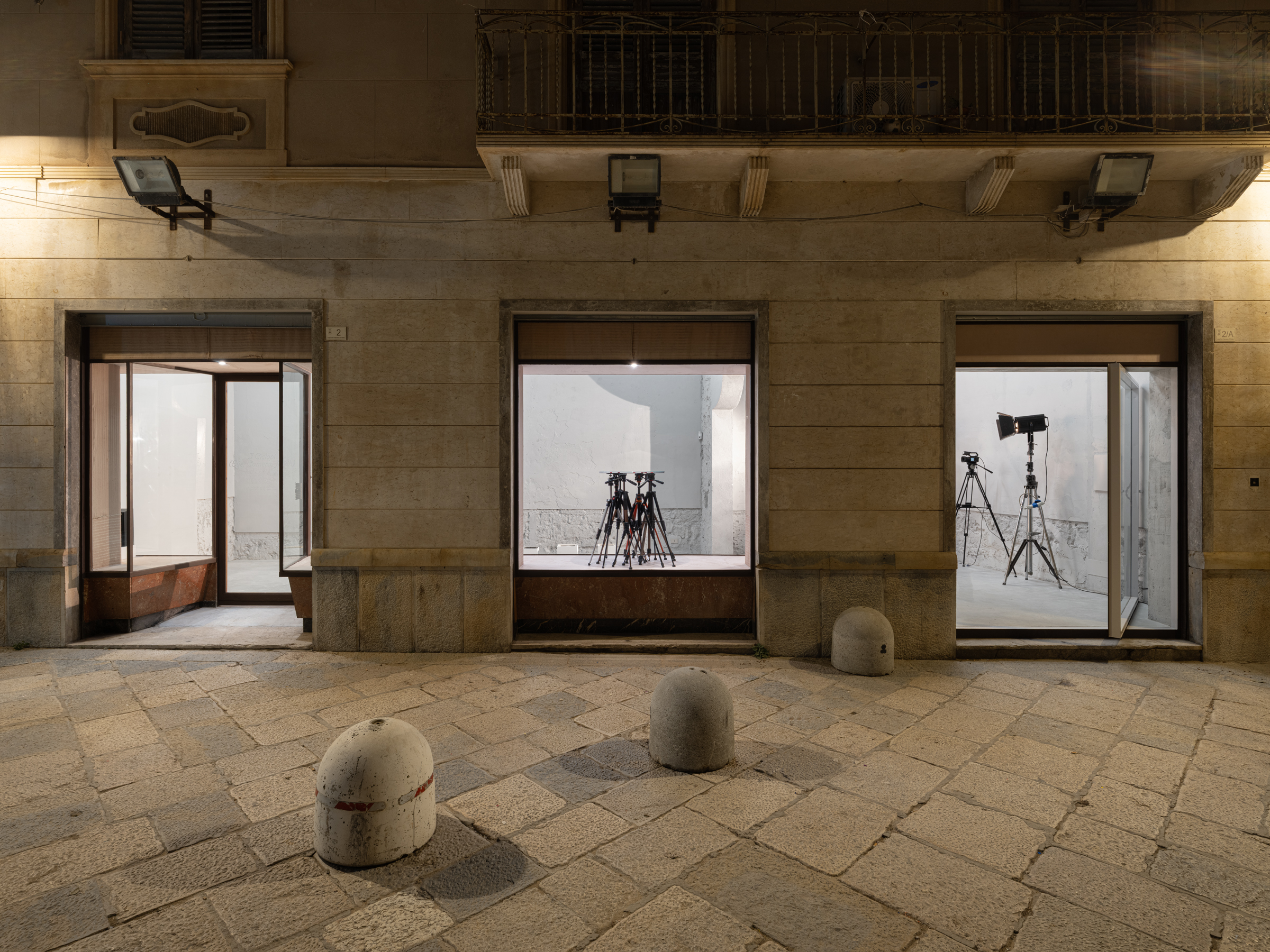
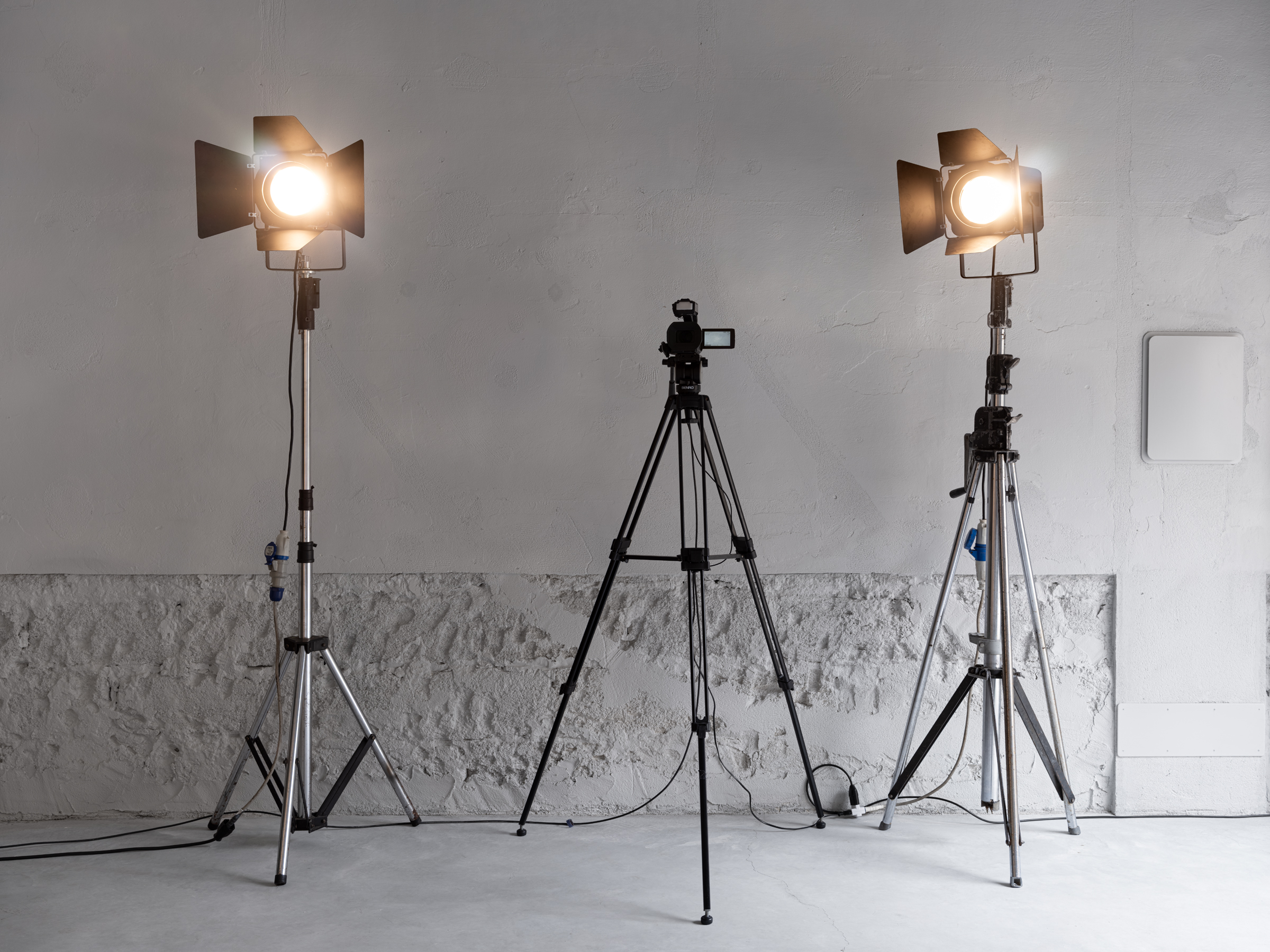
The presence of the camera in everyday life is now ubiquitous – in a sense, we are all living in Smithson’s camera store. Taking up this connection between the singular eye and the camera’s lens, I Ciclopi (Eye, Camera, Myth) brings together artworks that demonstrate forms of cyclopic vision by alluding to, repurposing, or modifying camera technologies, to consider how we see or are seen through a one- eyed point of view. This motif runs throughout the show, beginning with Jasper Marsalis’ Eye 3 (2026) [9] for which the artist has developed software that recognizes a person’s eye, transmitting its image from a video camera to a small monitor installed in another part of the exhibition. The setup of equipment in the entrance of INCURVA deliberately stages this process, riffing off the cult of personality whereby no-one is safe from an ever-present predatory eye.
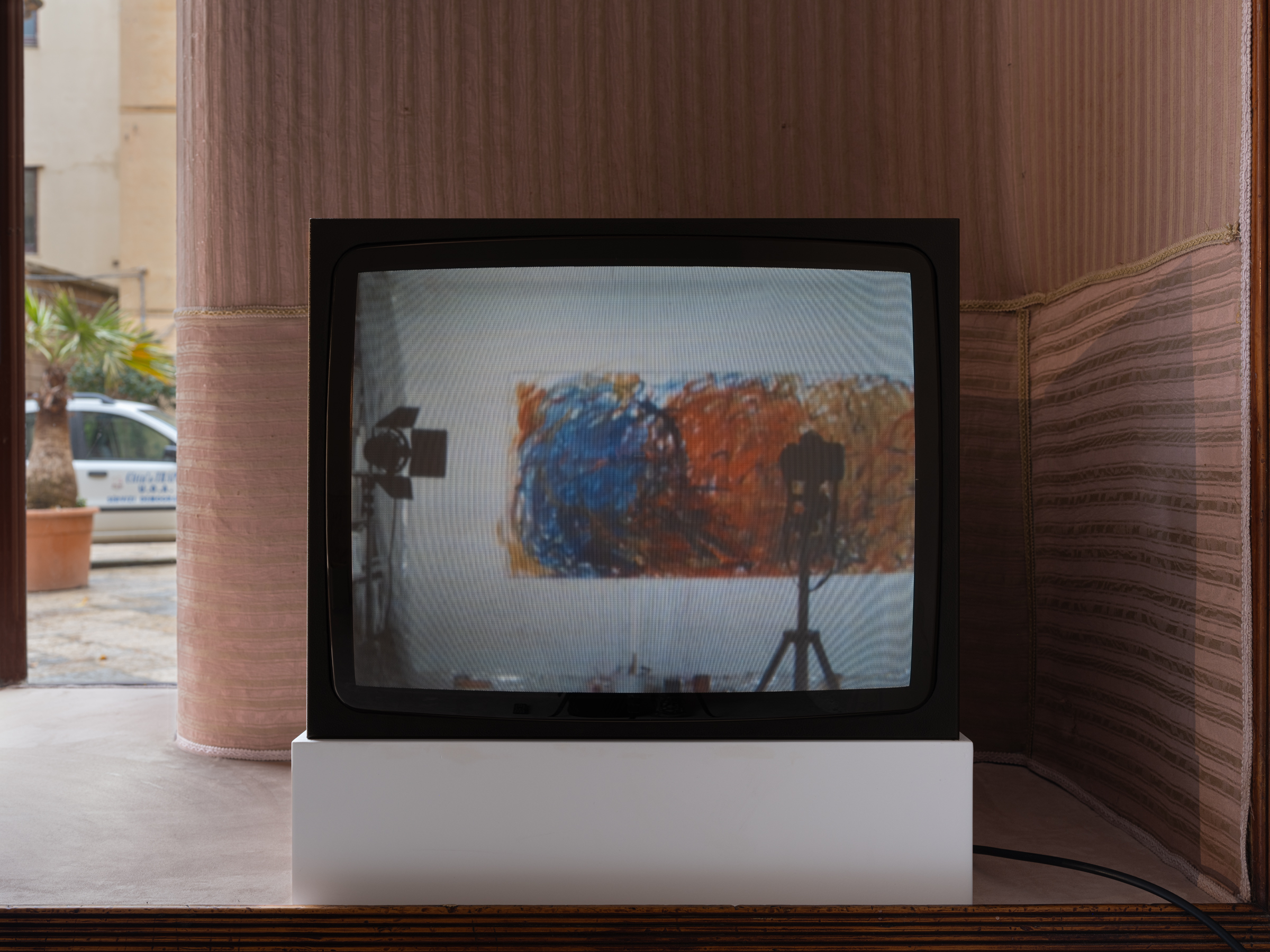
Elsewhere in the exhibition, other artists have innovated with cameras, with precedent set by MargaretRaspé’s 1983 film, Gelb, Rot und Blau entgegen (Towards Yellow, Red and Blue)[2]. In the late 1970s, Raspé devised and built a ‘camera helmet’ to record often mundane, domestic chores and her own expressionistic painting (in the final shot of Gelb, Rotund Blau entgegen, the artist turns to face a camera set up to document her painting). While this subjective point of view has been mainstreamed in the advent of GoPro technologies, Raspé filmed directly what she saw as a ‘camera-woman-machine’.
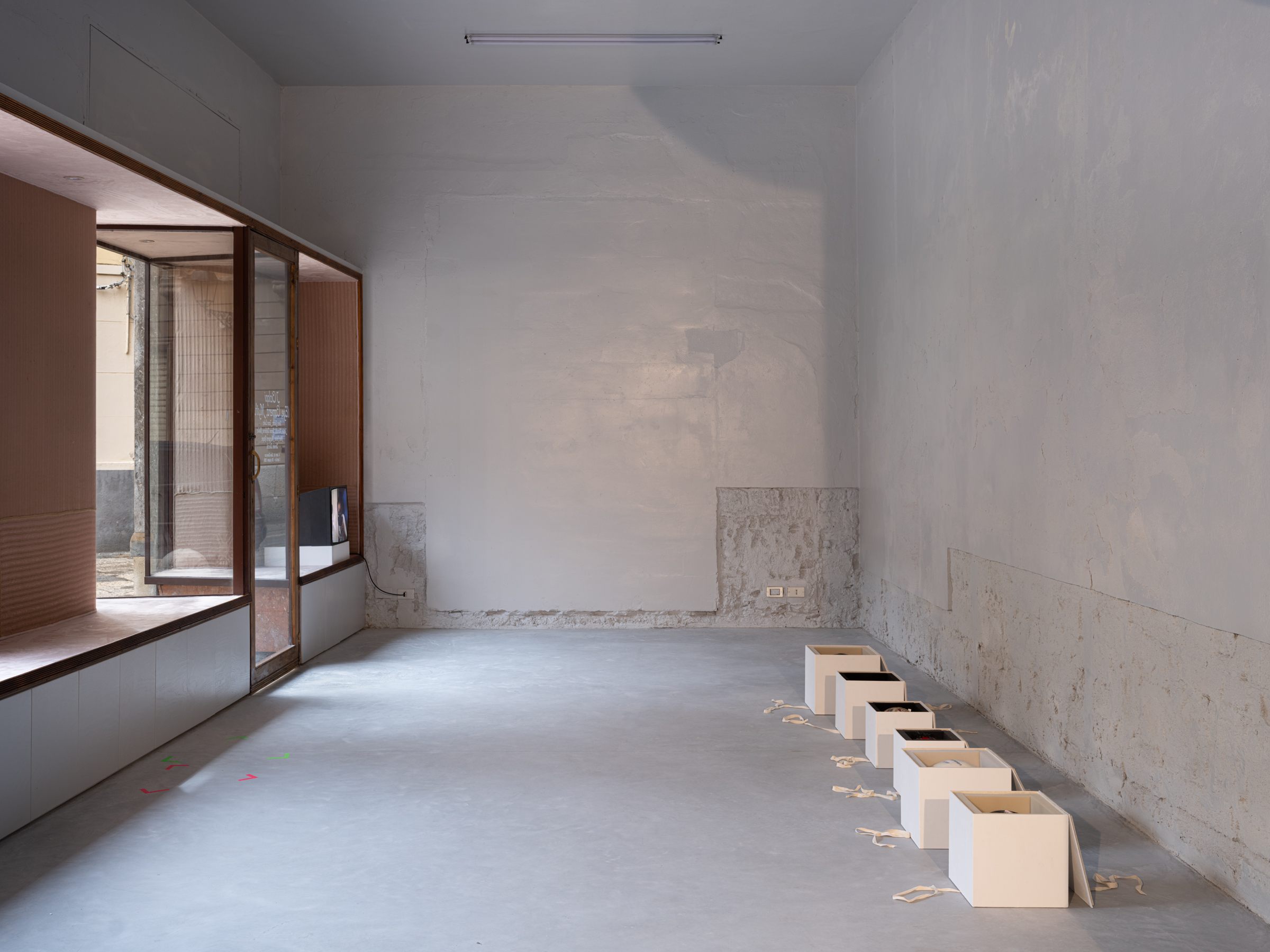
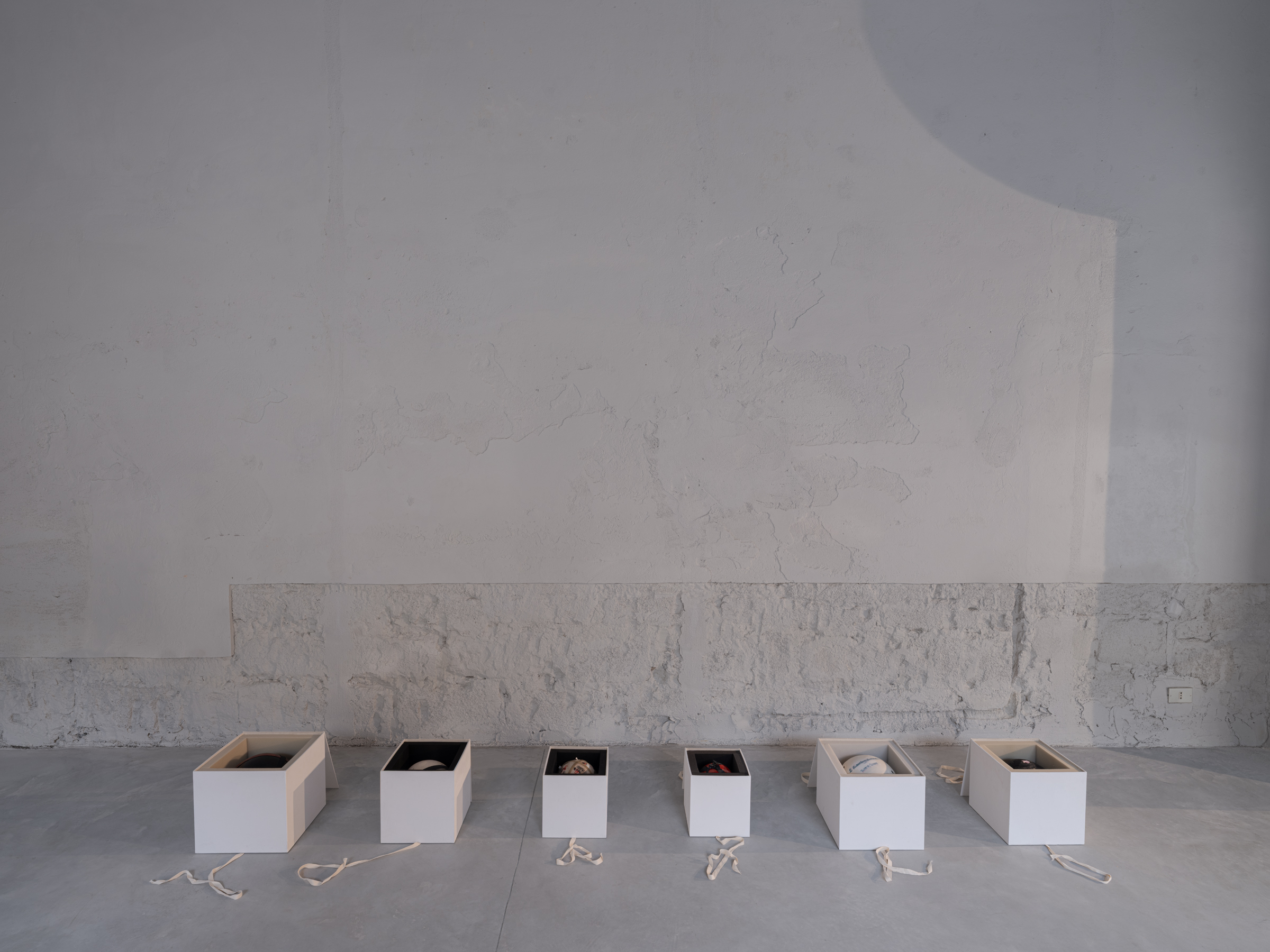
Raspé’s embodiment of the camera further suggests that the eye cannot exist without a body, or support, which is touched upon in the works of Nina Porter and Davide Stucchi. Made from hollowed wooden spheres, Porter’s simple, pinhole cameras resemble singular disembodied eyeballs, which, like cameras, are useless without someone to operate them. These works are made to be used at specified points in the future, indicated by titles such as Winter 35, For the year 2065, and summer 2074 (all 2025) [8,3,5], a built-infuturity that nonetheless connects photography to its rudimentary beginnings. While the camera, as a proxy for the eye, needs some kind of body or tripod to hold it, Stucchi has made a new sculpture for INCURVA’s window display, imagining it as belonging to the camera store in Smithson’s text. A cluster of tripods holds up a circular glass top to create a display table for a camera. In the space, pieces of brightly colored tape affixed to the floor demarcate the placement of a tripod’s legs - often used by paparazzi photographers whose job is to pursue celebrities.
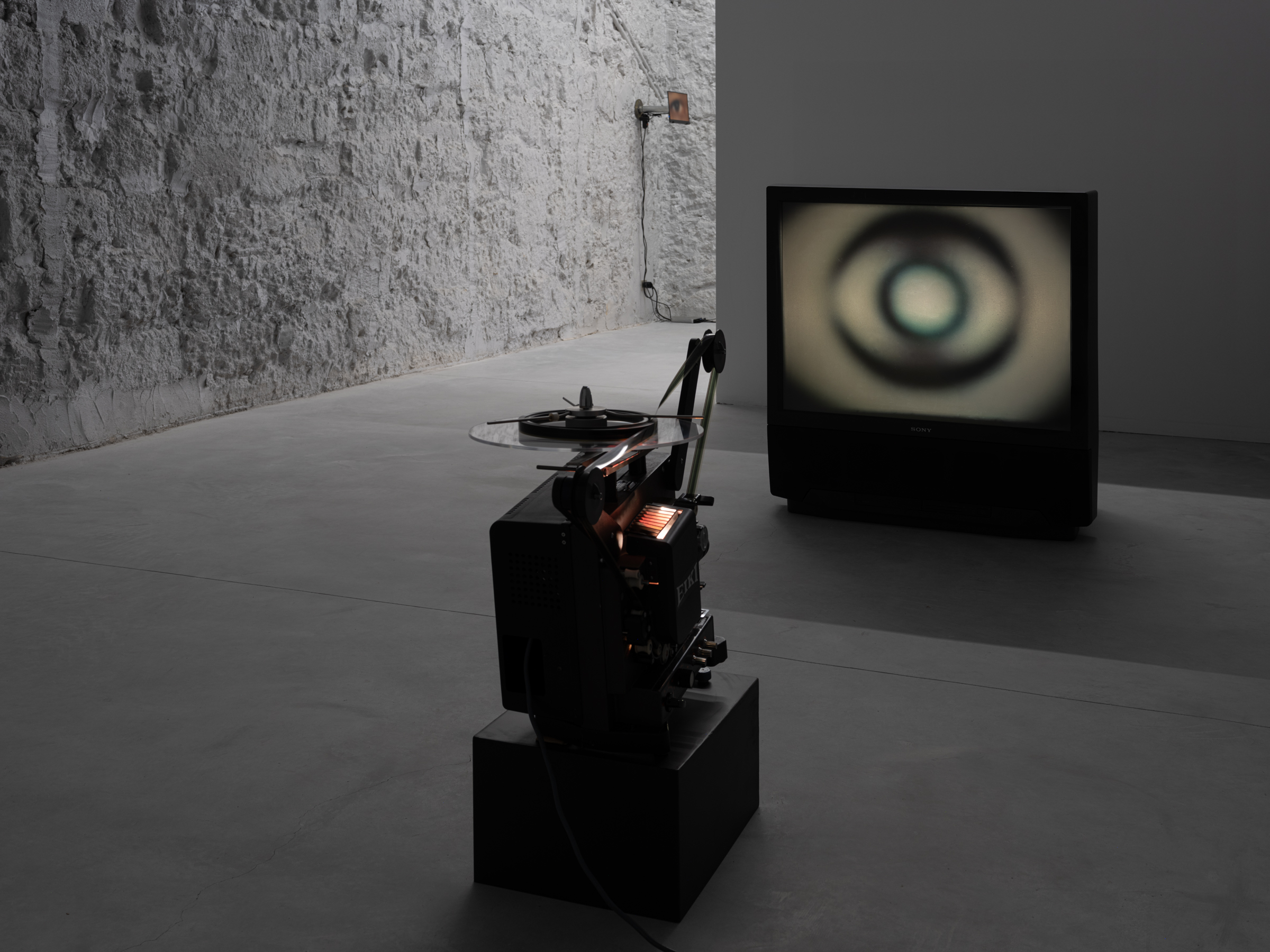
Other works represent passages of time in relationto technological changes. In Simon Dybbroe Møller’s sculpture, News (2010) [11], a 16mm film is projected onto the flat surface of a rear projection television screen. Dybbroe Møller filmed simplified, ad hoc versions of global news broadcasting logos that incorporated the singular eye in their program’s title sequences and idents. Its soundtrack, a drunken rendition of CBS’ jingle, imbues the work with a foreboding sense of an ancient chant. Dora Budor, similarly, has folded several mediums into her piece, Drama in a Dramatized Society (2025) [12].
This so-called ‘video sculpture’ is a makeshift cube monitor made from a found champagne shipping box left over from a New Year’s celebration, and a Fresnel lens, which warps and distorts scenes from Marcel L’Herbier’s 1928 silent film L’Argent seen through it. Like Dybbroe Møller, Budor’s use of materials refers to developments in viewership; the Fresnel lens was used regularly in cathode ray tube monitors before flatscreen technology. The flattening of the image over time also speaks to a cyclopean vision that lacks depth.
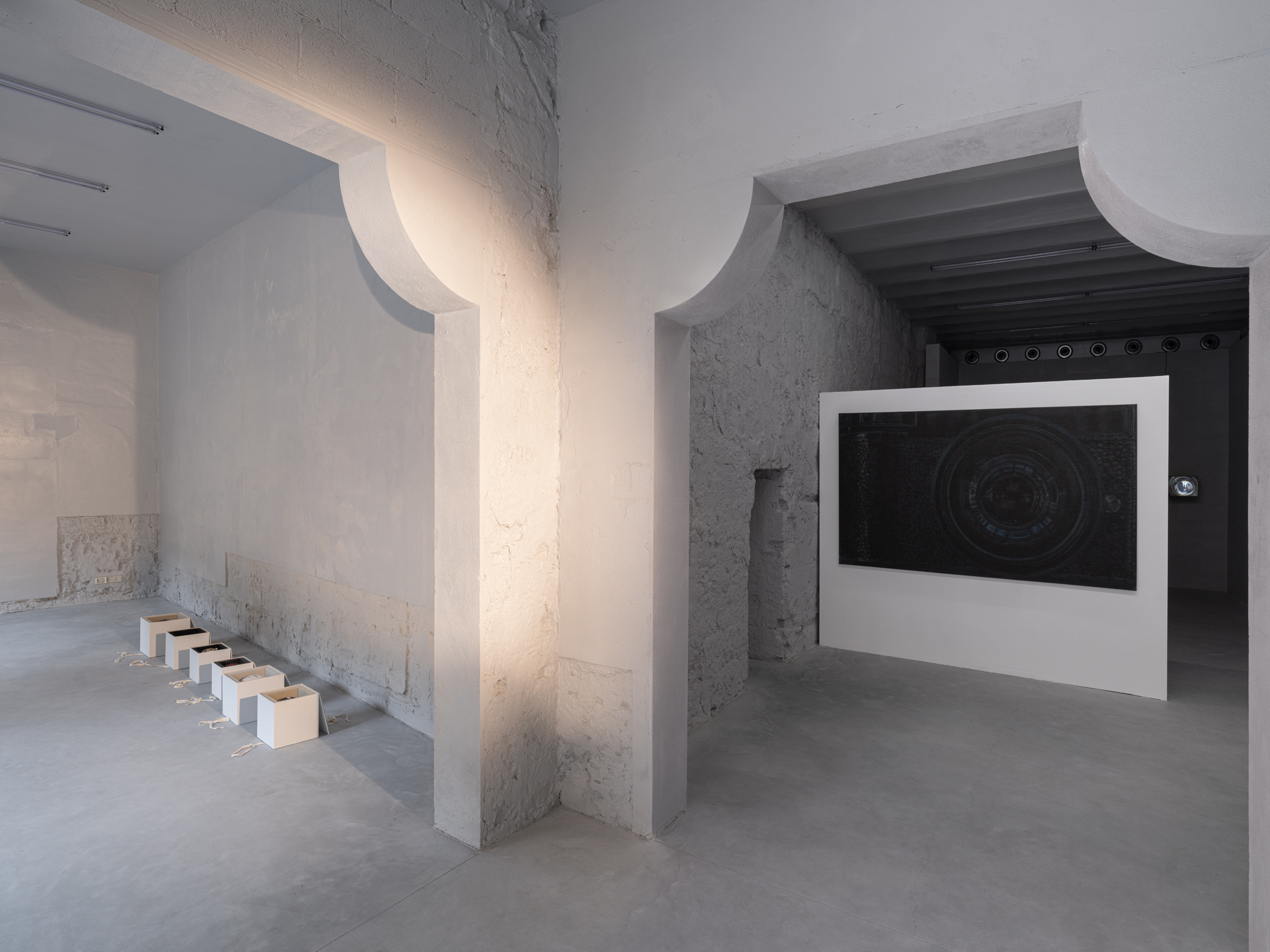
Jana Euler’s Camera 4 (Lumix) in use since 2018 (2021) [10] is one of a series of paintings of popular Single-Lens Reflex film camera brands, such as Canon, Minolta, and, in this case, Lumix. Like many of her other paintings, the frame is a container for the image – here, the dimensions of the canvas match the shape of the camera as seen from the front. Scaled up, however, the lens appears as a gigantic eye protruding into space. In I Ciclopi (Eye, Camera, Myth) , Euler’s painting is positioned in the centre of the show to create an omnipresence, magnifying the contemporary sensation that one can be captured on camera and recorded at any given moment.