Eric N. Mack at American Academy of Arts and Letters

In 1997, Eric N. Mack saw his first fashion show on TV. He was mesmerized by the shapes coming down the runway. Around that time, his father was reselling denim and streetwear—North Face jackets and early Roc-A-Wear—out of a refurbished moving truck. Mack began to play with how he dressed himself. His favorite garments were a Mchunu tee and a sweatshirt by Marithé + François Girbaud (he describes the halls of his arty public high school as a daily catwalk). As he began to understand the power of self-invention, he became curious about how everyday obsessions, like fashion and popular music, could be worked into art. He wondered what kind of artist he wanted to become. He saw a Sam Gilliam survey at the Corcoran, a Morris Louis retrospective at the Hirshhorn, and a Christo and Jean-Claude exhibition at the National Gallery. He liked how art could dress a room and reconfigure space entirely.
Mack trained at three art schools. During one crit, when a professor asked what his abstract work was “about” (the professor asked none of his peers this question), Mack paused, looked at the stretched spandex he was showing, and responded, “It’s about flexibility.” That flexibility led Mack to call himself a painter and rarely use paint, to collaborate with menswear designers like Kiko Kostadinov and Grace Wales Bonner, and to sheathe an abandoned gas station in a California desert with luxurious translucent textiles.
That Mack’s works defy categorization, or exercise their right to opacity, per Édouard Glissant, is partly the point. Although they could variously be called assemblage, sculpture, or installation, Mack likes referring to them as paintings in part because he values the conversations that come out of that tradition. He cites Blinky Palermo’s Stoffbilder paintings, fabricated from commercially available bolts of cloth, and Rauschenberg’s Jammers, sail-like works attached to poles andpinned to the wall, as raising questions that interest him: “‘Is this a readymade? Is this an abstraction on? Is this a landscape?’ Particularly, ‘How is this an object—beyond just a simple picture?’” (1) He enjoys calling his works paintings because, as he puts it, “it sits in people’s heads in uncomfortable ways.” They are paintings as provocation.
Mack is constantly sourcing fabric. It ends up on rolling racks and in piles in his studio, which looks like the atelier of a mad dressmaker. There are chiffons and Kente cloth, wax hollandais and floral chintz, shimmering Lurex and deadstock polyester. In New York, he gets yardage from a fabric emporium in the garment district. He has a source in Milan for scampolo (remnants) by the pound, thanks to a fashion connection. Household textiles, like sheets or dishtowels, he gets from the Twenty-Third Street flea market in Manhattan, after passing them often enough that the colors and patterns begin to stick in his mind.
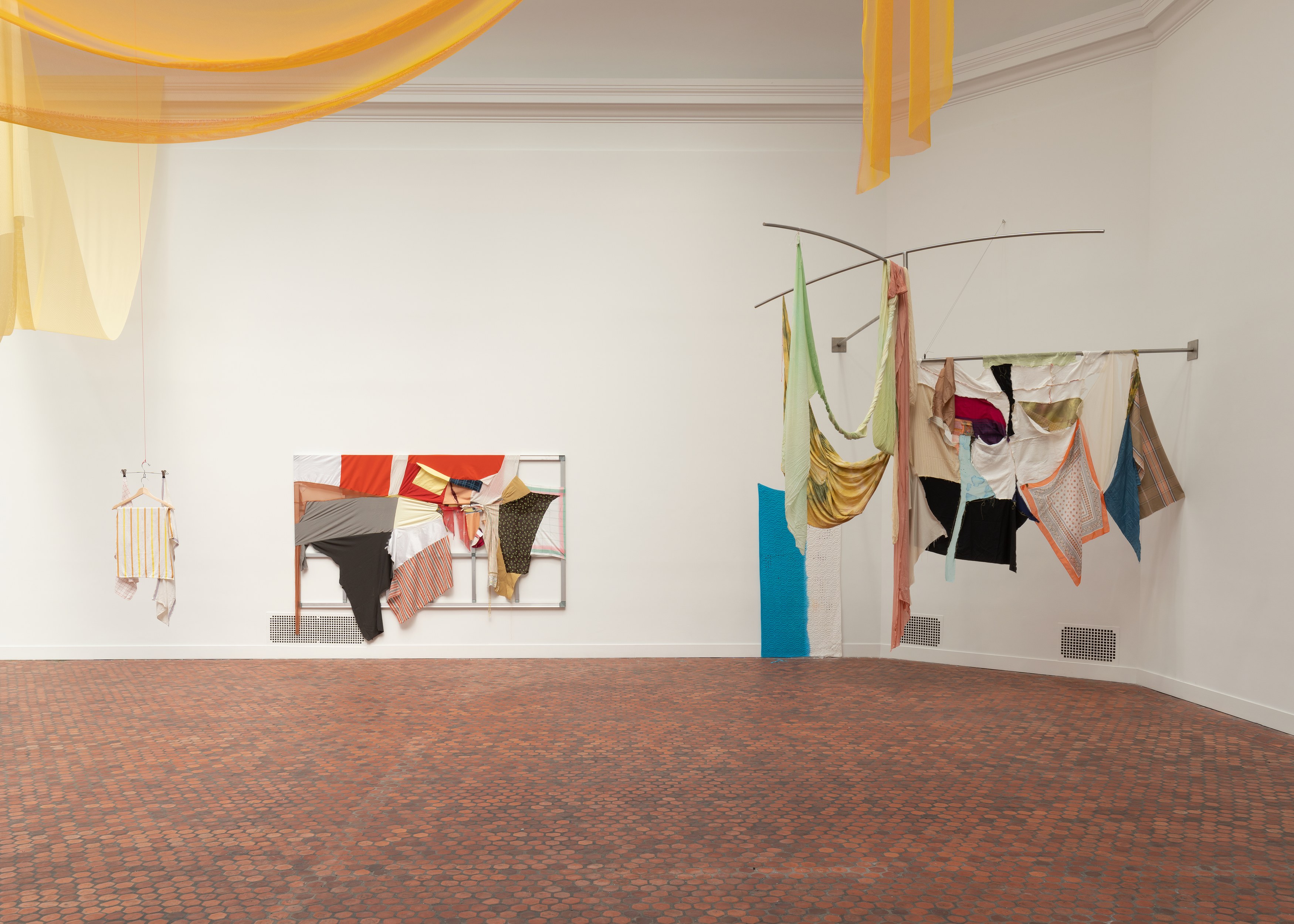
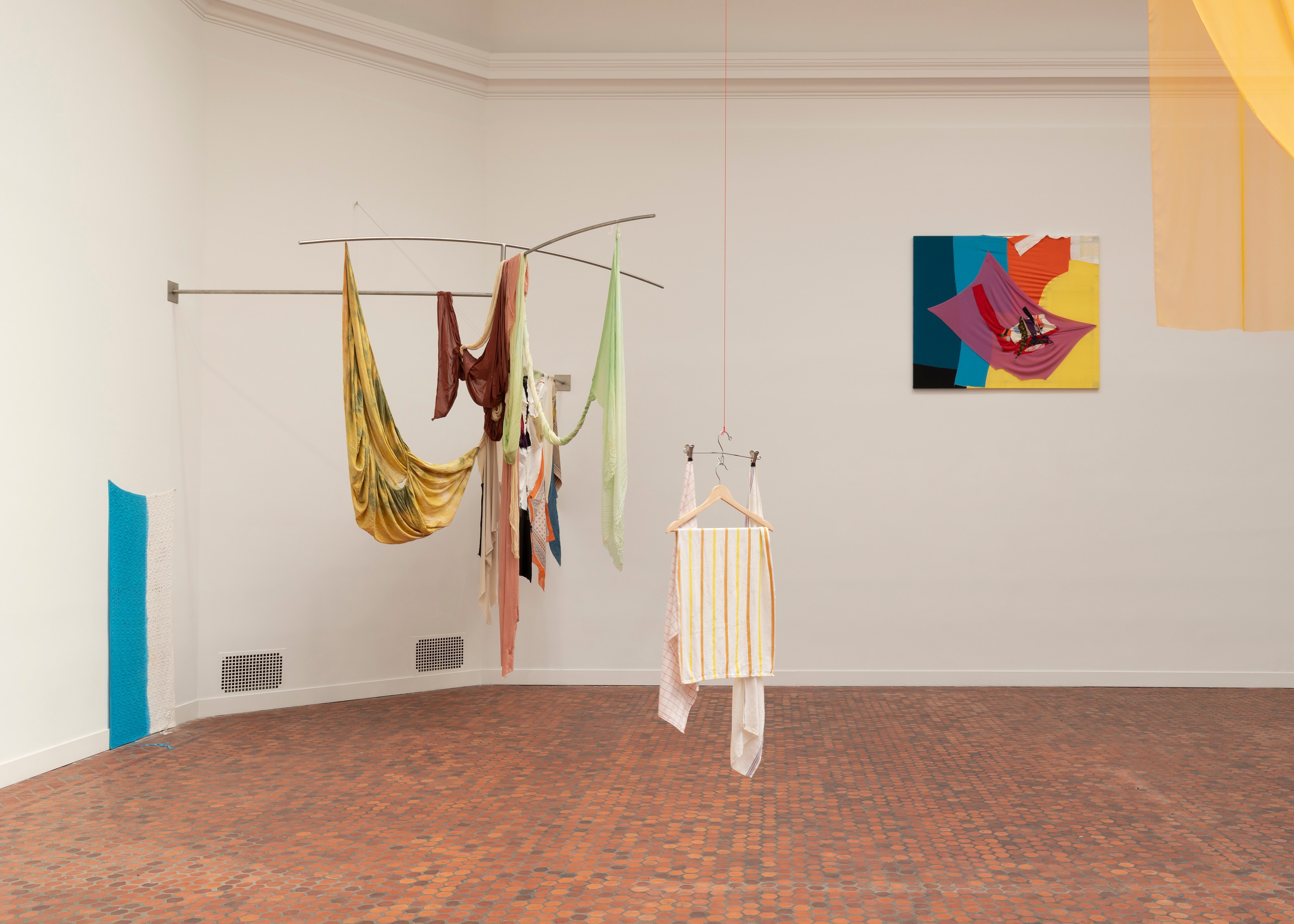
Artistic evolution follows material attraction. As a young artist, Mack experienced a breakthrough when he was walking down Third Avenue and came across a pair of discarded silk-lined curtains on the sidewalk. He took the fabric back to his studio, and, since he was interested in circular forms, decided to stretch it on a cross-stitch hoop. He integrated the stretched silk into a larger painting with grommets and acrylic paint and other things he had around his studio, like pretzels. He wanted the work to bring art and life together and to be an index of his creative process, including what he was eating. The smudge on the fabric he’d found would be incorporated into the composition, not cut away. In later experiments, he combined thin strips of painted canvas to make vertical paintings that looked like braided necklaces. He worked with moving blankets, whose zigzag stitch patterns functioned like ready-made drawings, and whose protective qualities added emotional depth. Eventually, Mack started building works from numerous textile fragments, first composing them as colors and shapes by hand, pinning the pieces to the wall, and then suspending them on stretcher bars and armatures, making further adjustments. Each textile’s inherent properties—how it drapes, stretches, or reflects light—guide his decisions. A raw edge asks to be exposed, or a piece of spandex wants to cling to the edge of a piece of aluminum.
In 2009, the term “provisional painting” was in the air as a way to describe contemporary painting that appeared dashed off, tentative, or even self-canceling. The approaches varied, but the works in one way or another challenged conventional ideas of legibility and virtuosity. As Raphael Rubinstein, the critic who coined the expression, put it, provisional painting was “major painting masquerading as minor painting.” (2) This was a year after the New Museum in New York opened its Bowery building with Unmonumental, an influential exhibition of sculpture by thirty artists whose work was equally antiheroic, much of it made from personal, everyday materials. Conversations around this work were formative for Mack. How to convey attitude through gesture? How to make a painting as nuanced as life itself? How to command a room, with only the simplest of means? Of his installations, Mack says, “I constantly think about how I could make a work in a space that would be as effective as, like, a number of Lil’ Kim looks.” He once named a show after the rapper’s stylist, Misa Hylton.
Fabric frequently functions as a conduit to the everyday. We’ve likely seen a version of the prints and patterns in Mack’s paintings before, maybe even on a favorite piece of clothing. We can predict how a textile will feel wrapped around our body just by looking at it. Mack works with that resonance, with memory, as much as the physical fabric itself—human emotion stored in a particular weave or print. There’s little artifice or illusion in his paintings, little mystery to their versos. Instead, they seek direct connection: our gaze, our motion. Mack works in the round, or suspends voluminous paintings with their bellies exposed above our heads, like the diapha- nous flying alien Jean Jacket from Jordan Peele’s film Nope. The installations anticipate our movement through them, fabric rippling as we pass by. Mack’s paintings need the body. (3)
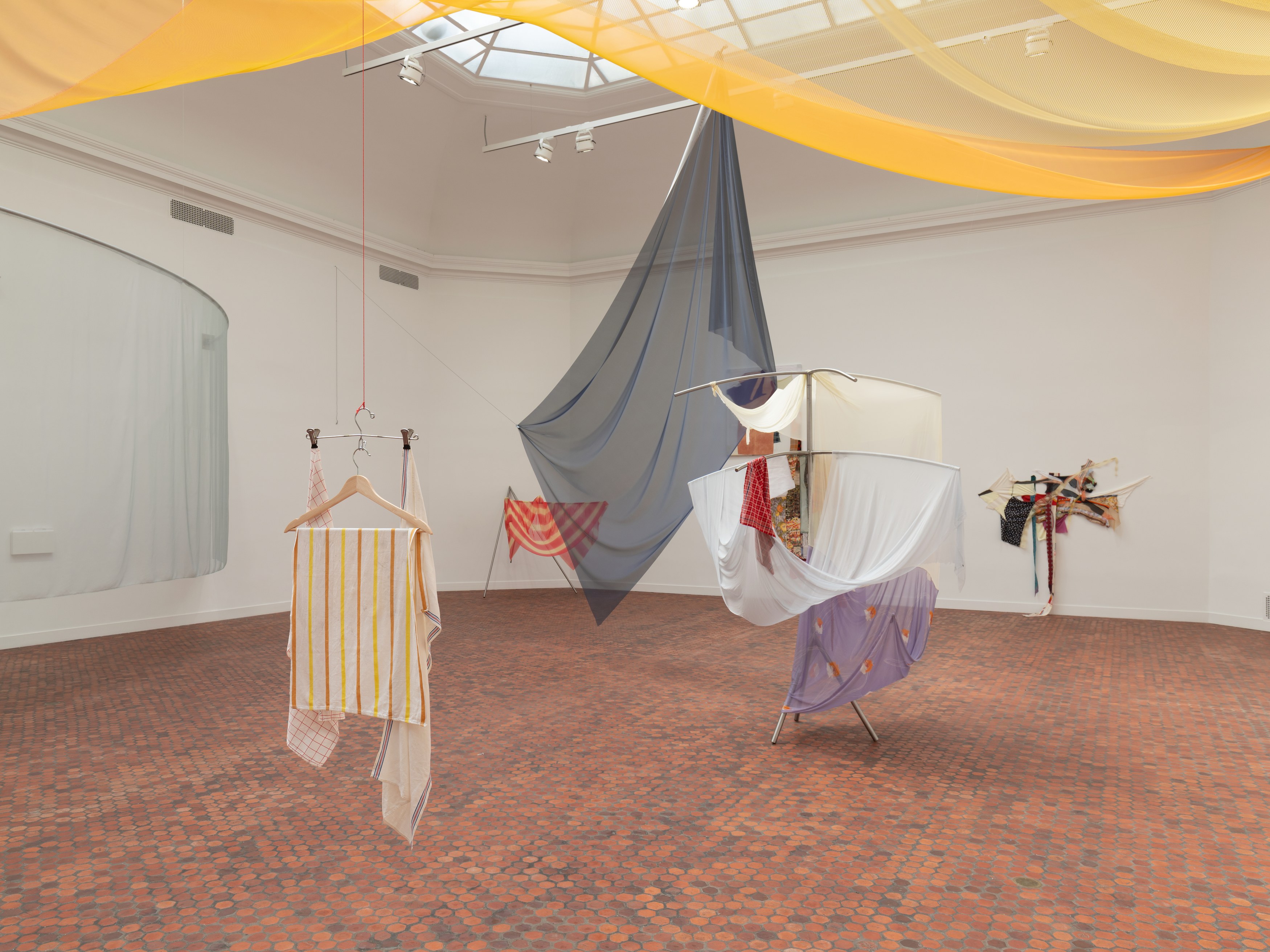
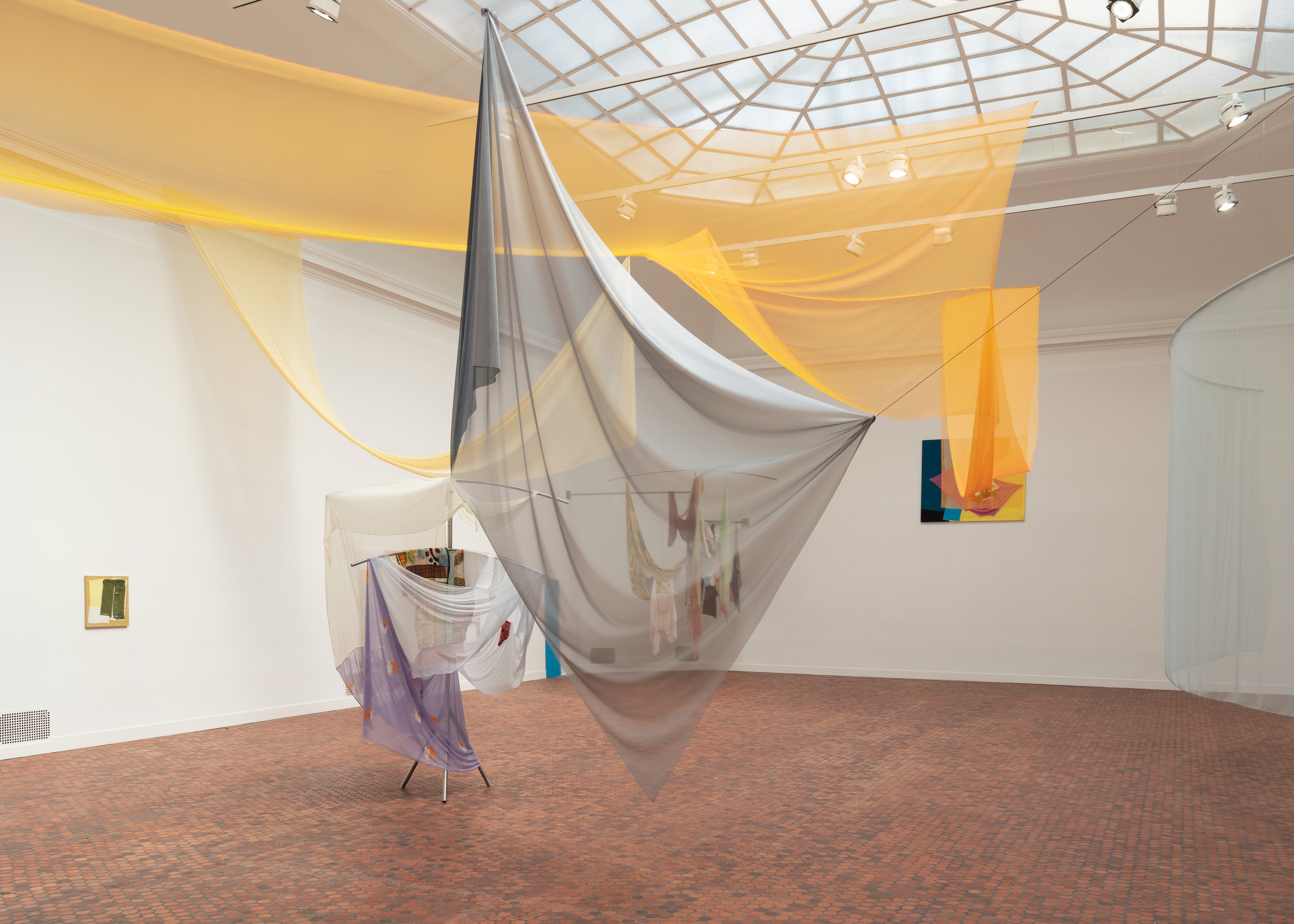
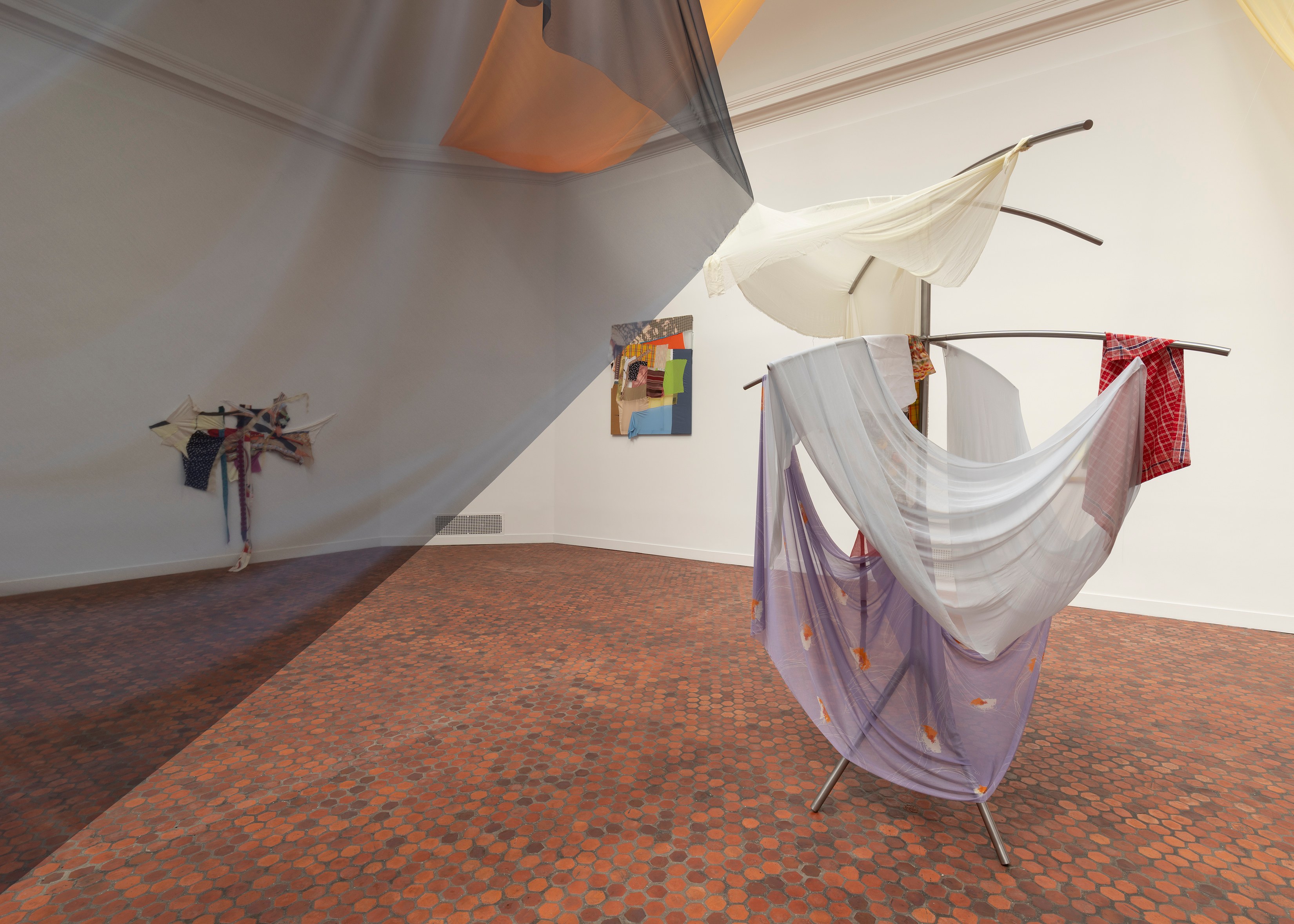
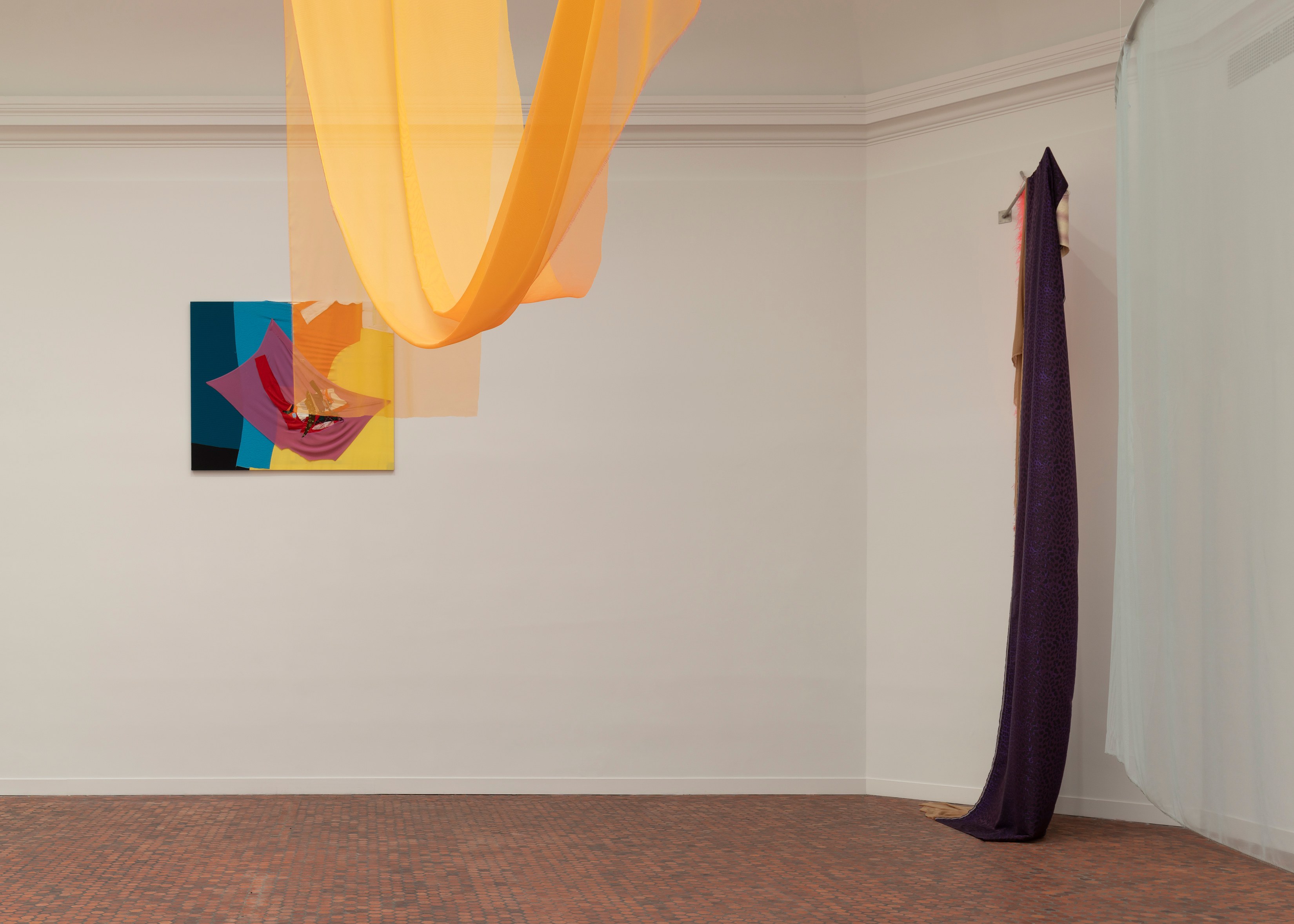
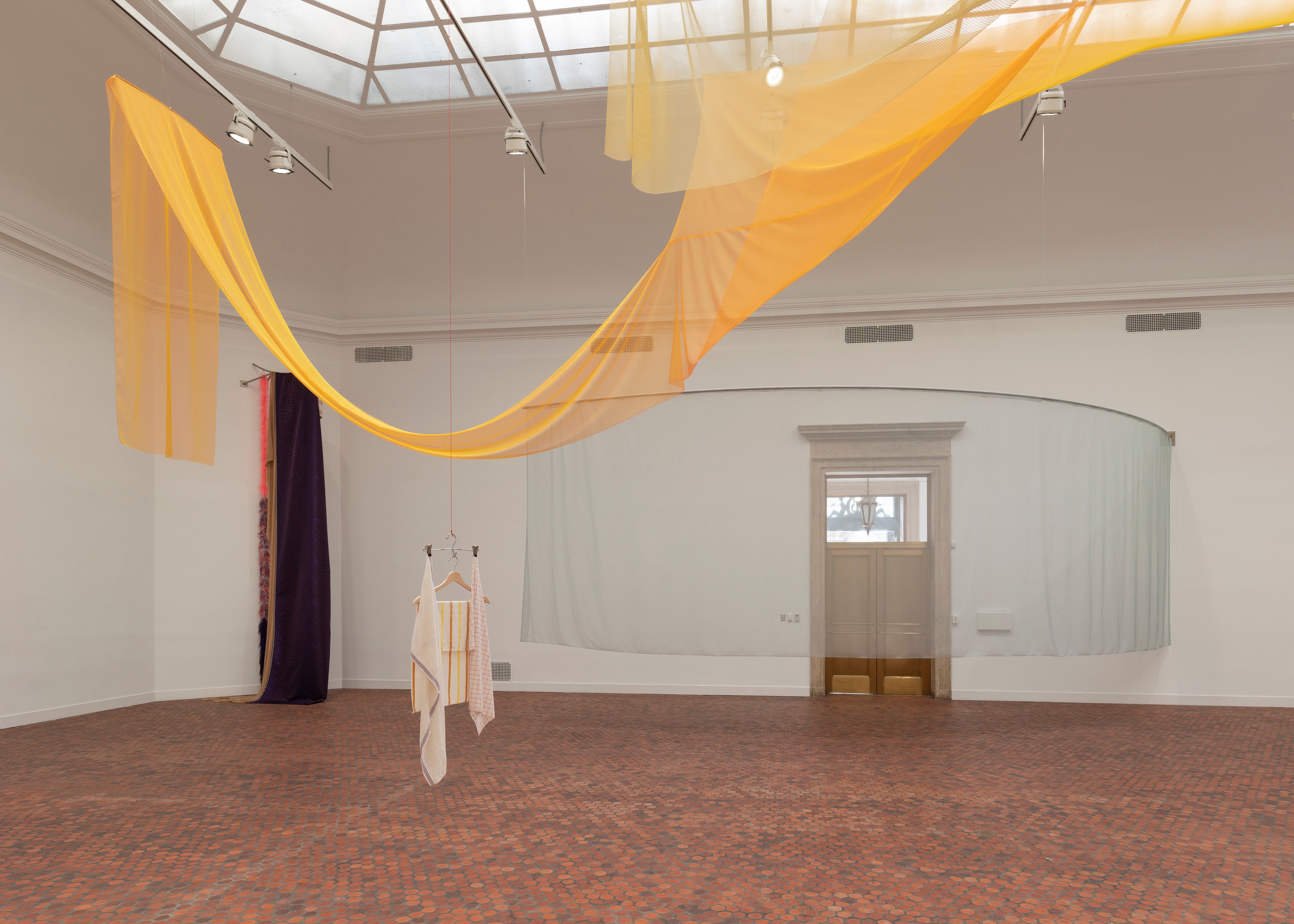
Over the last few years, Mack has been experimenting with custom steel armatures that temporarily anchor his paintings to existing architecture while anticipating future mobility. He describes the works as site-responsive, rather than site-specific, with the flexibility to perform differently as they move from one context to another. In this installation at Arts and Letters, Mack transforms the skylit North Gallery into a dynamic environment of suspended textile paintings that rely on these armatures. The first work, hung like a curtain across the threshold, acts like a filter or a lens, shaping our sense of the room as we enter. Others lean against a wall, cantilever over a passageway, or grip a corner of the room. Seeing the exhibition requires moving through and around these objects.
For large-scale installations like this one, Mack works improvisationally in response to the site. Arrangements build on previous experience, and what appears spontaneous, even ethereal, is, like any virtuosic improvisation, only possible because it is hard won. His paintings develop amidst piles of fabric in the studio, when textile histories temporarily fade away and Mack finds form through cutting, folding, and stitching. Is the tension right? Is the combination surprising? Does it make him feel something? Working onsite before an exhibition is human and present. It is a matter of attention—moving things around to catch the way the light comes through the glass ceiling, considering how blue mesh changes the mood of a work across the room. What’s most important is staying open and being willing to change direction. The interpretation comes later, when previously unconscious connections emerge. Above all, Eric N. Mack prizes nuance. He sees museums and spaces like this one, which is exhibiting his newest works, as places to hold and protect that nuance.
Jenny Jaskey
––
1. These are questions Mack says he asked upon seeing Blinky Palermo’s Stoffbilder, or “cloth paintings.” See Eric N. Mack, “An Interview with Eric N. Mack,” interview by Valeria Biamonti, émergent magazine, 2021, www.emergentmag.com/interviews/eric-n-mack.
2. Raphael Rubinstein, “Provisional Painting,” Art in America, May 1, 2009, www.artnews.com/art- in-america/features/provisional-painting-raphael-rubinstein-62792/.
3. In 2020, Mack curated a show at Simon Lee Gallery in New York and wrote in the press release: “The role of a mannequin in a storefront is to elicit a direct relationship between the consumer, their body and the garment; to engender a sense of its structure. In a similar way, the role of the viewer in the act of observing, or consuming, an artwork bestows value and radiant spirit: the art object, at its most sacred, should reflect altered systems of value, especially in observation of our world’s brutalities.” Simon Lee Gallery, “Pedestrian Profanities,” press release, 2020, www.simonleegallery.com/usr/documents/exhibitions/press_release_url/205/pedestrian-profanities_ny-pr_final.pdf.