A person I know told me: “Jenny Holzer once wrote—Someone wants to cut a hole in you and fuck you through it, buddy—I think art needs someone who can take care of this wound.” Is Kunst today who cuts the hole, who takes care of it, or the hole itself?
Kunstindustrie; a title that in my ears has sounded all the time like KUNTSindustrie, if nothing else for the appealing girl depicted on the poster, whose tip of the tongue caresses the quizzical term “artistic autonomy.” The show does not fall—but if it falls—it lands on its feet: retracing the teleological approach of Alois Riegl (1858–1905) in his Die Spätrömische Kunstindustrie, it sets out to indicate the predominant taste that defines our epoch. In this sense, the artists addressed, twenty-five to be exact, can breathe a sigh of relief regarding the fact that no one cares whether their works are more or less valid and can indeed rejoice at having been elevated to today’s “artistic volition” or Kunstwollen. What today's Kunstwollen is… that is another matter entirely.
Showstopper of the first room is a heap of cardboard boxes that evoke (resurrect) the names of deceased artists such as Kippenberger, Cézanne, Hamilton, Schwitters, and others, from which rises what seems to be a road sign whose directions lead towards more or less explored places known as Black Pilling, Orgasm, Revenge, Gulag, Cocainism, etc.
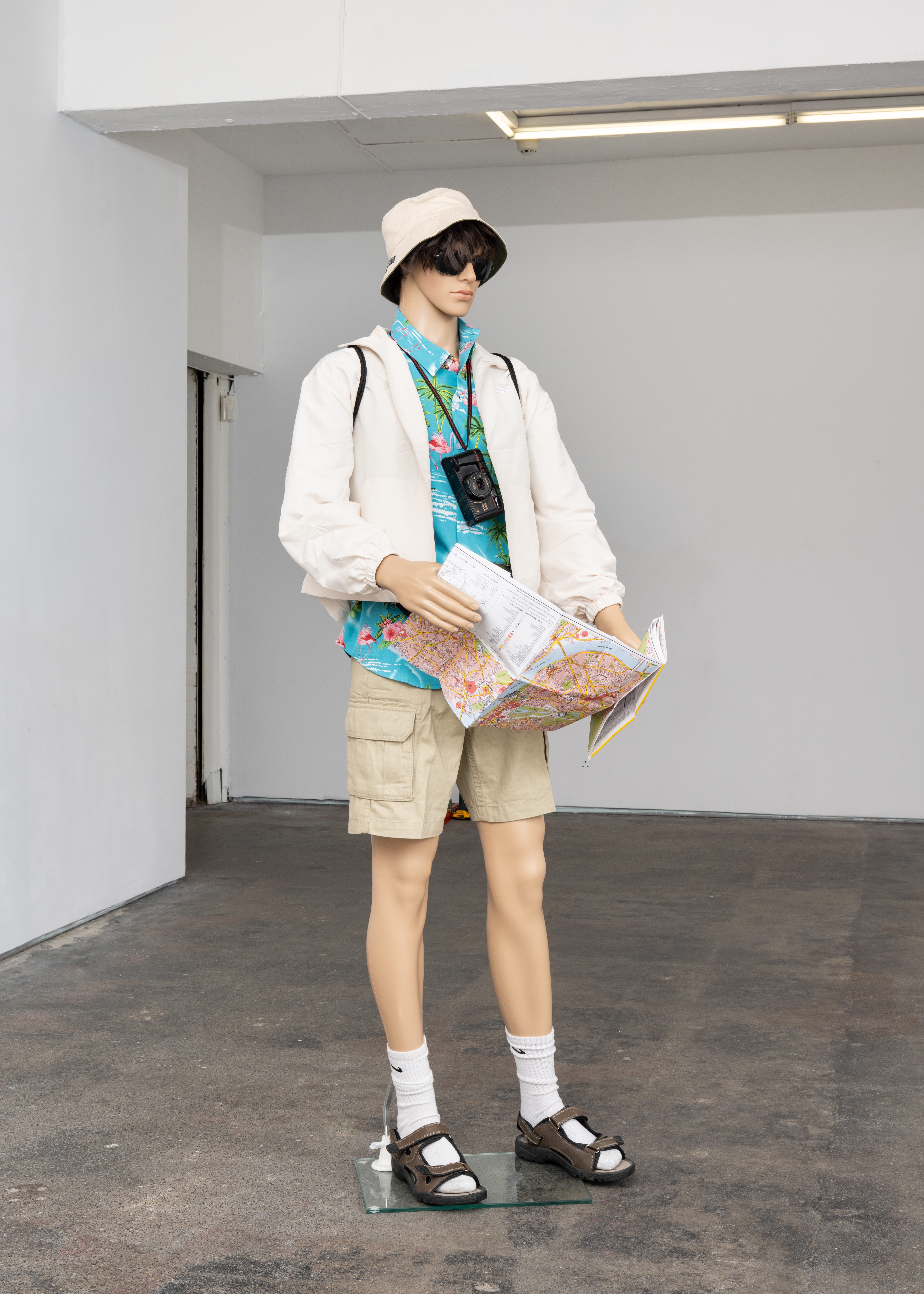
“Cocainism” points unabashedly to the toilet: although Seventeen not being all that in vogue, at the opening one could barely move. Someone even mistook Connor Crawford’s mannequins for real people; not the first time one finds themselves talking to pieces of plaster high as a kite. Thanks, Dan Mitchell, for having rabelaisianly indicated the way (A Mountain of Dead Billionaires), and thanks, Adam Farah-Saad, for having made the dense human coexistence in a basement bearable; or rather unbearable, depending on how much you like the smell of semen, grass, and tarmac.
Curated by Charlotte Seux and Lydia Eliza Trail, Kunstindustrie acts as a melting pot of the three broader categorisations of absurdism, conceptualism, and fashionableism; the corpus of the show takes over three rooms:
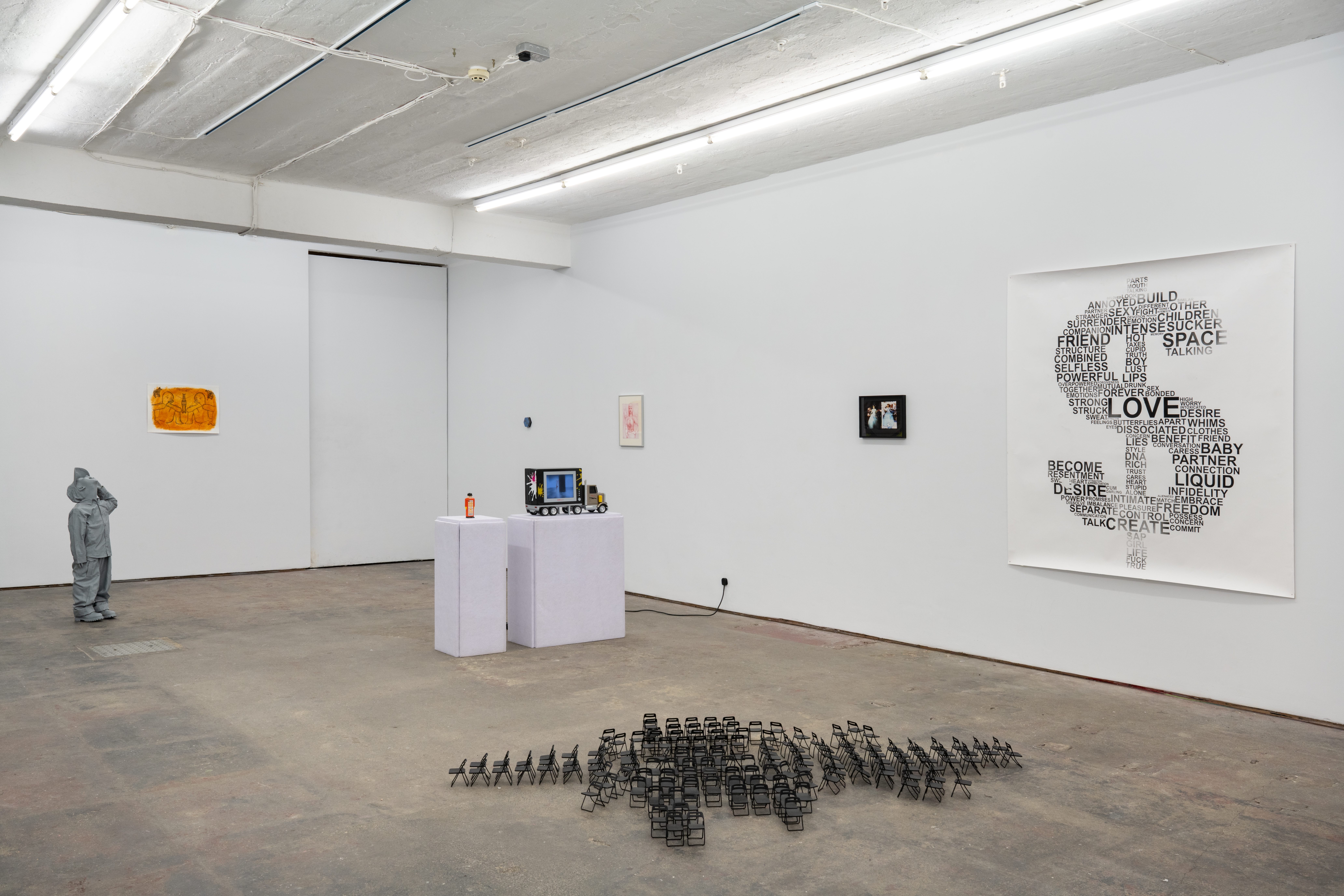
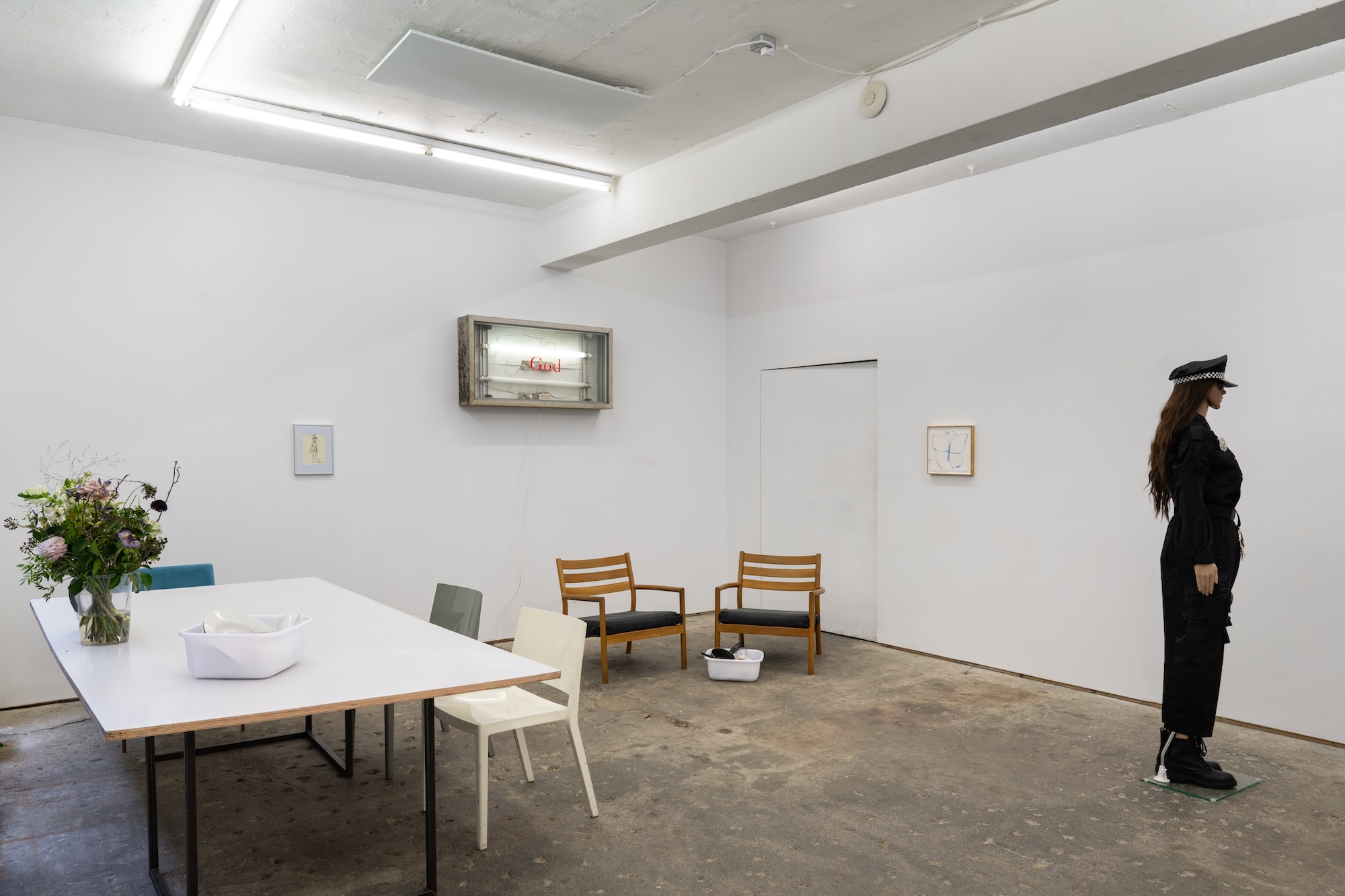
The curation is as taxonomified as you would expect from a show that uses a diagram as its poster. A sturdy policewoman appears next to Mitchell’s Shame, a paper-printed, framed, and zoomed A4 version of his signature directions; a punk Miscreant looks straight at the wall giving his back to the public, no future; 4’33 of Solomon Garcon, in the shape of a chodey kalashnikov (an allusion to John Cage?) points straight at his back, while from the trigger side a masked woman in red smiles. A child Ashtray in military salute opens his mouth wide towards the sky and seems to give life to Palisade. In the same corner, a Final Notice by Giulia Ley intrudes in a feverish lamentation on council tax bills paired with the tragedy of a Greek Frieze and idiomatic symbols. Headspinning.
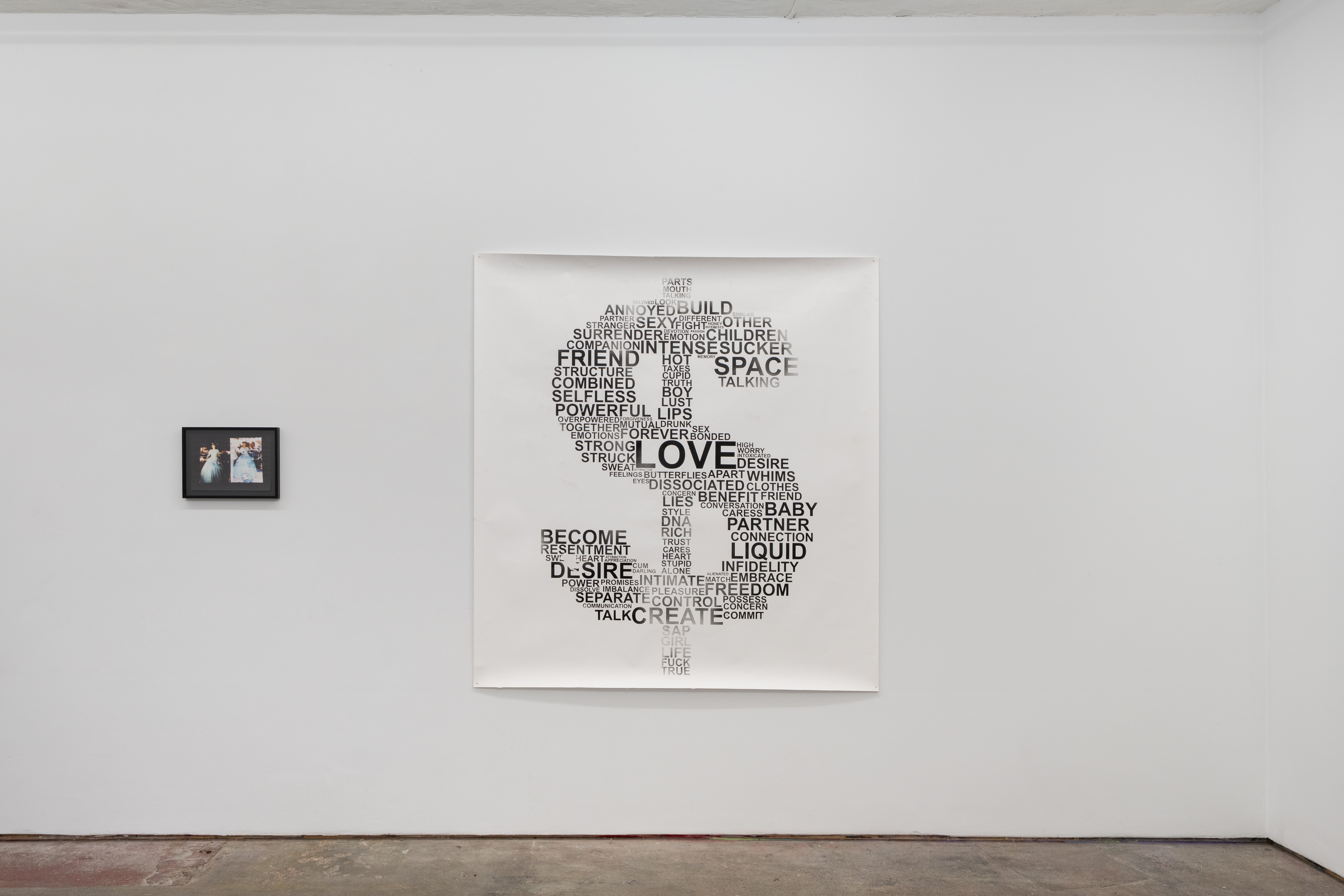
Borrowing from Paul de Man’s Blindness and Insight (1971), we can think of every historical period as undergoing a “modern” moment of crisis or reckoning, in which it becomes self-conscious as a period. The modern can therefore be understood ahistorically, almost as a recurring category rather than a fixed epoch. In this sense, we are right now experiencing modernity. Culture tries to break away from the past and establish a fresh “now,” with the coinage of a new vocabulary as the backbone of Kunstindustrie. This pressure is felt in works such as Scene City by Ana Viktoria Dzinic or Love by Bedros Yereztian and Morag Keil, underlying the latent obsession towards the aestheticisms of the beginning of 21st century and the fact that, as De Man himself says, insight comes through blindness: we only recognise our historical situation when something fails. Have we perhaps been deceived by Rimbaud’s motto, according to which “one must be absolutely modern”? E-speaking, Instagram profiles of artists active for decades have recently emerged with the democratic curiosity to interface with the new generations; the virtuoso of photography Eric Kroll, for example, is present in the room and over-present on the feed. Established.
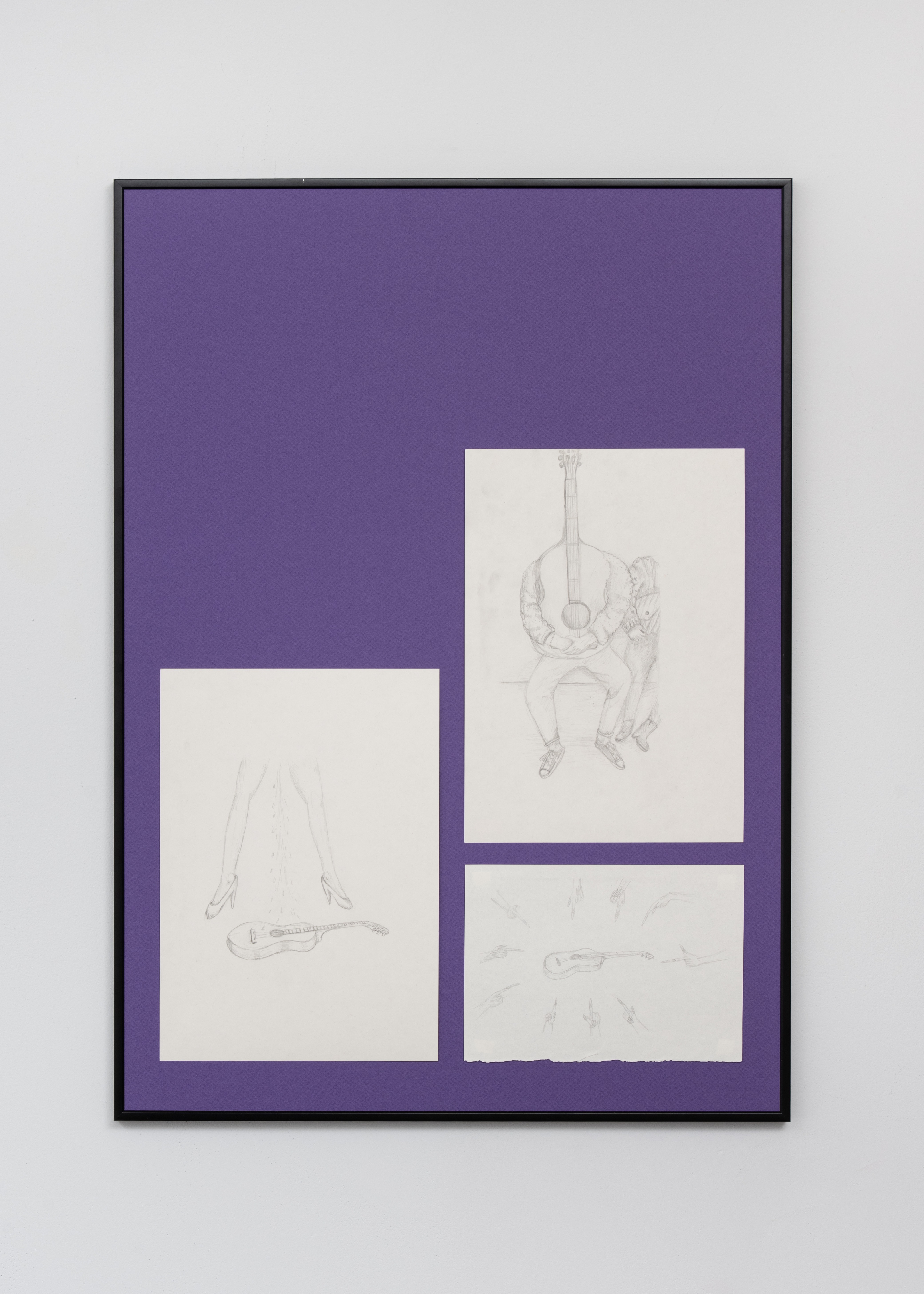
Dominance is asserted by the fetishistic Reba Maybury’s Humiliated Acoustic Guitars, pencil drawn by her slaves, as well as by the red ink inflated breasts of Piotr Dłużniewski’s BDSM imagery. The art market may well be declining, but sex does not stop selling—or rather, sex is never not created. Kidnapped from advertising and propaganda, another ism of today is that of fonts; letters line up with the violence of boldness, à la Nancy Dwyer; just as violent are all the works present, each in its own way, representing the apex of the flag it carries. The strength of the Industry at large is precisely that of leaving no escape, and here the entire gallery is a blitzkrieg, one is targeted at all the five, perhaps six, senses—the sixth is concluded with the sound of Isa Genzken, a 1979 recording of Dusseldorf airport TRI-STAR airplanes taking off, documenting aspirational holiday-goers from the ground.
Charting the aesthetic terrain of today, Kunstindustrie stands out as a very self-conscious cross-section of a panorama of things that exist insofar as they have a name and are inscribable in a category; after all, what is not? Kunstindustrie makes itself an emissary of this rampant post-pop fascism of the reference, or moodboard. It is an assemblage of neologisms that, to return to the initial question, does not position itself as the hand that cuts the hole, nor as that which takes care of it, nor as the hole itself. Kunstindustrie is rather the finger twisted inside it; someone had to.
—
Rebecca Isabel Consolandi (b. 2002) is a writer, editor and cultural critic who lives between Milan and Hollywood.