
A bug is a clandestine insect prone to extinction, an internet error, and, in niche internet slang, a term to describe a vague sense of overshoot or uselessness. In Berlin-based artist Arash Nassiri’s first institutional solo exhibition, A Bug’s Life at Fluentum, we follow a handmade, bug-shaped wooden string puppet in a reverent exploration defying futility. The bug, in this central video, is exploring a villa designed by Hamid Omrani, a US-Iranian architect whose buildings, commissioned by wealthy members of the Iranian diaspora in 1980s Los Angeles, became known as “Persian Palaces.” The architectural through line ambiently resonates in the former Nazi-era building in which it is presented, the mildly unsettling, yet scenic baldness of the former Reichsluftwaffen-Central in which the video collection is located.
A 2024 interview with Omrani on display in the foyer serves as a sort of introduction. An expert comments on Omrani’s work, maybe fittingly: “That moment I think is definitively past, it’s over.” This “overness” is sedimented by the style having been deemed excessively kitsch and, maybe out of a philistine sensibility, prohibited by LA authorities in 2004. Taste is enmeshed here with aspirational social status, and setting the scene in front of this fact puts the lens on a nexus of class and migration. The question of style, and the role of Pariah vs. Parvenue could have been a conceptual hook, but disappears into an amalgam of further political aspects raised through metaphor and narrative.
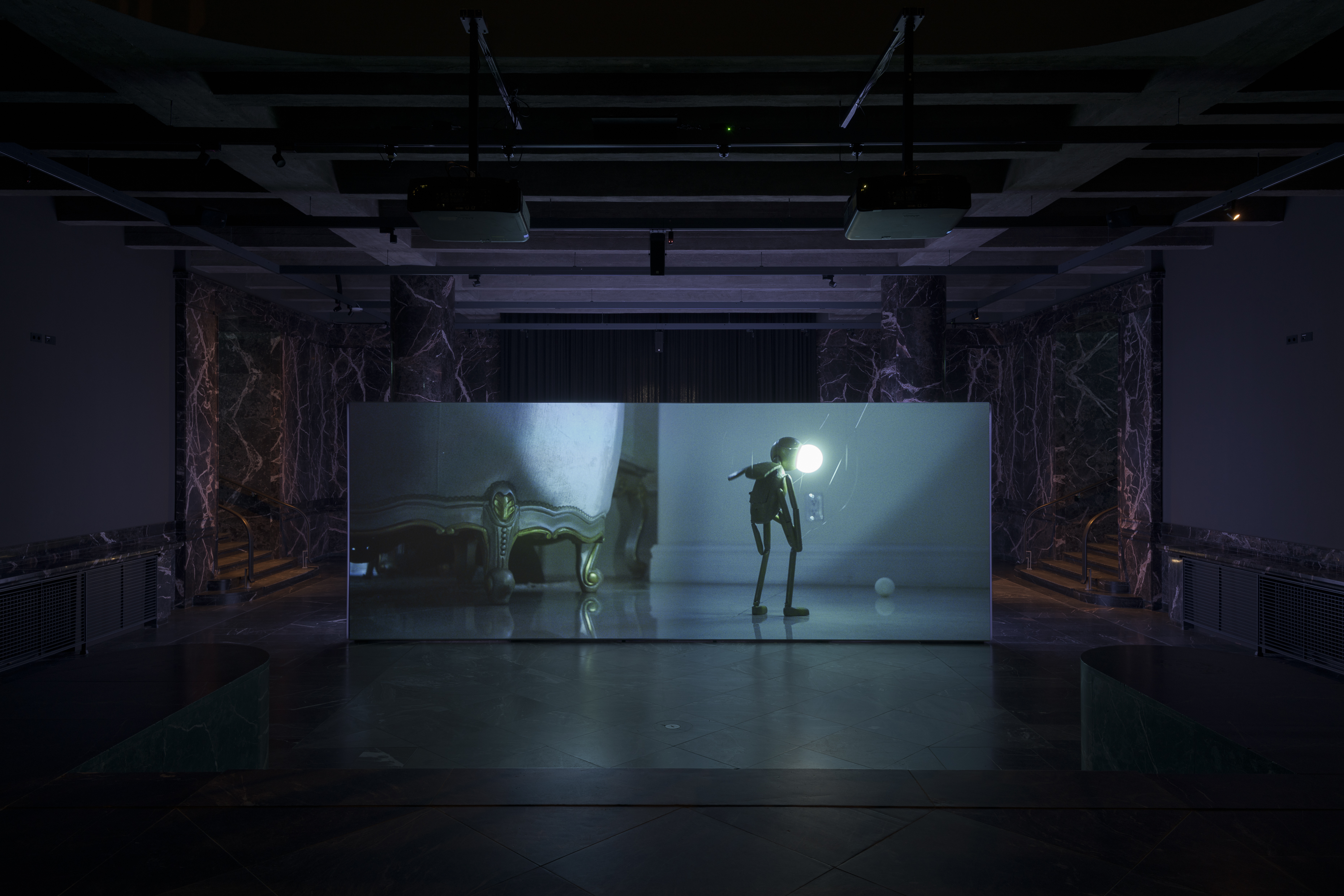
The main space contains a room-filling LED screen background, hugging the building’s own columns as the first point of reference upon entering. This could easily go unnoticed, but stands to serve as a parallel between the differential use of columns in Fascist and Kitsch-neoclassical architecture. Walking around it, the video as the center piece of the exhibition appears on the other side of the section, while the blue light elevates the cold aesthetic of the excessive stone work of the representative hall. Trying to find a spot to sit, one becomes a bug in this interior architecture designed to make a big man small, and a small man big.
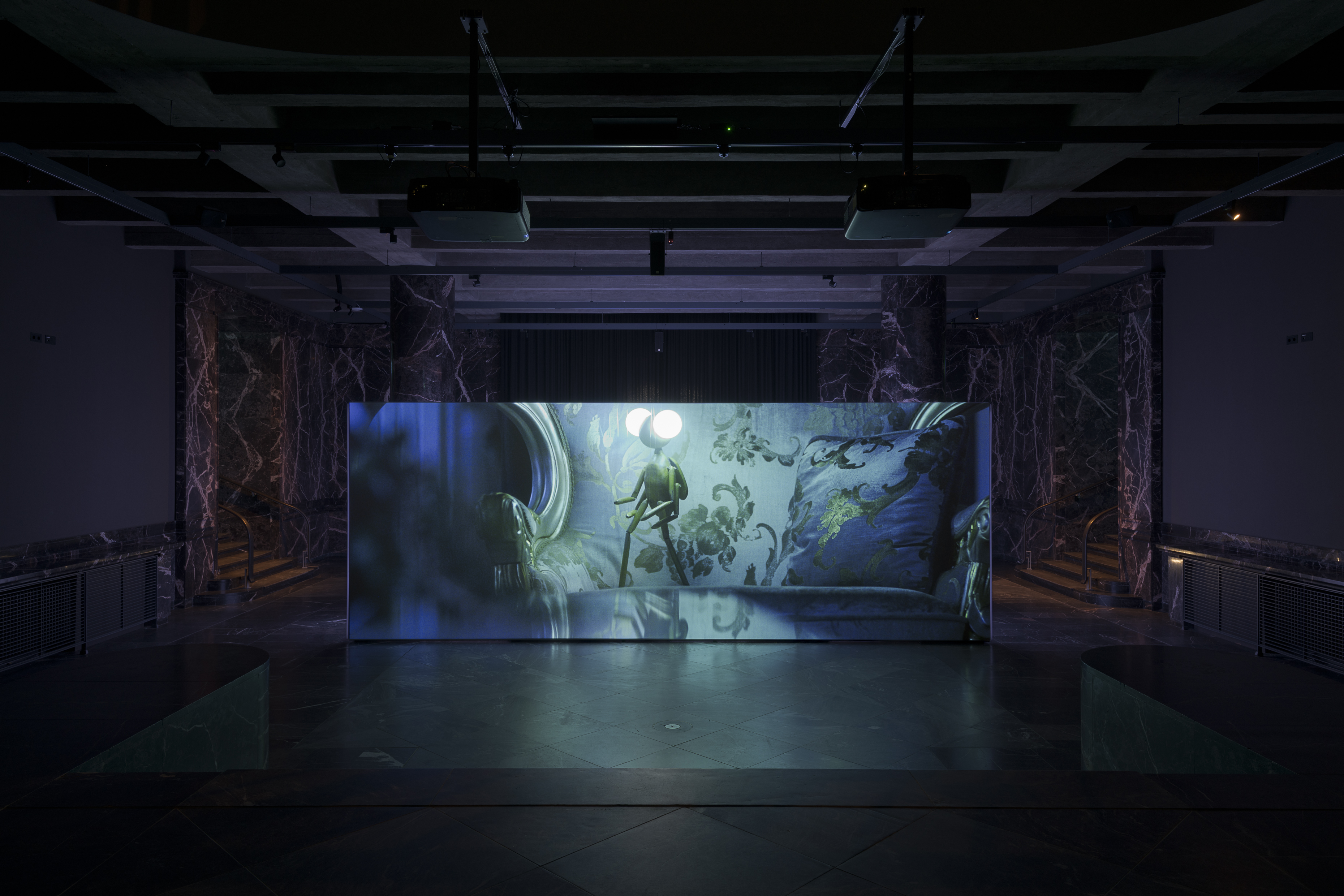
The sound fills the room, with sonic details of the puppet walking, sitting, losing a leg or an eye, stuck in repetition. The bug’s eyes are round light balls which fall off easily without ending him, so his existence seems both roughly assembled and fantastically durable. Exploring the villa at night, it is confronted with an impractical material world inexplicable to it. In one instance, the lightbulb-eyes fall to the floor, become decor or a lighting fixture, and lie there while the lights go on, then slowly vanish. Exploring the villa, the string puppet tries, in a Sisyphean, intuitive, and highly impractical way, to discover the functionality of human-scaled appliances. Cut to another scene, it dangles its clattering wooden feet over a water basin that magically fills itself. I note: “Water doesn’t actually reach the wiggling feet, again points to indifferent discovery.”
What could be read as a metaphor for a reparative sensibility of alienation, or for Ghorbat (a Persian term for melancholia experienced in displacement) is distorted through the supremacy of an immersive state: use of light, sound, and atmosphere countering both my affective identification with the material and inquisitory drive. What remains is narrative disgression. First, in the introductory interview, then, through sign and metaphor. The installations in the smaller wing rooms contain marble splinters which are remnants from the renovation of the Fluentum building, decorated using the pietra dura technique. Spotlighted with a fluorescent light, placed so that the spectator inevitably covers the piece with their own shadow, making it appear as exhibited discovery.
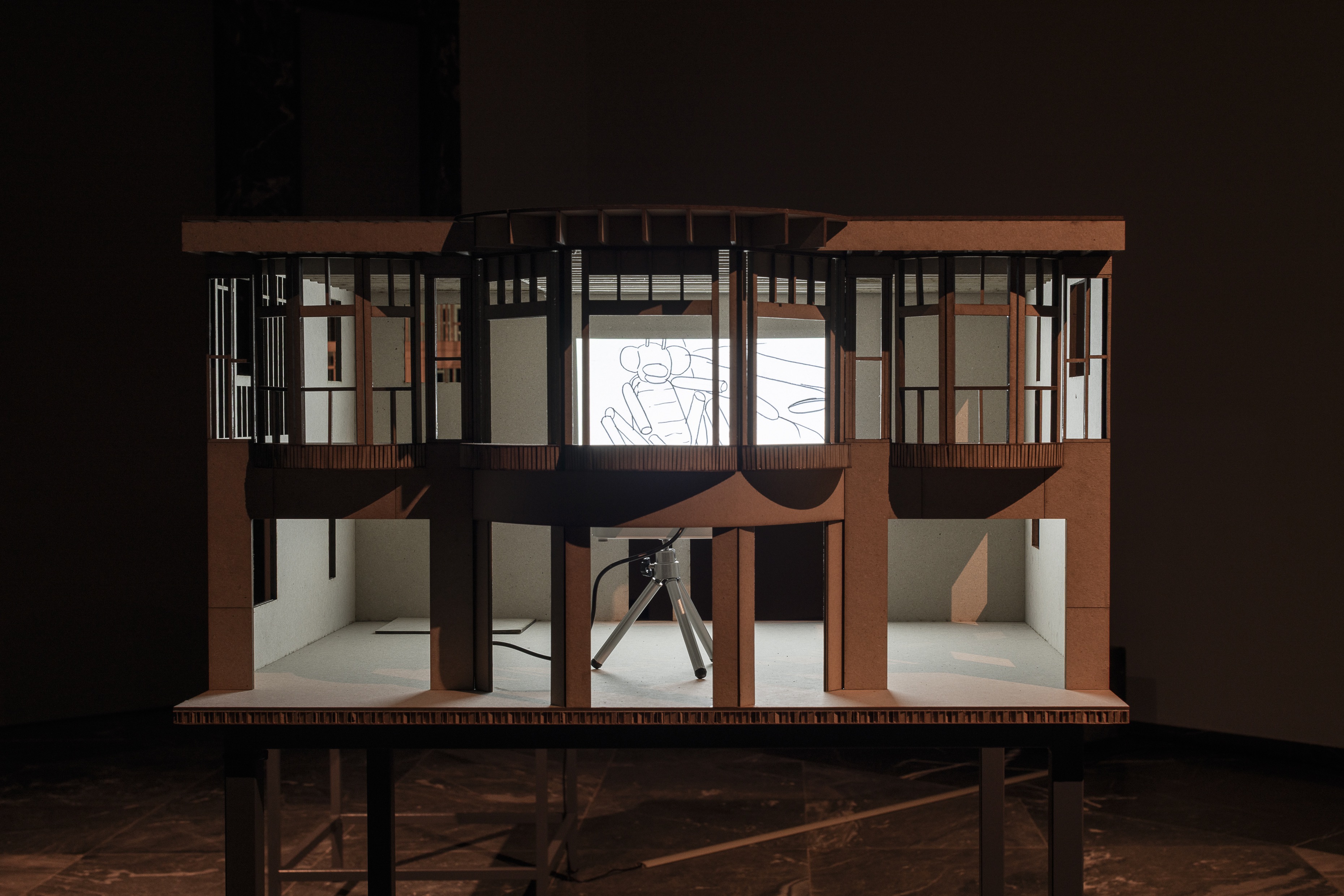
Upstairs, via the bifurcated staircase, three maquettes of Omrani houses sit under a warmer light, while the paper models and the stop-motion storyboard drawings for the film are projected onto an interior wall from a minute beamer. Located in the building’s ambient, brutal stripped classism, the installation’s aesthetic narrative diffusions could resemble a testing site for ideological models, stripped of their potential evil through quirk. Since architectural ideologies are replaceable, they can be removed and rebuilt at any time, at any other place.
If there are two types of heroism, big and small, the second being a sort of humble bravery, by holding on to the potential of the impossible, Fluentum’s former Nazi building embodies the first, and the bug serves as a funky antidote. The bug figure conveys a sort of “tiny-heroism”-melancholia, a feeling that is matched with the nostalgia of longing for a once Great World that the Omrani columns easily and factually evoke. Since this storyline is distracted by the many other, postmodernly linked references, rather than evoking a problem and expanding on it, going through the exhibition feels like following an associative riddle without the ambition to complicate or resolve. Nothing is more functionalist—and thus dismal and anti-climactic—than a fully coherent political message towards a political purpose in the arts, like the Maoist K-Gruppen in West Germany after ’68 demanded. But the existing breaks are unproductively ambiguous, hyper self-aware and polished, while insisting on the claim of being playful.
Historical parallels and retrospection can serve as useful points of reference. Here, however, they cloud judgment, evoking a proto-political universe through a sense of nostalgia and innocence. It remains unclear whether this constitutes a politically relevant affect for the show, as it competes with other floating signifiers. The highlighted historical architectural markers, columns, if contrasted, could pose questions towards what Daniel Loick calls Uneven and Combined Fascism, the idea that fascism does not arrive all of a sudden but is already lived by some long before it is recognised by others. After decades of obsession with political art that had helped flatter a false feeling of liberal comfort, I am asking myself whether this show wants to be read as political at all, and whether, by evoking the political as vibe, it ends up counteracting its original goal.
—
Arash Nassiri (b. 1986, Tehran) lives and works in Berlin. His practice draws on the visual languages of music videos, television, and cinema, reworking familiar formats into speculative, allegorical forms. His work often investigates how built environments absorb and reflect histories of migration, displacement, and cultural hybridity.
Leonie Sophia Döpper (b. 1991, Cologne) is a curator, editor and writer based in Frankfurt am Main, where she runs the exhibition series Society. She is interested in prose, psychoanalysis, critical theory and the feminine experience.


